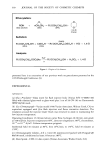
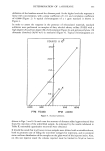
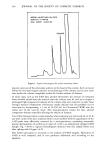
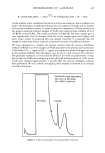
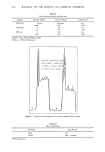
j. $oc. Cosmet. Chem., 31,329-337, (December 1980) Direct gas chromatographic determination of 1,4-dioxane in ethoxylated surfactants JOHN J. ROBINSON, Varian Associates, Instruments Group, Florham Park, NJ 07932, and EMIL W. CIURCZAK, Stevens Institute of Technology, Dept. of Chemistry, Castle Point Station, Hoboken, NJ 07030. Received June 9, 1980. Presented at the New York Chapter of the Society of Cosmetic Chemists Meeting, May 1980, Paramus, NJ. Synopsis A gas chromatographic method for the quantitative determination of 1,4-dioxane in ethoxylated surfactants is presented. The surfactant mixture is first injected into a glass wool filled precolumn, maintained at 60øC. The dioxane in the sample is swept off the precolumn and concentrated at the head of the analytical column by flowing carrier gas. After a suitable time delay, the column temperature is programmed up and the dioxane eluted and detected by a flame ionization detector. Response of the detector to dioxane standards is linear in the range of 1 ppm to 10OO ppm, with precision in the 1% to 2% range. Recovery of dioxane from fatty alcohol ethoxy sulfate (FAES) (highly ethoxylated), FAES (low degree of ethoxylation), and PEG 150 distearate was 102%, 92%, and 102% respectively, based upon standard additions. INTRODUCTION There has been considerable interest in recent years in the detection and determination of 1,4-dioxane (1,4-D) in ethoxylated surfactants. 1,4-D is formed in these products as a by product of the reaction of ethylene oxide (ETO) with an alcohol to form the ethoxylated product (Figure 1). An additional source of 1,4-D is the further reaction of the ethoxylated alcohol with chlorosulfonic acid to form an alcohol ethoxy sulfate. Under the acidic conditions of this reaction, the polyoxyethylene chain can be cleaved and cyclized to 1,4-D (1,2). While subsequent vacuum stripping of the product will remove a large fraction of the 1,4-D formed in these reactions, removal of the last traces of 1,4-D can be a long and costly process. In view of the reported carcinogenicity of 1,4-D (3-5), and subsequent concern for its presence in commercial surfactants, several methods for the determination of low levels of 1,4-D in surfactants have appeared recently. Birkel et al. (6) have proposed a GC method based on partial vacuum distillation of the sample, with sensitivity to the 0.5 ppm level in polysorbate 60 and 80. A headspace analysis GC method was also proposed by Weiser (8) at a recent CTFA meeting. The direct injection method 329

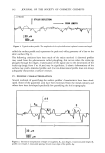
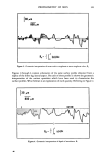
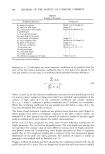
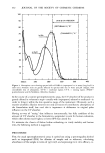
330 JOURNAL OF THE SOCIETY OF COSMETIC CHEMISTS Ethoxylation: ROH + ( fatty alcohol) /oN nCH2CH 2 • R ( OCH2CH2)nOH -I- (EtO) (EFA) (1,4-D) (trace) Sulfation: (FAES) R(OCH2CH)nOH + CIS03H---R(OCH2CH2)nOSO3H + HCI + 1,4-D (EFA) (CSA) Analysis: R (OCH2CH2)nOSO3Na H30+ ß R(OCH2CH2)nOH + H2S04 + 1,4-D Figure 1. Origins of 1,4-dioxane. presented here is an extension of our previous work on precolumns presented at the 1979 Pittsburgh Conference (9). EXPERIMENTAL APPARATUS (a) Glass Precolumn--Glass insert for flash injector body (Varian P/N 37-000813-00) filled with silanized glass wool or glass wool plus 2 cm of 5% OV-101 on Chromosorb WHP 80/100 mesh. (b) Gas Chromatograph--Varian model 3740 (Varian Associates, Walnut Creek, CA) or equivalent equipped with •-in flash injectors and flame ionization detectors. The insulation around the injector heater block was removed to assist in maintaining the low injector temperature. Operating Conditions: 35 ml/min helium carrier flow, hydrogen 30 ml/min, zero grade air 300 ml/min. Injector temperatures 60øC, detector temperature 250øC, electrometer, 10 -•2 or 10 -n A/mV. Column temperature program: Isothermal hold 10 minutes at 80øC, then 20øC/min. to 170øC, hold 10 minutes at 170øC. (c) Chromatographic Column--6 ftx 2 mm I.D. stainless steel packed with Porapak QS 80/100 mesh, conditioned at least 24 hours at 240øC. (d) Data System--CDS-111 data system (Varian Associates, Walnut Creek, CA).
Purchased for the exclusive use of nofirst nolast (unknown)
From: SCC Media Library & Resource Center (library.scconline.org)