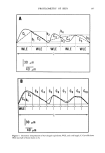
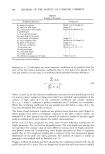
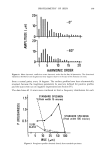
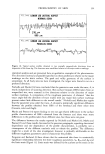
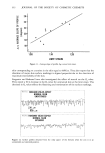
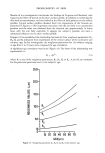
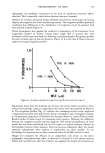
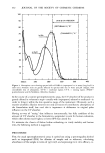
358 JOURNAL OF THE SOCIETY OF COSMETIC CHEMISTS direction? Is it suitable to get a coefficient of variation lower than 0.2?" These investigators usually ran five parallel scans (Section VI) in each direction specified relative to a body axis. A mean coefficient of variation (CV) for all roughness parameters was computed to be approximately 16%. Ishida et al. ran 80 parallel scans in an unspecified direction. They did not report scan length nor variation in their measurements. Hoppe has in effect ran 36 scans, 20 mm long, in 36 radial directions. He has not reported the variation in his data. From the frequency distributions he presented (Fig. 16), a mean CV was computed to be approximately 27%. Nicholls et al. ran one scan of unknown length in an unspecified direction. They did not report the variation in the roughness parameters. From their control data, a mean CV was computed to be approximately 26% (25% for SSB's, 29% for replicas). All of the CV values reported here I have calculated and are only approximate values. They represent the inter-replica variation. In the cases where multiple scans were run they also represent within replica variation. One source of the within replica variation is the actual differences in the peak and valley geometry which exist across the surface of the skin. Further investigations of the possible sources of variation are needed. Measuring the effects of cosmetic products on the stratum corneum by profilometry has proven to be a challenging endeavor. There are questions which remain unanswered. However, assessments of changes in the skin's topography brought about by cosmetic products have been made successfully. It is difficult to say which of the fifteen roughness parameters (Table II) discussed in this review is best suited for the substantiation of a cosmetic's efficacy. Each roughness parameter describes a particular feature of the surface profile. How these features relate to perceptible characteristics of skin, such as smoothness, has not been established. Ishida et al. (13) have attempted to correlate degree of visualized smoothness with their roughness profiles (Fig. 14). These data have not undergone statistical analysis and it is not known if they represent significant differences. Hoppe (12) has found a significant age correlation for the roughness parameters, Rr, Rz, Rp and Ra (Section VI). He was also able to consistently quantify changes in the skin's topography resulting from cosmetic treatment (Section VI). Based on what has been reported in the literature thus far, it appears that the standard roughness parameters, Rr, Rz, Rp and Ra are the best choice for characterizing the skin's surface pattern. In addition to measurements of change, the products' efficacy must also be demonstrated. This requires a characterization of the desired state. The investigations reviewed in this article have contributed significantly toward this end. The future of profilometry as it is applied to cosmetic efficacy substantiation looks promising. REFERENCES (1) J.J. Obrzut, Iron Age, 156-158, (August 1977). (2) S. Hard and O. Nilsson, Appl. Opt., 17, 3827-3836 (December 1978). (3) M. Giglio, S. Musazzi and U. Perini, Opt. Commun., 28, 166-170 (February 1979). (4) J. K. Prall, J. Soc. Cosmet. Chem., 24, 693-707 (1973). (5) C. A. Garber and C. T. Nightingale, J. Soc. Cosmet. Chem., 27, 509-531 (November 1976). (6) S. Makki, J. C. Barbenel and P. Agachi, Acta Dermatovener, 59, 285-291 (1979). (7) J. C. Barbenel, S. Makki and P. Agache, Submitted for publication, (1980).

PROFILOMETRY OF SKIN 359 (8) J. Ferguson and J. C. Barbenel, to be published in the Proceedings of the International Symposium on Bioengineering and The Skin, Cardiff, UK (1980). (9) (lO) (11) (12) (13) (14) (15) (16) (17) (18) S. Nicholls, C. S. King and R. Marks, J. Soc. Cosmet. Chem., 29, 617-624 (1978). R. Marks, J. Soc. Cosmet. Chem., 29, 433-440 (1978). C. S. King, S. P. Barton, S. Nicholls and R. Marks, Br.J. Dermatol., 1OO, 165-172 (1979). U. Hoppe, J. Soc. Cosmet. Chem., 30, 213-239 (1979). T. Ishida, N. Kashibuchi, K. Morita and S. Yuasa, Cosmet. Toil', 94, 39-47 (October 1979). R. Marks and R. P. R. Dawber, Br.J. Dermatol., 84, 117-123 (1971). R. Marks and A.D. Pearse, Br.J. Dermatol., 92,651-657 (1975). $. Nicholls and R. Marks, Br.J. Dermatol., 96, 595-602 (1977). R. Marks, S. Nicholls, and D. Fitzgeorge,J. Invest. Dermatol., 69, 299-302 (1977). B.J. Ley, S. G. Lutz, and C. F. Rehberg, Linear Circuit Analysis, McGraw-Hill Book Company: New York, N.Y. 1959 Chap. 6.
Purchased for the exclusive use of nofirst nolast (unknown)
From: SCC Media Library & Resource Center (library.scconline.org)