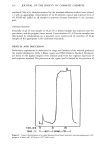
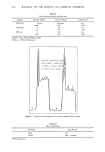
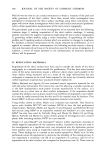
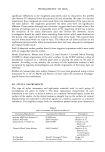
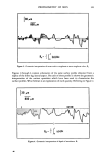
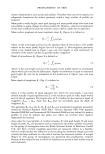
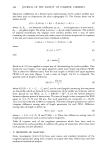
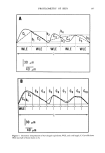
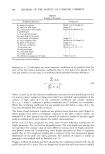
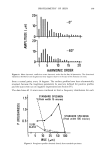
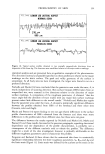
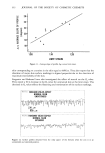
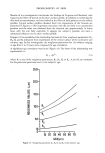
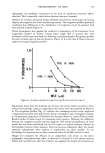
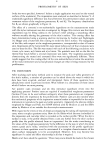
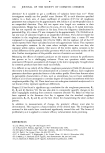
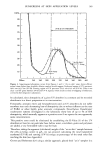
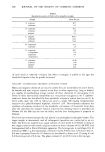
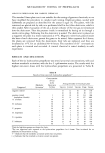
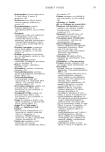
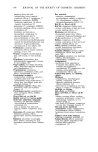
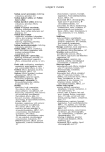
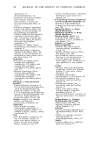
346 JOURNAL OF THE SOCIETY OF COSMETIC CHEMISTS Harmonic coefficients of a Fourier series representation of the surface profiles have also been used to characterize the skin's topography (7). The Fourier series can be written as (18) y (t) = A• sin (c01 t + 4)•) + A2 sin (c02 t + 4)2) + ---, (4) where A•, A 2, . .. are harmonic coefficients, c0•, c0•,... are frequencies, t is time and 4)2, .-. are phase angles. The terms A i sin (c0 i t + 4)i) are called harmonics. This method of analysis reconstructs the original curve (surface profile) with a sum of terms consisting of a constant and sine and cosine waves of various frequencies. In equation 4, the sine and cosine terms have been combined as follows acosc0t+bsinwt=Asin(c0t+4)), where (5) (6) and arctan- (7) b Ishida et al. (13) have applied a unique way of characterizing the surface profiles. They divide the scan length, /into equal segments called wave length equivalents (WLE). This is done five different times. First the scan length is divided into equal segments (WLE) 6.25 /am wide (Figure 7) and a ratio of length, L(6.25), is computed. The quantity ratio of length is defined as ' C(6.25) L(6.25) - / , (8) where C(6.25) = C• + C2 ... C, and Ci are the cord lengths connecting the two points on the profile which are formed by the intersection of the profile and adjacent vertical h2] U2 b i are the vertical distances lines, spaced by one WLE i.e., Ci = [(WLE)2 +-ij , between adjacent points of intersection. The ratio of length is then computed for WLE equal to 12.5, 25, 50 and 100 /am. Five such quantities are computed i.e., L(6.25), L(12.5), L(25), L(50) and L(100) are computed. The ratio of length quantities are used to compute difference among ratio of length parameters for each WLE. Difference among ratio of length is defined as P(i) = L(i) -- L(2i) (9) where i = 6.25, 12.5, 25, 50 and P(100) = 0. These five differences among ratio of length parameters are used to assess surface roughness. Table II contains each of the roughness parameters which have been used to characterize the surface profiles. In addition the group of researchers which have used each quantity are also tabulated. V. METHODS OF ANALYSIS Some investigators (6,9,10,15,16) have used means and standard deviations of the roughness parameters along with a statistic to analyze their data. Others have used less traditional methods of analysis.

PROFILOMETRY OF SKIN 347 A WLE 30 •m 40 •m Figure 7. Geometric interpretation of wave length equivalents, WLE, and cord length, C. Curve B shows WLE one half of those shown in A.
Purchased for the exclusive use of nofirst nolast (unknown)
From: SCC Media Library & Resource Center (library.scconline.org)