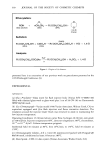
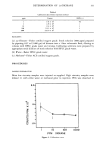
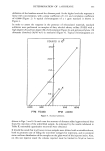
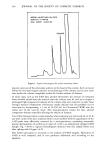
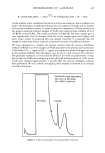
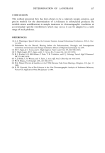
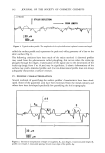
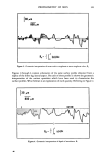
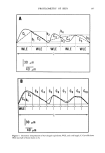
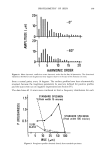
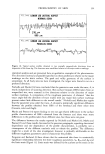
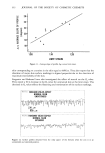
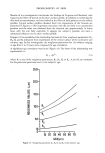
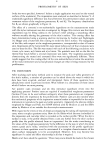
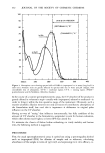
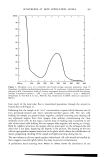
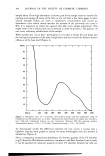
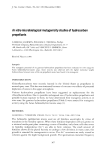
356 JOURNAL OF THE SOCIETY OF COSMETIC CHEMISTS 1.0- 0.5- ORE MASSAGING AFTER MASSAGING I I I I I 5 lO 25 50 lO0 WLE (/.,m) Figure 15. Roughness profiles of forehead skin obtained before and after facial massage. 21 TREATED,,,, UNTREATED 0 50 100 150 FI T (um) Figure 16. Frequency distributions for the roughness parameter R T before and one-half hour after treatment (see text).

PROFILOMETRY OF SKIN 357 body site were specified, however I believe a single application was used on the ventral surface of the underarm). The impressions were analyzed as described in Section V. A statistically significant difference was found between the pretreatment values and post treatment values of the roughness parameters, Rr and Rz. The frequency distributions for Rr are shown graphically in Figure 16. The effect of a cosmetic's non-reabsorbable ingredients on the measurements made with the stylus instrument was also investigated by Hoppe. His concern was that these ingredients may be filling valleys in the surface's relief yielding a smoothing effect without actually altering the geometry of the skin's surface. This coating effect has been demonstrated using a scanning electron microscope by Garber and Nightingale (5). Hoppe used a buttermilk film coating to model the skin's surface. The topography of the film, with respect to the roughness parameters, corresponded to that of human skin. Impressions of the buttermilk film were taken before each of four emulsions were used to treat the film. The film was treated with each of the following emulsions: w/o cream, o/w cream, w/o lotion and o/w lotion. The products were left on the film for twenty-four hours before a second impression was taken. The roughness pararneters characterizing the treated and untreated films were not significantly different. These results suggest that the coating effect of the non-reabsorbables is below the sensitivity of the stylus instrument and actual physical changes are what is being measured by the profilometer. VII. DISCUSSION After studying each stylus method used to measure the peak and valley geometry of the skin's surface, a number of questions can be asked about the ways in which the data have been acquired, analyzed and interpreted. Some of these questions have already been raised in previous sections. What follows is a discussion of those issues which I believe are most pressing. Are positive casts necessary and do they introduce significant errors into the replicating process? Positive casts are required if standardized roughness parameters (Section IV) are to be used without ambiguity when these parameters are computed directly from the impression by the profilometer. Positive casts are also needed when the mechanical properties of the impression material makes it impossible for the stylus instrument to reproduce the peak and valley geometry. Apparently the silicone rubbers employed by Hoppe and Prall, the SUMP method used by Ishida et al. and the SSB's taken by Marks et al. are suitable for direct stylus measurements. With regard to the errors or loss of detail accompanying the taking of impressions and casts, some complex questions exist How do the flakes which become embedded in the impression and cast alter what is recorded as the surface profile? When the skin's surface is scaly, is the profile obtained from a cast any further from the skin's surface profile than the profile obtained from an impression? Are the scales contributing to the values of the roughness parameters? Is the difference in the way in which the stylus senses a peak and a valley, combined with the asymmetry of the profile significant? Answers to these questions must be ascertained if a complete characterization of the skin's surface topography is to be accomplished. However, they may become less significant if a cause and effect relationship is all that is required. Makki et al. have asked the questions: "How many scans should be made in the chosen
Purchased for the exclusive use of nofirst nolast (unknown)
From: SCC Media Library & Resource Center (library.scconline.org)