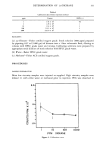
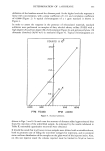
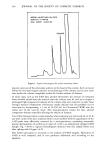
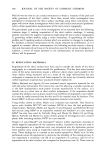
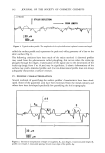
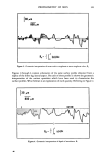
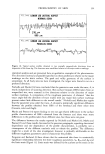
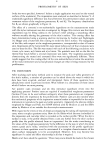
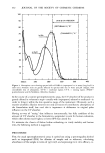
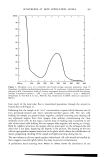
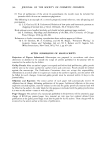
SUNSCREENS AT SKIN APPLICATION LEVELS 363 lOO% 90 80 70 60 50 40 30 20 lO 200nm 240 260 280 300 320 340 360 380 400 Figure 2. Absorption curve of a commonly used broad-coverage sunscreen preparation using 7% O-padimate (2-ethylhexyl-p-dimethylaminobenzoate) and 3% oxybenzone (2-hydroxy-4-methoxy-benzo- phenone) in IPA. Concentration: 0.200 g/L Solvent: isopropanol Instrument: Beckman DB Slot opening: medium. Transmitted erythema = 2.0% = 47.11/23.685. Transmitted tanning = 27.2% = 188.8/6.942. (O-padimate by Van Dyk & Co. Inc., Belleville, N.J. Oxybenzone by BASF, American Cyanamid, E. Merck.) how much of the total solar flux is transmitted (penetrates through the screen) to human skin (3,4)(Figure 2). Following this, the sample in its "as is" concentration is spread thinly between two of four previously-cleaned and dried, optically-matched quartz cells. The two cells holding the sample are pressed firmly together, carefully removing and cleaning off any expressed surplus from their opaque sides without contaminating the clear windows of the cells. At this stage a narrow strip of masking tape is attached to one side of the joined cells holding the two opaque sides together and serving as a hinge. Held by capillary attraction, the sample cells are pried apart on the unhinged side and dried over a hot plate, liquefying the deposit in the process. The heating of the two cells in open position imparts some heat to the glass, which delays the solidification of waxes, postponing clouding of the sample and light-scattering during the run. The two reference cells are taped together beforehand. All cells should be handled by their stoppers, inserted tightly before the assay to prevent contamination. A preliminary hand scanning from 400nm to 200nm shows the absorbance of our

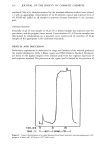
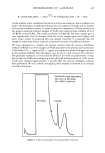
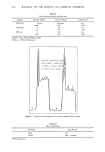
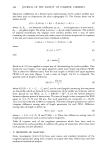
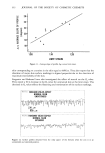
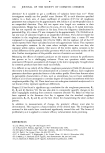
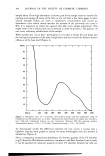
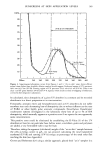
364 JOURNAL OF THE SOCIETY OF COSMETIC CHEMISTS sample taken. If too high absorbance is shown, part of the sample must be removed by opening and wiping off some of the film on one cell with a fine tissue paper. It takes several attempts before we reach a satisfactory concentration and record an absorbance curve which closely matches the maxima of the previously run curve in IPA. It is important•.to reheat the opened cells after every sample adjustment. This might seem to be a tedious task, but is essential in order to prevent a "flat plateau" of our curve, indicating solidification of the sample. When satisfactory "as on skin" spectrogram is recorded, it shows the real shape and the real spectral position of the tested sunproduct and thus reveals the hitherto unseen influence of the base itself (Figure 3). 100% 90 80 70 60 50 40 30 20 10 I I I I I I I I 200nm 240 260 280 300 320 340 360 380 400 Figure 3. Absorption curve of a commonly used broad-coverage sunscreen preparation using 7% O-padimate and 3% oxybenzone "as on skin." Measurements made between two empty cells. Concentra- tion: 0.200 g/L (calculated) Solvent: air only Instrument: Beckman DB Slot opening: medium. Transmitted erythema = 0.7% = 17.12/23.685. Transmitted tanning = 5.7% = 39.75/6.942. To demonstrate vividly the differences between the two curves, a tracing over a lightbox, aligning both graphs at exactly the same wavelengths over one another is satisfactory (Figure 4). Since a comparison of maximum absorbance of a known quantity of the UV absorber in g/L (found by IPA dilution method in compliance with Beer-Lambert Law) is made, it can be assumed the unknown quantity of same UV absorber between the cells can
Purchased for the exclusive use of nofirst nolast (unknown)
From: SCC Media Library & Resource Center (library.scconline.org)