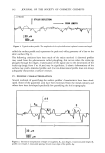
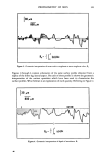
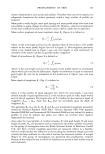
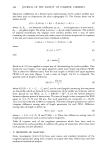
340 JOURNAL OF THE SOCIETY OF COSMETIC CHEMISTS Prall (4) was the first to use a stylus instrument to obtain a measure of the peak and valley geometry of the skin's surface. Since then, several other investigators have attempted to characterize the skin's surface markings using stylus instruments. This paper will review those investigations which have used stylus instruments (profilome- ters) to obtain quantitative measurements of the horny layer's topography. The procedures used in each of the investigations to be reviewed have the following common steps: 1) making impressions of the skin's surface markings, 2) making positive casts from the negative impressions (replicating the skin's surface topography), 3) generating surface profiles using a stylus instrument, 4) quantifying the surface profiles and 5) applying analysis schemes which are sensitive to changes in roughness. To facilitate a rational interpretation of the results obtained by profilometry, as it is applied to cosmetic efficacy substantiation, the following sections contain a descrip- tion and discussion of each step in the procedures used by the various investigators. In addition, a review of results pertinent to the substantiation of treatment products' efficacy will be presented. II. REPLICATING MATERIALS Impressions of the skin's surface have been used to transfer the details of the skin's topography to a material more suitable for profilometry. This has been done because some of the stylus instruments require a reference datum plane nearly parallel to the mean surface being measured and as a result of the large deformations the skin undergoes in response to the small loads imposed by the stylus tip. Generally, silicone rubber impression materials have produced reliable replicas (5). Makki, Barbenel and Agache (6) have evaluated several impression materials for use with the stylus instruments. The criteria they used for selecting a suitable material are: 1) the flow characteristics must permit accurate reproduction of the surface, 2) it should cure in a short time at skin's surface temperature, 3) the impression should contain few artifacts, such as those caused by air bubbles and improperly cured rubber, 4) it must be easily removed from the skin and 5) the material must be harmless. They found Silflo ©, a silicone rubber, dental impression material most suitable. Using similar criteria as above, Makki et al. evaluated cast materials. They found an epoxy resin Araldite MY778 © with hardener HY956 to have the best performance characteristics. Barbenel, Makki and Agache (7) and Ferguson and Barbenel (8) have had success using Silflo © as an impression material and Araldite © as a cast material. Silflo © has also been used by Nicholls, King and Marks (9), Marks (10) and King, Barton, Nicholls and Marks (11). Each of these groups of investigators used a styrene plastic slide mounting medium DPX © as a cast material. Hoppe (12) used Silosaft © and Xantopren © silicone rubber impression materials to obtain negative impressions of the cutaneous surface. A positive cast was not used in his investigations, as a significant error was introduced into the replication process when positive casts, using an unspecified material, were made from negative impres- sions. These findings are in contrast to the results reported by Makki et al. (6) who performed a series of experiments to determine the reliability of the casting process. In one experiment a secondary cast (B) of an impression of a primary cast (A) of an impression of the skin's surface was compared to the primary cast (A). There were no

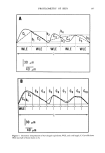
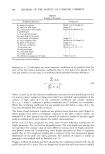
PROFILOMETRY OF SKIN 341 significant differences in the roughness parameters used to characterize the profiles (see Section IV) obtained from the primary (A) and secondary (B) casts. In a second experiment, they compared two casts made from two impressions of the same site on the same subject. The roughness parameters for these casts were not significantly different. These results, although not conclusive, suggest that if any detail is lost in the process of making casts it is a repeatable event or the magnitude of the loss is below the sensitivity of the stylus instrument used (see Section III). However, future investigators should be careful when extending these results, which were obtained on the shaven, volar aspect of the forearm, to other areas of the body. This is particularly true for those areas which are scaly or hairy. The effects of cell debris and hair on the replication process and the stylus measurements have not been adequately investigated and require further study. Prall (4) obtained surface profiles directly from negative impressions which were made with an unspecified silicone rubber. Ishida, Kashibuchi, Morita and Yuasa (13) used Suzuki's Universal Micro Printing (SUMP) to obtain impressions of the skin's surface. In the SUMP method, a drop of amylacetate is placed on a celluloid plate prior to placing the plate on the area of interest. According to the authors, the accuracy of this replication method is well recognized by Japanese dermatologists and reliable impressions of the horny layer are obtained. Profiles of cyanoacrylate skin surface biopsies (14) have been generated using a stylus instrument (9, 11, 15-17). Marks and Pearse (15) have called this method of investigat- ing the horny layer surfometry. III. STYLUS INSTRUMENTS The type of stylus instrument and replication materials used by each group of investigators are given in Table I. The basic operational characteristic of each instrument is the same. A stylus is moved, at a constant horizontal speed, across the surface of the replica. As the stylus traverses a straight line on the surface, its vertical displacements are converted to electrical signals by a resistive, capacitive or inductive transducer. The amplified output from the transducer plotted versus time (distance) is Table I Stylus Instruments and Replication Materials Instrument/Manufacturer Impression/Cast Material Investigators Surfcom 30B/Tokyo Seimitsu Co. Surfcorn 38/Ferranti Surfometer/G. V. Planer Ltd. Talysurf 4/Rank Taylor Hubson Not Specified Not Specified SUMP/None Ishida et al. (13) Silfio©/Araldite © Makki et al. (6) Silfio©/DPX © Nicholls et al. (9), Marks (10) and King et al. (11) Silfio©/Araldite © Makki et al. (6), Barbenel et al. (7) and Ferguson and Barbenel (8) Silosaft ©, Xantopren©/None Hoppe (12) Silicone rubber/None Prall (4)
Purchased for the exclusive use of nofirst nolast (unknown)
From: SCC Media Library & Resource Center (library.scconline.org)