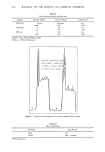
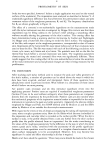
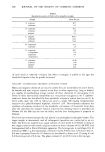
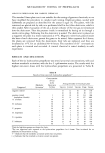
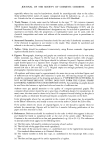
MUTAGENICITY TESTING OF PROPELLANTS 369 ASSAYS IN DESICCATORS FOR GASEOUS CHEMICALS The standard Ames plate test is not suitable for the testing of gaseous chemicals, so we have modified the procedure to conduct such testing. Duplicate plates, seeded with Salmonella are prepared as described for the assays in agar (5). The plates, with lids removed, are placed side by side on a perforated shelf in the 9-liter desiccator, which is then sealed. After evacuation of the air, a known volume of the test gas in introduced into the desiccator. Then the pressure inside is normalized by letting air in through a sterile cotton plug. Following this the desiccator is sealed. The desiccator is placed on a magnetic stir plate in a room maintained at 37øC. Magnetic stirrer bars, placed inside the base of each desiccator, permit the gases to be mixed. After exposure for 6 hours, the plates are removed from the desiccators, their lids are replaced, and they are incubated at 37øC for an additional 40-45 hours. The numbers of his + revertants on each plate is counted and recorded. A control chemical is tested similarly in each experiment. RESULTS AND DISCUSSION Each of the six hydrocarbon propellants was tested at several concentrations, with and without metabolic activation, with the five $. typhimurium strains. The results with the highest non-toxic doses with the hydrocarbon propellants are presented in Table II. Table II Results of desiccator with hydrocarbon propellants •'2 Metabolic Compound Activation 3 Concentration of Gas in the Desiccator (v/v)% Average histidine revertants per plate TA1535 TA1537 TA1538 TA98 TA100 negative control - 15 12 10 29 138 + 16 18 30 38 155 positive control -- 2 34 10 16 234 900 (methylene chloride) + 2 52 12 52 237 1066 A. n-butane - 50 24 6 18 22 122 + 50 26 4 37 48 134 B. isobutane - 50 23 4 7 26 108 + 50 10 4 16 26 98 C. propane - 50 20 18 14 18 114 + 50 18 5 16 21 88 D. isopentane -- 10 22 3 14 15 124 + 10 10 6 16 22 124 E. n-pentane - 10 25 1 8 26 138 + 10 14 6 22 18 116 F. isobutane - 40 23 10 10 28 103 + 40 7 6 14 18 91 •Onty the high dose groups are shown for clarity. 2The test organisms were exposed to the hydrocarbon propellants for 6 hours. Then incubated for an additional 42 hours before scoring. 3(_) Indicates that the metabolic activation system was not present. (q-) Indicates that the metabolic activation system wa• present.

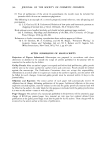
370 JOURNAL OF THE SOCIETY OF COSMETIC CHEMISTS The positive control mutagen, methylene chloride, was mutagenic in strains TA98 and TA100 and was slightly mutagenic in TA1535 (6). Hydrocarbon propellant A, (n-butane) was tested at concentrations of 5, 10, 20, 30, 40 and 50%. It was not mutagenic in any of the tested strains. Similar results were obtained with all the other hydrocarbon propellants. Hydrocarbon propellant D (isopentane) was somewhat toxic at concentrations of 10% and above, so additional tests were conducted to determine whether the compound was mutagenic at concentrations of 1, 2, 5 and 8%. These results indicate that hydrocarbon propellant D is not mutagenic at the lower concentrations. Hydrocarbon propellant E (n-pentane) was toxic at concentrations of 25 and 50%. Therefore, additional tests at concentrations of 1, 2, 5, 8 and 10% were performed. In none of these tests at the lower concentrations did hydrocarbon propellant E appear to be mutagenic. Hydrocarbon propellant F (isobutane) was weakly toxic at a concentration of 50% but was not mutagenic at concentrations of 5, 10, 20, 30, or 40%. The results indicate that none of the hydrocarbon propellants was mutagenic in the Ames Salmonella microsome assay in 5 strains exposed for 6 hrs. in desiccators. ACKNOWLEDGEMENT These assays were conducted under the direction of Dr. Simmon at S. R. I. International. REFERENCES (1) B. N. Ames, F. D. Lee, and W. E. Durston, Proc. Nat. Acad. Sci. USA 70, 782-786 (1973). (2) B. N. Ames, W. E. Durston, E. Yamasaki, and F. D. Lee, Proc. Nat. Acad. Sci. USA 70, 2281-2285 (1973). (3) L. D. Keir, E. Yamasaki, and B. N. Ames, Proc. Nat. Acad. Sci. USA 71, 4159-4163 (1974). (4) L. A. Poirier and V. F. Simmon, C/in. Toxico/. 9 (5), 761-771 (1976). (5) B. N. Ames, J. McCann, and E. Yamasaki, Mutation Res. 31,347-364 (1975). (6) Independent plate incorporation assays with known mutagens were conducted with all strains, including a control chemical that required metabolic activation. The results of these experiments were within expected ranges.
Purchased for the exclusive use of nofirst nolast (unknown)
From: SCC Media Library & Resource Center (library.scconline.org)