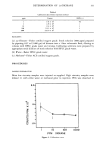
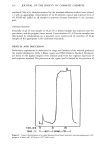
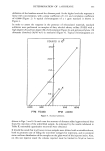
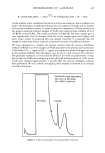
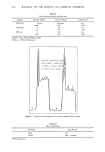
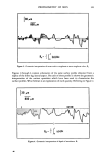
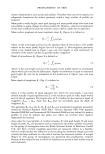
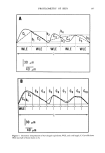
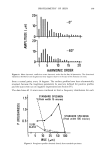
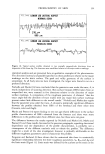
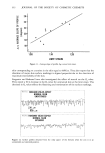
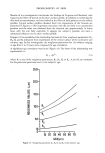
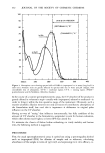
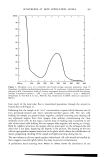
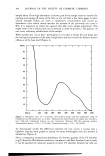
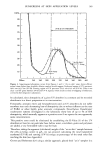
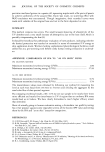
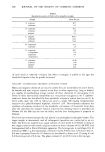
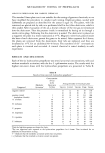
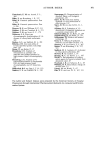
DETERMINATION OF 1,4-DIOXANE 333 definition of the baseline around the dioxane peak. At the higher levels the response is linear with concentration, with a slope coefficient of 1.213 and correlation coefficient of 0.9999 (Figure 2). A typical chromatogram of a 1 ppm standard is shown in Figure 3. In order to assess the response in the presence of ethoxylated materials, standard additions were performed on samples of fatty alcohol ethoxy sulfate (FAES) with a high degree (A) and low degree (B) of ethoxylation (Figure 6), and polyoxyethylene 150 distearate dissolved (50/50 w/v) in methanol (Figure 4). Typical chromatograms are COUNTS X I0 6 250' 200- 150- _ 50- I000 500 .... 566 ' ' io'oo PPM FOUND PPM ADDED Figure 4. Standard additions. shown in Figs. 5 and 6. In each case the amount of dioxane added approximated that found by injection of the unfortified sample. As indicated by the results tabulated in Table II, reasonably quantitative recoveries were obtained. It should be noted that in all cases viscous samples were diluted with a suitable solvent, both to promote ease of filling the microliter syringes for injections, and to promote more uniform distribution of the samples on the glass wool of the injector insert. Also, on this size injector insert the volume injected must be limited to 50/,tl or less to

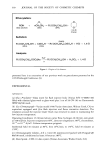
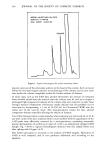
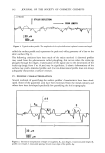
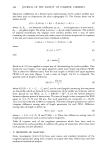
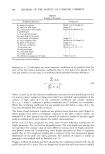
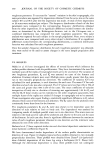
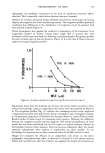
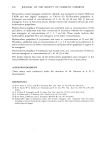
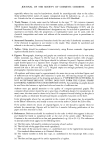
334 JOURNAL OF THE SOCIETY OF COSMETIC CHEMISTS SODIUM LAURETHOXY SULFATE 50%(V/V) IN WATER 20•11 DIRECT INJECTION DIOXANE Figure 5. Typical chromatogram for sodium laurethoxy sulfate. prevent carryover of the ethoxylate solution to the head of the column. Such carryover will at the very least require extensive reconditioning of the column, and in some cases may render the column completely useless for further analyses of dioxane. In some cases, such as low ETO fatty alcohol ethoxylates, the amount of unreacted lower alcohol eluted from the injector onto the column may be such as to require a prolonged high temperature bakeout of the column after each injection to elute these strongly retained components. Preliminary results indicate that this problem can be overcome by incorporating 1-2 cm of 5% OV-iO1 on Chromosorb WHP near the outlet end of the injector insert. This mini-precolumn retains the fatty alcohol component without materially affecting the elution of dioxane. Use of the mini-precolumn is also desirable when analyzing very low levels of 1,4-D. In our tests, most of the trace materials which could interfere with the quantitation of the 1,4-D peak were effectively removed by a mini-precolumn, permitting reasonably precise determination of as little as 0.2 ppm of 1,4-D in an exhaustively stripped FAES sample. Fig. 7 shows a typical chromatogram obtained with this sample before and after spiking with 0.5 ppm 1,4-D. One further precaution is necessary in the analysis of FAES samples. Hydrolysis of FAES is acid catalyzed, and in turn produces additional acid according to the equation.
Purchased for the exclusive use of nofirst nolast (unknown)
From: SCC Media Library & Resource Center (library.scconline.org)