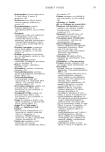
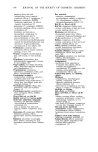
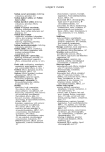
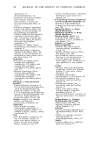
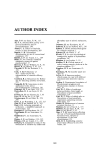
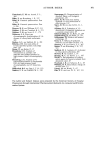
AUTHOR INDEX 381 Pantelouris, E. M. see Anand, C. L., 269 Rahn, P. see Rosenberg, I.E., 237 Rehn, D. Cosmetic preservatives. Part I, 253 Rehn, D. Cosmetic preservatives. Part 2, 299 Reusser, R. E. see Williams, R. P., 311 Robbins, C. R. see Crawford, R. J., 273 Robbins, C. R. see Scott, G. V., 179 Robinson, J. J. Direct gas chromatographic determination of 1,4- dioxane in ethoxylated surfactants, 329 Roekey, S. L. see Stafford, M. L., 281 Robeira, J. R. Cost and utility of several microbial genetic toxicology tests, 145 Rosen, W. see Berke, P., 37 Rosenberg, I. E. Analysis of nitrosamines in cosmetic raw materials and finished product by high pressure liquid chromatography, 237 Rosenberg, I. E. Analysis of N- nitrosodiethanolamine in linoleamide DEA by high pressure liquid chromatography and UV detection, 323 Rutherford, B.S. see Ong, J. T. H., 153 Sanders, L. A. see Stafford, M. L., 281 Sauermann, G. Characterization of dandruff flakes cell biological parameters, 201 Sayre, R. M. Sunscreen testing methods: in vitro predictions of effectiveness, 133 Sayre, R. M. see also LeVee, G. J., 173 Schanno, R. J. Evaluation of 1,3- dimethylol-5,5-dimethyl hydantoin as a cosmetic preservative, 85 Schenckenberg, D. see Rehn, D., 299 Schenkenberg, D. see Rehn, D., 253 Schlossman, M. Modern nail enamel technology, 29 Scott, G. V. Effects of surfactant solutions on hair fiber friction, 179 Simmon, V. F. see Kirwin, C. J., 367 Spears, T. see Rosenberg, I. E., 237, 323 Stafford, M. L. Analysis of 1,4-dioxane in ethoxylated surfactants, 281 Stewart, R. see Leyden, J., 19 Thomas, W. C. see Kirwin, C. J., 367 Wachi, Y. Decomposition of surface active agents by bacteria isolated from deionized water, 67 Westlund, J. R. see Schanno, R. J., 85 Williams, R. P. Electrostatic charge on aerosol cans, 311 ¾anagi, M. see Wachi, Y., 67 Zatz, J. L. see Liao, W. C., 107, 123 The Author and Subject indexes were prepared by the American Society of Hospital Pharmacists through International Pharmaceutical Abstracts, its computerized IPA Infor- mation System.

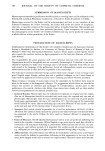
JOURNAL OF THE SOCIETY OF COSMETIC CHEMISTS INFORMATION FOR AUTHORS The JOURNAL OF THE SOCIETY OF COSMETIC CHEMISTS publishes papers concerned with cosmetics or the sciences underlying cosmetics, as well as other papers of interest to SCC members. It is the function of the Editorial Committee to set standards, to judge the scientific merit of a paper, and to help in the editing of the paper and its preparation for press. The Editorial Committee is charged with the responsibility for the maintainance of the JOURNAL'S high standards. It is therefore not the policy of the JOURNAL OF THE SOCIETY OF COSMETIC CHEMISTS tO guarantee publication of all submitted papers. All papers presented before a meeting or seminar of the SOCIETY OF COSMETIC CHEMISTS or before one of its sections, or those papers submitted directly to the Editor will be considered for publication in the Journal. Papers presented before the SOCIETY OF COSMETIC CHEMISTS or one of its sections are the property of the SOCIETY and may not be published in or submitted to other journals. Only if the JOURNAL OF THE SOCIETY OF COSMETIC CHEMISTS is unable to publish a presented paper may it be published in another journal of the author's choice. SUBJECT MATTER The JOURNAL will consider manuscripts for publication in the following categories, provided they are prepared in proper scientific style and adequately referenced: 1. Original Articles. Descriptions of original research work in cosmetics or related areas. 2. General Articles. Articles of a general character may be considered for publication providing they are of a scientific and technical nature. These articles may be concerned with newer analytical techniques, developments in dermatology, toxicology, etc. 3. Review Articles. Intended to present an overview of recent advances in a specific area related to cosmetics. The author of such a review is expected to be actively engaged in the area and capable of presenting a critical evaluation of published reports of a scientific and technical nature. Solicited by special invitation from the Editor and Editorial Committee not subject to review by the Editorial Committee. 4. Preliminary Communications. Intended to provide for rapid dissemination of novel concepts and findings, such articles should not exceed four printed pages (approx. 10 double-spaced typed pages). Subject to review, but the time for editorial action will not exceed three weeks and the manuscripts will be published ahead of those submitted for regular processing. 5. Technical Notes. Relatively short manuscripts containing new information obtained by laboratory investigation, these do not contain the depth or extent of research involved in an Original Article. 6. Letters to the Editor. Comments on JOURNAL articles are invited, as well as brief contributions on any aspect of cosmetic or related science that does not warrant publication of a full-length paper in one of our other categories. May include figures and/or references, but brevity is necessary. 383
Purchased for the exclusive use of nofirst nolast (unknown)
From: SCC Media Library & Resource Center (library.scconline.org)