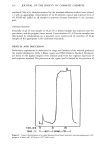
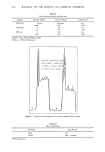
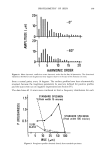
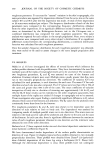
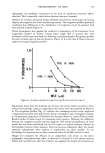
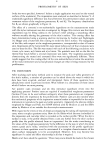
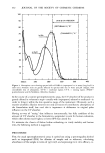
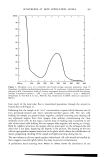
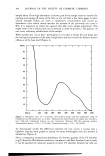
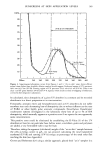
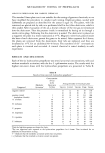
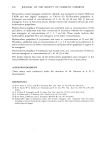
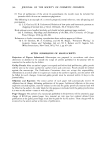
SUNSCREENS AT SKIN APPLICATION LEVELS 365 100% 90 80 70 60 50 40 30 20 10 UV-B & UV-A REGION I / / / / I IPA Assay ' t•P,k ."As O,n Skin" 1• . Assay 200rim 240 260 280 300 320 340 360 380 400 Figure 4. Superimposed absorption curves from Figures 2 and 3. "As on skin" assay shows efficacy several times higher than alcoholic dilution method would suggest. Erythemal region of UV spectrum: 292.5 nm-337.5 nm (UV-B). Tanning region of UV spectrum: 322.5 nm-372.5 nm (UV-A). There is no clear "cut-off'' point between UV-B and UV-A regions, which results in some overlapping of influences, covered in their respective calculations. be calculated, since absorptivity of a given UV absorber is a constant and its recorded absorbance in a direct proportion to its concentration. Fortunately, aromatic esters and benzophenones used as UV absorbers do not suffer anywhere near such devastating loss of absorptivity due to solvent influence as the case of PABA or other highly polar aromatic compounds. Nevertheless O-padimate/ oxybenzone systems investigated in the laboratory show loss of up to 5% of IPA absorptivity, which naturally appears as a positive error if we equate the two apparently same concentrations. This positive error could be eliminated by establishing the K-Value (5) of the UV absorbers at hand in our particular base before water, emulsifiers, gums and polymers are added, a very formidable task to say the least. Therefore, taking the apparent (calculated) weight of the "as on skin" sample between the cells as being correct in g/L, we can proceed calculating the total transmitted erythemal (UV-B) and tanning (UV-A) energy as percentage of the total solar flux reaching the skin (see Appendix). Groves and Robertson (6,7) using a similar approach, placed their "as is" samples in a

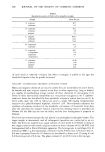
366 JOURNAL OF THE SOCIETY OF COSMETIC CHEMISTS precision machined groove in a quartz cell, squeezing surplus with a flat piece of quartz to achieve uniformity of the assayed film. Claim was made, no scattering effect with W/O emulsions was encountered. Though imaginative, their recorded curves were made with volatiles of the original base and not in the form deposited on skin. SUMMARY The method contains two errors. The small (unseen) lowering of absorptivity of the UV absorber and a very small increase of absorptivity due to the base itself, which is partially compensating the first (8). It should be beneficial for preliminary evaluation of new products, indicating whether the desired protection was reached or exceeded in terms of transmitted UV energy at skin application levels. Workers lacking sophisticated photobiological facilities could utilize this as a pre-screening tool before costly human testing evaluation is undertak- en. APPENDIX: COMPARISON OF IPA VS. "AS ON SKIN" RUNS IPA DILUTION METHOD Maximum transmitted erythemal energy (UVB) ....................................................... 2.0% Maximum transmitted tanning energy (UVA) .......................................................... 27.2% AS ON SKIN METHOD Maximum transmitted erythemal energy (UVB) ....................................................... 0.7% Maximum transmitted tanning energy (UVA) .......................................................... 5.7% The transmittance values were obtained by following our method (4) measuring the level at each 5nm band from 292.5nm to 372.5nm and dividing the aggregate by the total solar flux of that spectral segment. By comparing erythemal results, 2.0%: 0.7% we see our sample to be nearly three times more efficient and nearly five times better in UV-A region than an ordinary IPA assay would lead us to believe. We have clearly formulated a much higher efficacy screen than intended. Short of actually going to human evaluation testing, a formulatot can profit by testing his or her product against some reputable screens of the known SPF value and testing them by the IPA and "as on skin" assays for comparison. REFERENCES (1) I. M. Klotz and D. M. Gruen,J. Am. Chem $oc., 67, 843 (May, 1945). (2) B. M. Cumpelik, "Spectral shift of lambda max of PABA in hydro/alcoholic system," Tech. Bulletin, Van Dyk & Co., Inc., (1977) (3) S. I. Kreps,J. Soc. Cosmet. Chem., 14, 626 (1963). (4) B. M. Cumpelik,J. Soc Cosmet. Chem., 23, 333-345 (1972). (5) K-value = absorptivity (%) of 10 mg of a compound/lcm/L. (6) G. A. Groves, Cosmet. Toiletry, 91, 47 (August 1976). (7) D. F. Robertson and G. A. Groves, "Measurement of UV radiation," Meeting of the American Society for Photobiology, U. of Vermont, Burlington, VT, June, 1978. (8) R. L. Goldemberg, Cosmet. Perrum., 89, 35 (April 1974).
Purchased for the exclusive use of nofirst nolast (unknown)
From: SCC Media Library & Resource Center (library.scconline.org)