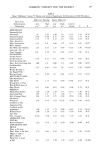
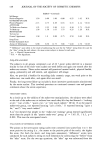
142 JOURNAL OF THE SOCIETY OF COSMETIC CHEMISTS Outlook on LijS: The improvement in outlook was greater for the training groups (F = 7.03 1,35 d.f., p 0.025). Attitude to Make-Overs.' The improvement in attitude was greater for the passive groups (F = 12.5 1,35 d.f., p 0.01). There were no differences between any of the groups for the two age questions. For the long-term effects there was no difference between the two make-over treatments for self perception (F = 1.375, 1,34 d.f.N.S.). For cosmetic care, however, the training group increased their cosmetic usage more than the passive group one week after and one month after the make-overs (F = 1212.78, 1,33 d.f., p 0.001 and F = 5.59, 1,33 d.f., p 0.025). Finally, the long-term interview questionnaire revealed that 100% of those who had received cosmetics were still using them on a regular and consistent basis one month after the make-over session. Only two out of the eight low p.a. subjects and five out of the eight high p.a. subjects reported that they had occasionally used their old make-up. Seven of the eight of each attractiveness group said they wished to continue using the make-up one from each group responded "maybe." The mean response for "how comfortable" they felt wearing the make-up was positive (5.94 on a 7-point scale). DISCUSSION The first hypothesis was confirmed. Make-over sessions do have beneficial effects on self-perceived psychological well being and subsequent cosmetic care. There are short- term benefits in terms of self-perceived appearance (physical attractiveness and looking well/healthy), socializing (feeling like going out, social confidence, and feeling glad to see people), feelings (confidence in appearance), self-image (wanting to be seen and feeling happy to look at self), outlook (on life), and attitude to make-over sessions. There were also long-term beneficial effects on self perception and on cosmetic care one week and one month after the make-over. The second hypothesis, that the physically attractive and unattractive elderly might differ in the benefits from make-overs, was also confirmed. The physically unattractive benefitted more. For eight of the eleven short-term dimensions affected by make-over treatment, the low p.a. group improved more than the high p.a. group this was in terms of appearance (looking well/healthy), socializing (feeling like going out, social confidence, and feeling glad to see people), feelings (optimism and confidence in ap- pearance) and self image (wanting to be seen and feeling happy to look at self). The long-term effects were that the unattractive benefitted more than the attractive in terms of self perception and their cosmetic care increased more one month after the make- over (although not after one week), perhaps suggesting that the unattractive elderly can benefit more the longer the time. With respect to the third hypothesis, the type of make-over does not appreciably influence the outcome. Regarding short-term scales, only two dimensions, "outlook" and "attitude," were affected and there was no long-term effect of type of make-over on self perception. However, cosmetic care increased more for the training group in the week following and one month after the make-over.

COSMETIC THERAPY FOR THE ELDERLY 143 Is the enhanced self perception that occurs with cosmetic use due to looking more physically attractive or due to feeling more cared for after cosmetics have been applied? Cosmetics provide an excellent vehicle both for enhancing attractiveness and conveying that care, time, and trouble are being taken to improve appearance. Either explanation is possible but it is likely that both are contributing to the positive changes that occur. The results of greater improvement in attitude towards make-overs for the passive make- over as opposed to the training group may be related to the idea that the elderly respond more positively to the feeling that another is caring for them. Kastenbaum (14) has emphasized that elderly individuals who take good care of their skin are more likely to develop a positive psychological cycle. This theme has been developed further by Graham and Jouhar (15). Looking better engenders positive feed- back from associates, reinforcing self esteem and improving societal contacts. Why did the attractive benefit less than the unattractive? It may be because of the operation of a "ceiling" effect, i.e., that there is less room for improvement when the starting level is higher with respect to both appearance and psychological well being. The fact that the low p.a. group did improve more than the high p.a. group also indicates that more than a placebo effect is operating. In our previous study (12) we found that the attractive and unattractive elderly usually used cosmetics to about the same degree. Thus, we cannot attribute the greater degree of benefit in the low p.a. group to the fact that they normally use little. Nonetheless, we gained the impression that the unattractive were not as skillful in their use of cosmetics and were clearly not enhancing their appearance as much as they could be. This is compatible with the frequent observation that it is the low p.a. individuals who usually benefit most strikingly from make-overs in term of their appearance changes. Since the beneficial effects seem to apply much more strongly to the unattractive and their self perception is significantly less favorable along a number of important dimen- sions (12), it seems likely that this difference could be narrowed by various cosmetic strategies, including training by professionals, make-overs, group cosmetology, etc. Thus, some of the social problems associated with aging might be alleviated. Few other studies have previously looked at middle-aged or elderly persons in relation to attractiveness. There are notable exceptions (17, 18, 19,20). Aging is inevitably as- sociated with deterioration in attractiveness. The changes tend to be negative and are viewed by many with fear and revulsion. By using cosmetics to counteract numerous signs of cutaneous senescence, the aged should reap benefits in multiple social and psychological dimensions. This concept may have widespread applications which so far have received scant attention. Connor et al. (16) found that older persons were judged less favorably as job applicants. However, they suggest that this kind of bias may not be due to age per se rather, one decisive factor may be whether the person is attractive or not. The policies and attitudes toward the aged, therefore, have to be reexamined to determine the extent to which a deteriorated, uncared-for appearance influences "ageism." In so far as the "what is beautiful is good" stereotype has been shown to apply with equal force to the elderly, we see an important role for cosmetics in improving the lot
Purchased for the exclusive use of nofirst nolast (unknown)
From: SCC Media Library & Resource Center (library.scconline.org)