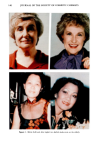
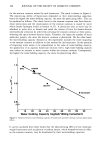
144 JOURNAL OF THE SOCIETY OF COSMETIC CHEMISTS of the elderly. Others will perceive them more positively this should feed back to their self-esteem, eventually generating more healthy and positive patterns of social behavior. We encountered a variety of attitudes of the elderly towards cosmetics in recruiting subjects for this study many did not use make-up and did not particularly like the idea. Still, they were willing to participate for the sake of promoting scientific research. Many expressed concern that they might look too artificial or frivolous, in a way that might be thought "inappropriate" for their age. They were generally relieved and pleased when the cosmetician gave them a natural and not excessively made-up ap- pearance. These anxieties about the social implications of cosmetic usage often stemmed from the attitudes prevailing during their younger years. Those who were open-minded about participating in an experiment with facial make- up that might not only improve their appearance but their psychological well being as well, tended to benefit most. A few made up their minds that they would not be open to dramatic changes at their stage in life and these tended to benefit less. All too often aged individuals accept their appearance and state of health as an act of fate which one should not try to moderate. Often this has the force of superstition and long-standing religious beliefs which view cosmetics as unseemly manifestations of vanity. "Vanity of vanity. All is vanity." (Ecclesiastics). We observed particularly striking benefits with the hospitalized individuals since their initial mood state was, not surprisingly, relatively low this points to yet another group where cosmetic practice may favorably influence health and well-being. In post-surgical cases there is almost always a need for a psychological boost, for a little extra care to speed along the recovery. For the mentally ill, who often tend to neglect their ap- pearance, there is evidence that appearance can influence the kind of help and attention they receive (21). Cosmetic therapy as an adjunctive therapy would be expected to aid recovery from emotional illness (22). Make-overs could also be very helpful in other areas of negative appearance. For ex- ample, great benefits can be realized by those with various disfigurements and discol- orations, scars of all kinds, hyper- and hypo-pigmentation (especially vitiligo), and hemangiomas (port wine stains). In these cases, cover-up/masking cosmetics are par- ticularly valuable. The psychological benefits of "cosmetic therapy" for individuals with such disfigurements need to be demonstrated with objective data. The important psychological and social benefits which can accrue from cosmetic pro- cedures need to be disseminated among geriatric physicians and among the elderly themselves. ACKNOWLEDGEMENTS We are grateful to Elizabeth Arden, Inc. for Glenn Roberts who conducted the cosmetic make-overs, and for supplying the cosmetic products. We also thank Dr. Carl Silver of Drexel University for statistical advice. REFERENCES (1) J. A. Graham and A. J. Jouhar, Cosmetics considered in the context of physical attractiveness: A review, Int. J. Cos. Sci., 2, 77-101 (1980).

COSMETIC THERAPY FOR THE ELDERLY 145 (2) E. Berscheid and E. Walster, "Physical attractiveness," in Advances in Experimental Social Psychology, L. Berkowitz, Ed. (Academic Press, New York, 1974), Vol. 7, pp 158-216. (3) J. A. Graham and A. J. Jouhar, The effects of cosmetics on person perception, Int. J. Cos. Sci., 3, 197-208 (1981a). (4) J. A. Graham and A. J. Jouhar, The psychology of cosmetics: How others see us, CTFA Cos. J., 13, 25-29 (1981b). (5) J. A. Graham and A. F. Furnham, Sexual differences in attractiveness ratings of day/night cosmetic use, Cos. Technol., 3, 36-42 (1981). (6) J. A. Graham and A. J. Jouhar, The effects of cosmetics on self perception: How we see ourselves. Work in progress, The University of Pennsylvania (1984). (7) G. R. Kaats and K. E. Davis, The dynamics of sexual behaviour of college students, J. Marriage Fam., 32, 390-399 (1970). (8) E. W. Mathes and A. Kahn, Physical attractiveness, happiness, neuroticism and self esteem, J. Psychol., 90, 27-30 (1975). (9) J. A. Graham, The psychology of cosmetic care. Presented at British Red Coss Society Beauty Care Organizers' Annual Conference. Guildford, England, March 1983. Also due to appear in British Red Cross Society Training Manual, Notes on Beauty Care in Hospital. (10) Red Cross Report, Basic skin care and cosmesis for the chronically ill, the mentally disturbed and the aged infirm. A service of the British Red Cross Society, J. Dermatol. Surg. Oncol., 7, 455-459 (1981). (11) E. MacDonald, The hospital beauty scheme, J, Soc, Cos. Chem., 10, 246-257 (1959). (12) J. A. Graham and A.M. Kligman, Physical attractiveness, cosmetic use and self perception in the elderly. Unpublished manuscript, The University of Pennsylvania, submitted for publication (1984). (13) G. W. Shedecor and W. G. Cochran, Statistical Methods, 6th ed. (Iowa State University Press, 1967). (14) R. Kastenbaum, On the significance of the skin in human aging and survival: A few psychobiological observations. Columbia Point (Dorchester) Campus, University of Massachusetts (1974). (15) J. A. Graham and A. J. Jouhar, The importance of cosmetics in the psychology of appearance, Int. J. Dermatol., 22, 153-156 (1983). (16) C. L. Connor, R. P. Walsh, D. K. Litzelman, and M. G. Alvarez, Evaluation of job applicants: The effects of age versus success, J. Gerontol., 33, 246-252 (1978). (17) J. F. Cross and J. Cross, Age, sex, race and the perception of facial beauty, Devptal. Psychol., 5, 439-443 (1971). (18) J. F. Cross, J. Cross, and J. Daly, Sex, race, age and beauty as factors in recognition. Percept. Psychophys., 10, 393-396 (1971). (19) G. R. Adams and T. L. Huston, Social perception of middle-aged persons varying in physical at- tractiveness. Devptal. Psychol., 11, 657-658 (1975). (20) D. F. Johnson and J. B. Pittenger, Attribution, the attractiveness stereotype and the elderly. In press (1984). (21) A. Farina, E. Fischer, S. Sherman, W. Smith, T. Groh, and P. Mermin, Physical attractiveness and mental illness, J. Abn. Psychol., 86, 510-517 (1977). (22) M. Pertschuk, "Appearance in Psychiatric Disorder," in The Psychology of Cosmetic Treatments, J. A. Graham and A.M. Kligman, Eds. (Praeger, New York, in press, 1984).
Purchased for the exclusive use of nofirst nolast (unknown)
From: SCC Media Library & Resource Center (library.scconline.org)