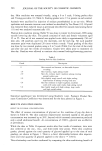
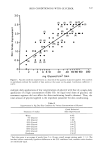
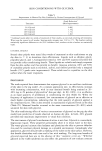
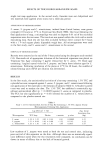
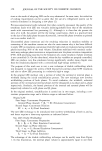
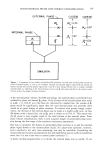
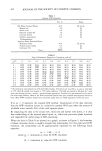
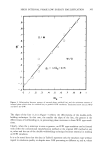
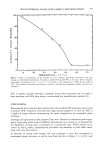
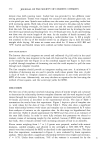
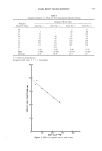
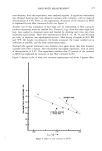
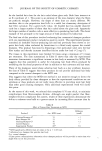
362 JOURNAL OF THE SOCIETY OF COSMETIC CHEMISTS Table I Anionic O/W Emulsion Wt. % Phase Oil Phase (Internal Phase) 40.0 Mineral oil 3.0 Stearic acid 2.0 [3, Glyceryl stearate SE 1.0 [3• Cetearyl alcohol 2.0 Sorbitan sesquioleate 0.5 [3, Triethanolamine Aqueous Phase (External Phase) Deionized water 50.9 Sodium lauryl sulfate 0.4 Carbomer 934 0.2 Total 100.0 Table II Type of Emulsions Prepared at Varying % and O/.,•O/'e 0 0.1 0.2 0.3 0.4 0.5 0.6 0.7 0.8 0.9 0 O/W O/W W/O W/O W/O W/O W/O W/O W/O W/O 0.1 O/W O/W O/W W/O W/O W/O W/O W/O W/O W/O 0.2 O/W O/W O/W W/O W/O W/O W/O W/O W/O W/O 0.3 O/W O/W O/W W/O W/O W/O W/O W/O W/O W/O 0.4 O/W O/W O/W O/W O/W W/O W/O W/O W/O W/O 0.5 O/W O/W O/W O/W O/W O/W W/O W/O W/O W/O 0.6 O/W O/W O/W O/W O/W O/W O/W W/O W/O W/O 0.7 O/W O/W O/W O/W O/W O/W O/W W/O W/O W/O 0.8 O/W O/W O/W O/W O/W O/W O/W O/W W/O W/O 0.9 O/W O/W O/W O/W O/W O/W O/W O/W O/W W/O * All emulsions were prepared in 250-ml Griffin beakers. The batch size was 200 g. oq and o• were kept at 25øC while [3• and [3• were heated to 75øC before addition. The bulk was mixed at 400 rpm for 5 rain each time during the first-, second-, and third-stage operations. Conductivity was measured at the end of the third-stage addition. Most of the W/O emulsions formed were quite unstable and separated within an hour. Most O/W emulsions formed were relatively stable with no visible separation within one hour. II at oq = 0 represent the original LEE method. Examination of the data indicates that the O/W emulsion inverts to a relatively unstable W/O type when the amount of withheld water exceeds 10% of the total aqueous phase. By inspecting the data in the second row, third row and further rows down, it is clear that withholding of the internal phase liquid, oq, effectively prevented phase inversion and expanded the useful range of LEE processing. When the data in Table II are plotted on a graph, as shown in Figure 3, the boundary of phase inversion shows a roughly straight-line relationship. For this particular O/W emulsion, the relationship can be approximately expressed by the following linear equation: oq = 1.2• - 0.15 where oq = minimum % value for O/W emulsion) -- •e = maximum o• e value for O/W emulsion

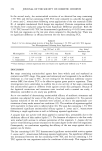
HIGH INTERNAL PHASE LOW ENERGY EMULSIFICATION 363 •9 .8 .7 .6 .4 .3 .2 .I -.I -.2 i! o/w ¸ w/o • = 1.2cx e-0.15 i • z J i i • I , .2 .3 .4 .5 .6 .7 .8 .9 i Figure 3. Relationship between amount of external phase withheld (%) and the minimum amount of internal phase which must be withheld (o O to produce O/W emulsions. Emulsions below line are W/O and above are O/W. The slope of the line (1.2) in Figure 3 reflects the effectiveness of the double-with- holding technique. In this case, the smaller the slope of the line, the greater is the effectiveness of withholding oq in preventing phase inversion to form W/O type emul- sions. Clearly, when the y-intercept is zero or greater, no O/W type emulsion can be formed with either the conventional emulsification method or the original LEE method at any O•e value and the use of the double-withholding technique becomes essential in making an O/W emulsion. It is to be noted here that the data in Table II represent only the emulsion type without regard to emulsion quality or droplet sizes. LEE processing at different o•e and oq values
Purchased for the exclusive use of nofirst nolast (unknown)
From: SCC Media Library & Resource Center (library.scconline.org)