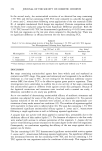
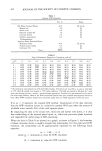
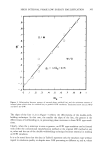
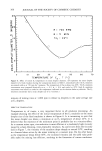
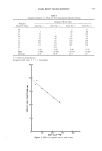
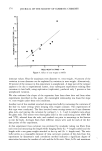
374 JOURNAL OF THE SOCIETY OF COSMETIC CHEMISTS 6O 55 50 •- 45 -- • 55 •0 25 I I I I 2 $ 4 5 TRESS WEIGHT IN GRAMS • Figure 4. Effect of tress weight on MTD. intercept values. Thus for maximum tress diameter vs. tress weight, 70 percent of the variation in tress diameter can be explained by variation in tress weight. Alternatively, 30 percent of the variance in this experiment is unexplained. A large part of the variance appears to be due to experimental scatter, since subsequent experiments relating fiber curvature to hair bulk, using replication (triplicates), produced only 5 percent or less unexplained variation. We also evaluated the slopes of the regression lines from these data and from other experiments described in this paper. No meaningful relationship was found for slope vs. tress weight under these test conditions. Another test of this method involved altering tress bulk by increasing the curvature of the hair via water setting while keeping tress weight constant. Two experiments of this type were conducted. The first involved water setting tresses on 8 mm diameter glass rods, and varying the curvature by curling 0, 1, 2, 3 and 4 complete turns about the glass rods. The tresses were thoroughly dried in the conditioning room (60% RH and 70øF), released from the rods, and combed out prior to mounting on the Instron to test for body. Averages from three different tresses were used for each of the five data points of this experiment. In this experiment tress curvature was estimated by randomly taking ten fibers from each tress and measuring.the length while hanging freely (Lc = length curled) and the length with a one gram weight attached to the tip end (Lt = length taut). The ratio Lc/Lt serves as a reasonable estimate of tress curvature analysis of the data from this experiment by Spearman's rank correlation method indicates a significant degree of association between the number of curls and the Lc/Lt ratio. Next, Lc/Lt and maximum

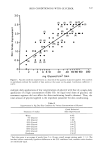
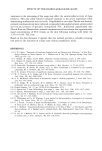
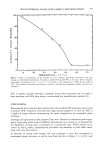
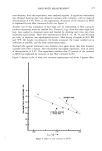
HAIR BODY MEASUREMENT 375 tress diameter, from this experiment, were analyzed together. A significant relationship was obtained showing that tress diameter increases with curvature, with an index of determination of 0.96. Thus, in this experiment, 96 percent of the variation in MTD is explained by hair fiber curvature (Lc/Lt) (see Figure 5). Another test of this assessment of hair body and its relationship to fiber curvature involved measuring water set braided hair. Tresses (2.4 g), from this same eight-inch hair, were soaked in deionized water and braided by dividing each tress into three essentially equal strands. These were intertwined to form 0, 12, 18, 24, and 30 braids per tress, in triplicate (see experimental section). After drying overnight at 60% RH and 70øF, the weight was removed, the braids unwound, the tresses combed out as uniformly as possible, and the body measurement taken. Testing Lc/Lt against maximum tress diameter once again shows that tress diameter increases with fiber curvature. The relationship was highly significant, with an index of determination of 0.95. This experiment indicates that 95 percent of the variation in MTD was explained by variation in hair fiber curvature (Lc/Lt). Figure 5 depicts a plot of these two curvature experiments and shows a greater effect •= 70 ,,, 60 m 50 '-' 40 x '""' •0 20 0.80 0.90 '.00 Figure 5. Effect of tress curvature on MTD.
Purchased for the exclusive use of nofirst nolast (unknown)
From: SCC Media Library & Resource Center (library.scconline.org)