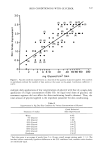
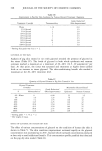
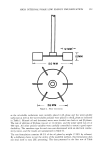
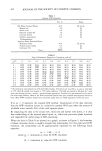
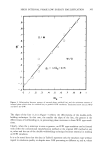
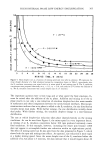
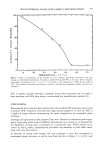
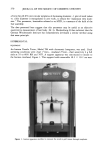
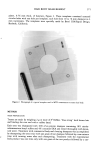
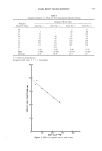
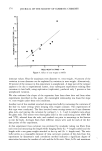
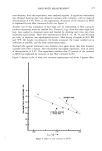
372 JOURNAL OF THE SOCIETY OF COSMETIC CHEMISTS minute rinse with running water. Curled hair was provided by two different water setting procedures: Tresses were wrapped wet around 8 mm diameter glass rods, one to six spirals per tress. Spirals were uniform over the entire tress, providing curlier hair with increasing spirals. Both ends of each tress were bound to the glass rods by rubber bands. After drying overnight, the bands were cut and the tresses carefully removed from the rods. For tests on braided hair, tresses were braided wet by dividing the tress into three equal strands and braiding from 12 to 30 braids per tress. In all cases braiding was done over the entire length of the tress. As the number of braids increased, the size of the braid pattern decreased, providing a curlier-kinkier tress. A 100 g weight was attached to the tip of the braided tresses via an alligator clip to hold the braids straight while drying. All water set tresses were dried for 12 hours at 60% RH and 70øF. Curled and braided tresses were combed out before Instron evaluations. BODY MEASUREMENT The Instron chart and integrator are zeroed and calibrated (4 g full scale) in the usual manner, with the tress mounted to the load cell chain and the top of the tress centered in the templa. te hole (see Figure 2) on the crosshead support (see Figure 1). Each tress is pulled through templates of decreasing size and the work required to pull the tress through each template recorded. The first template should provide an integrator reading near zero. A minimum of 6 templates of decreasing size are used to provide work values greater than zero. A plot is made of work vs. template diameter, and extrapolation to zero work provides the MTD of the tress. Alternatively, one may calculate an equation for the line using the method of least squares, and the x-intercept yields the MTD. DISCUSSION The first test of this method involved evaluating tresses of similar weight and curvature to determine the relationship between template diameter and the work required to pull tresses through the templates. Four two-gram tresses were prepared and water set with 30 braids and tested as described in the experimental section. The data of Table I summarizes the results from this experiment. Figure 3 depicts a plot of template size vs. work values for the data of tress 2 from Table I. These data show a significant linear relationship between work values and template size as demonstrated by F values from analyses of variance on the regression data. At this stage we hypothesized that the intercept (Table I) should approximate the MTD and thus serve as an estimate of the tress bulk (body). In order to more fully evaluate this parameter we elected to evaluate tresses of increasing weight by this method, because if MTD truly measures hair bulk, then it should correlate with increasing amounts of hair in an assembly. Eleven tresses weighing from 1.7 to 3.9 grams were prepared, washed with anionic shampoo, combed straight, and allowed to dry overnight at 60% RH-70øF. These tresses were then evaluated for MTD as described in the experimental section. The data from this experiment, summarized in Figure 4, were evaluated by linear regression analysis. These data show a significant relationship between tress weight and intercept, r 2 = 0.70. Under these conditions, 70% of the variance is accounted for by the

HAIR BODY MEASUREMENT 373 Table I Template Diameter vs. Work for Four Equivalently Braided Tresses Template Diameter (mm) Integrator Work Value Tress No. 1 Tress No. 2 Tress No. 3 Tress No. 4 48 - - 2 41 45 3 - 20 88 41 19 - 15 106 38 33 49 92 44 35 45 36 120 156 32 102 97 120 140 29 155 154 145 265 25 213 213 287 378 22 - 274 - - r 2 0.91 0.95 0.86 0.76 Slope - 0.085 - 0.063 - 0.079 - 0.059 Intercept 41.9 38.8 44.5 45.7 r 2 = Index of determination. Integrator work value X 1.7 = microjoules. 50 ,, f 40 30 20 I00 200 300 400 WORK VALUE • Figure 3. Effect of template size on work values.
Purchased for the exclusive use of nofirst nolast (unknown)
From: SCC Media Library & Resource Center (library.scconline.org)