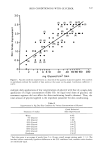
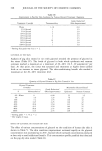
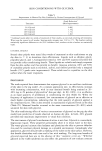
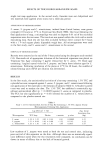
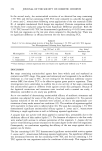
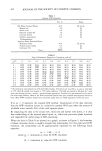
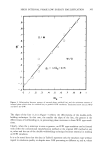
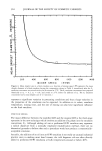
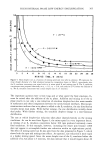
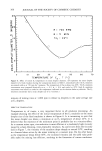
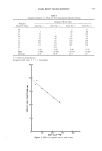
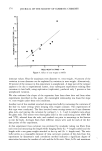
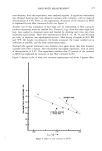
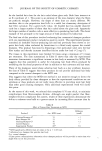
376 JOURNAL OF THE SOCIETY OF COSMETIC CHEMISTS for the braided hair than for the hair curled about glass rods. Both lines intersect at an X coordinate of 1. This point is an estimate of the tress diameter when the fibers are perfectly straight. However, the slopes of these lines are clearly different. We attribute this to the proposition that Lc/Lt is a useful but elementary description of hair fiber curvature. For a given Lc/Lt value, the braided hair has smaller diameter curls but a larger number of them than hair curled about the glass rods. Apparently the larger number of smaller curls is more effective in producing hair bulk. The classic example of this principle is the large amount of bulk produced by kinky hair. The final test of this procedure involved evaluating four commercial shampoo products with one experimental product included as positive control. This experimental product contained an insoluble friction-producing salt and had previously been shown to im- prove hair body when evaluated by beauticians in a blind study against the control shampoo. This product functions by depositing a fine particulate solid onto the hair fiber surface and thereby increases interfiber friction under low load (2 mg) (7). The tresses in this experiment were braided 30 times using a minimum of 3 tresses per treatment. The data summarized in Table II shows that only the experimental treatment demonstrates a significant increase in hair body as measured by MTD. This suggests that this parameter is useful for evaluating hair body effects produced by modifying the frictional properties of hair in addition to hair curvature and hair mass. Three of the shampoos tested above advertise hair body as a key attribute however, the data of Table II suggest that these products do not provide additional hair body compared to the control shampoo in the MTD test. This suggests that either the MTD test method is not sensitive enough to detect the body effects provided by these shampoos or that the experimental conditions are not optimum or these products are not really more effective in providing more hair body than other good cleaning shampoos. Only additional experimental work will clarify this point. At the outset of this work, we selected thin templates 0.76 mm thick, to minimize complications from fiber-template friction. Although one might predict that fiber- template friction complicates this system, results of these experiments demonstrate the ability to enhance tress bulk to a greater extent by increasing fiber curvature than by Table II Effect of Various Hair Treatments on MTD Difference Product:• Ave. MTD (mm) (mmõ) Cleaning Shampoo A? 53 - 1 Body Shampoo B? 53 - 1 Cleaning Shampoo C? 56 + 2 Control Shampoo 54 - Experimental Product 60* + 6 * MTD significantly different froIn all others at the c• = 0.05 level. • Advertised as a shampoo that provides hair body. õ vs. control shampoo. $ Upon private communication information about shampoo products will be provided to assist those who might wish to test this procedure.

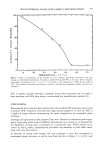
HAIR BODY MEASUREMENT 377 increasing fiber friction. For example, we achieved an increase in MTD of greater than 90 percent in the tress curvature experiments, but only an increase of 11 percent for the experimental treatment described in Table II. SUMMARY A new method is described for hair body which assumes that tress bulk as estimated by MTD is a valid assessment of hair body. By estimating MTD via compressional forces using the Instron, we have shown an increase in hair bulk (body) with increasing amounts of hair, with increasing fiber curvature and curvature type, and with increasing fiber friction. Three current shampoo products advertised as body shampoos failed to show an improved effect vs. the control shampoo in this test. REFERENCES (1) Studies of the Modification of Human Hair Properties by SurfaceTreatments, Phase II.' Hair Assembly Behavior, Progress Report No. 7, Textile Research Institute, Princeton, N.J. March 15, 1978. (2) P.S. Hough, J. E. Huey, and W. S. Tolgyesi, Hair body, J. Soc. Cosmetic Chem., 27, 571-578 (1976). (3) N. E. Yin, R. H. Kissinger, W. S. Tolgyesi, and E. M. Cottington, The effect of fiber diameter on the cosmetic aspects of hair, J. Soc. Cosmet. Chem., 28, 139-150 (1977). (4) C. Robbins, Chemical and Physical Behavior of Human Hair, (Van Nostrand Reinhold Co. 1979), p 199. (5) M. L. Garcia and L. J. Wolfram, Measurement of bulk compressibility and bulk resiliancy of a hair mass, IOth IFSCC Congress, Sydney, Australia (1978). (6) G. Blankenburg, private communication. (7) L. DiVerdi, private communication.
Purchased for the exclusive use of nofirst nolast (unknown)
From: SCC Media Library & Resource Center (library.scconline.org)