368 JOURNAL OF THE SOCIETY OF COSMETIC CHEMISTS to control the phase inversion problem in a commercial operation even if energy con- servation is not the purpose. The success of adopting the method, however, may be dependent on proper selection of the size of ote and oti as well as the mixing equipment and mixing conditions. As a rule, ote and oti values should not be selected at points too close to the phase-inversion boundary line. ACKNOWLEDGEMENT The authors gratefully acknowledge the experimental assistance of C. S. Chiang in connection with this research. REFERENCES (1) T. J. Lin, Low-energy emulsification I: Principles and applications, J. Soc. Cosmet. Chem., 29, 117- 125 (March 1978). (2) T. J. Lin, Low-energy processing of cosmetic creams and lotions, Cosmetics and Toiletries, 95, 51-56 (March 1980). (3) T. J. Lin, T. Akabori, S. Tanaka, and K. Shimura, Low-energy emulsification II: Evaluation of emulsion quality, J. Soc. Cosmet. Chem., 29, 745-756 (December 1978). (4) T. J. Li.n, T. Akabori, S. Tanaka, and K. Shimura, Low-energy emulsification III: Emulsification in higl-•'•-zange, Cosmetics and Toiletries, 95, 33-39 (December 1980). (5) T. J. Lin, T. Akabori, S. Tanaka, and K. Shimura, Low-energy emulsification IV: Effect of emul- sification temperature, Cosmetics and Toiletries, 96, 31- 39 (June 1981). (6) T. J. Lin, T. Akabori, S. Tanaka, and K. Shimura, Mechanisms of Enhanced Emulsification in Low- Energy Processing, Paper presented at 12th I.F.S.C.C. Congress, Paris, France, September 1982. (7) T. J. Lin and J. C. Lambrechts, Effect of initial surfactant location on emulsion phase inversion, J. Soc. Cosmet. Chem., 20, 185-198 (March 1969). (8) P. Becher, Emulsions.' Theory and Practice, 2nd ed., (Reinhold Publishing Corp., New York, 1965), pp 101-104.

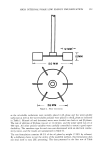
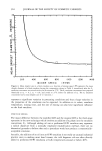
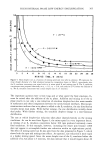
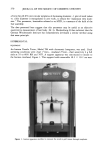
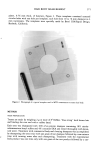
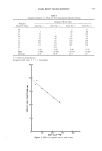
J. Soc. Cosmet. Chem., 35, 369-377 (November 1984) A method to evaluate hair body C. R. ROBBINS and R. J. CRAWFORD, Colgate Palmolive Company, Research Center, 909 River Road, Piscataway, NJ 08854. Received August 16, 1984. Synopsis A new method is described which employs the Instron Tensile Tester to evaluate the bulk of hair tresses. This procedure estimates hair bulk (hair body) by measuring the work required to pull tresses through templates of decreasing diameter. By extrapolation to zero (work) we estimate maximum tress diameter (MTD). MTD increases with increasing amounts of hair, with increasing fiber curvature and with increasing fiber friction. These observations are all consistent with expectations for a hair body measurement. INTRODUCTION Hair body is evaluated in our beauty salon as apparent thickness or volume of an assembly of hair, involving assessment by sight and touch. This is similar to a definition offered at Textile Research Institute in 1978 (1): "The apparent bulk of the hair on the head of an individual has often been referred to as body." A related but somewhat different definition has been offered by Tolgyesi (2): "Hair body can be defined as the structural strength and resiliency of a hair mass." These definitions involve either bulk or structural strength of a hair mass, while hair body methods described in the literature (1,3-5) generally focus on the components of the structural strength of a hair mass. Several laboratory methods have been described to characterize hair body (1,3-5). The Tolgyesi omega loop method (3) examines structural strength of a hair assembly, em- phasizing the bending properties more than the frictional behavior of the fibers. A method that emphasizes frictional behavior, but attempts to measure the bulk of hair fibers is the method of Scott and Robbins (4). This method involves randomly dropping 1 to 2 inch hair fibers into a graduated cylinder. Fibers with higher interfiber friction provide a larger volume and more body. Kamath and Weigmann's method (TRI) (1) involves transverse compression of a bundle of fibers to determine the compressibility and recovery behavior of hair tresses. Garcia and Wolfram (5) consider the force or work necessary to pull hair tresses through a teflon ring. Here the net force is a combination of fiber bending and fiber-fiber and fiber ring friction. But it's not clear with either of these two methods which parameter or combination of parameters correlates best with hair body. TRI suggests that their method is intended to measure the "tactile component of hair body as it is reflected in the resistance which hair offers to compression." An approach that we offer is a modification of the Garcia method. We assess the bulk of a hair assembly by measuring the work required to pull the tress through a succession 369
Purchased for the exclusive use of nofirst nolast (unknown)
From: SCC Media Library & Resource Center (library.scconline.org)