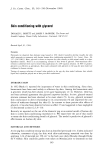
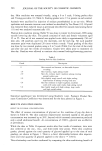
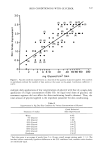
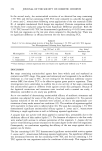
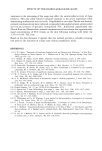
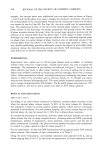
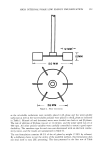
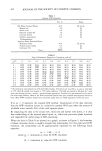
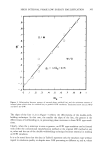
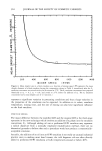
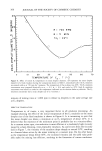
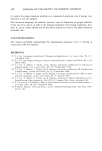
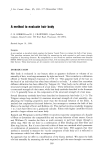
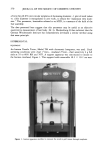
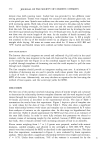
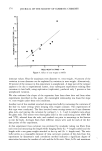
366 JOURNAL OF THE SOCIETY OF COSMETIC CHEMISTS 25 z 0 I0 20 30 40 50 60 70 TEMPERATURE OF E 2 , T (øC) __ Figure 6. Effect of initial E 2 temperature on mean droplet diameter. (D represents the mean droplet diameter of a final emulsion having the composition shown in Table I, immediately after the E 2 emulsion was mixed with % at 720 rpm for 5 minutes. The temperature of the oq phase was 26øC. The E 2 emulsion concentrates were prepared identically at o• e = 0.2, % = 0.8, and cooled to 26øC. Each E2 emulsion concentrate was heated or cooled to the temperature indicated on the abscissa before oq addition. The E2 emulsion concentrate had a mean droplet size of 2.5 microns.) minutes of mixing time at 1,000 rpm to reduce oq droplets to the same average size as E 2 droplets. EFFECT OF TEMPERATURE Temperature is, of course, a very important factor in all emulsion processing. An example showing the effect of the initial temperature of the E 2 emulsion on the mean droplet size of the final emulsion is shown in Figure 6. It is interesting to note that the mean droplet size shows a minimum at an E 2 temperature of about 40øC. It is believed that the existence of the minimum point is probably due to a viscosity effect. At a constant mixer rpm, size-reduction is most efficient at a moderately high viscosity range for a shear-thinning, time-dependent emulsion. As can be seen from the viscosity data in Figure 7, the viscosity of the emulsion drops sharply at around 50øC, resulting in a lowered shear action by the mixer rotating at a constant rpm. On the other hand, as the temperature drops below 40øC, the increased viscosity and the yield value prob- ably make the mixing less efficient, resulting in the formation of coarser emulsions.

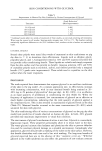
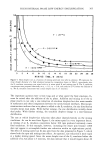
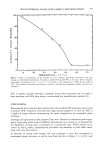
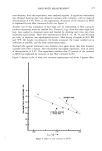
HIGH INTERNAL PHASE LOW ENERGY EMULSIFICATION 367 60 o u 50 40 30 •0 IO • I I I I i i I I I • I I , I O •0 :30 40 õ0 60 70 tEMPEr/•TUrE, t { øC) Figure 7. Effect of temperature on the viscosity on an E2 emulsion concentrate. (Viscosity is the scale reading on a Brookfield Sychrolectric Viscometer, model LVT,'spindle #4, at 0.6 rpm. The E2 emulsion concentrate was prepared at o• e = 0.2, o•, = 0.8, based on the composition in Table II and cooled to 26øC. The emulsion concentrate was heated or cooled to the indicated temperature before viscosity mea- surements.) This is another example showing a probable reason why sometimes one can make a finer emulsion with LEE than using a conventional hot emulsification method (6). CONCLUSIONS Experimental data presented here indicate that the modified LEE technique can be used to process O/W emulsions with relatively large internal phases or to carry out LEE in a higher ot range without encountering the usual complication of unintended phase inversion. Although all experimental data presented here were obtained on laboratory scale equip- ment, some pilot plant work on different formulations was carried out to demonstrate the feasibility of using such a technique on a commercial scale. When carried out at correct ot i and ote values, emulsification proceeded very smoothly to yield stable emul- sions with very fine texture. In addition to saving more energy, the new technique is even less susceptible to unintended phase inversion, as can be seen from the data in Figure 3 it can be used
Purchased for the exclusive use of nofirst nolast (unknown)
From: SCC Media Library & Resource Center (library.scconline.org)