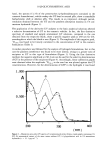
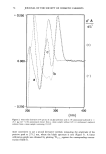
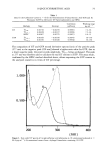
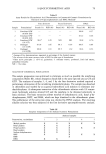
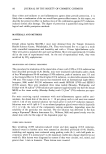
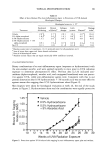
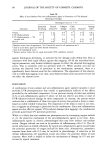
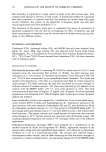
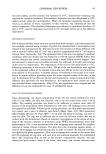
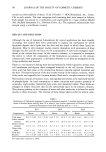
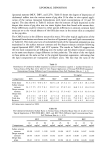
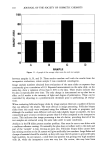
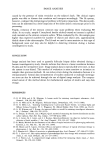
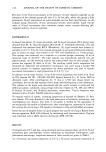
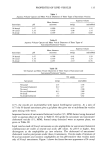
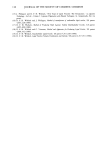
18 [3-GLYCYRRHETINIC ACID 79 Table II Assay Results for Glycyrrhetinic Acid Determination in Commercial Cosmetic Formulations by Derivative UV Spectrophotometric and HPLC Methods a First derivative Second derivative HPLC Sample Formulations c Found (%) RSD (%) Found (%) RSD (%) Found (%) RSD (%) 1 Emulsion O/W .... 100.8 0.57 (0.06% GT) 2 Emulsion O/W .... 101.2 0.44 (0.06% GT) 3 Emulsion O/W 98.3 b 3.29 ND ND 99.8 0.76 (1% GT) 4 Hydrogel 101.8 1.66 99.3 0.93 100.4 0.84 (1% GTP) 5 Hydrogel 100.8 1.91 99.5 1.32 99.6 0.53 (1% GTP) Average of five determinations, expressed as percentage of the claimed content. On account of the mean recovery value of 90% for this type of formulation. Other active principles: 2. olive oil, gaiazulene 5. rosemary extract, panthenol, birch leaf extract, polisorbate biosulfur. ND = Not done. ANALYSES OF COMMERCIAL FORMULATIONS The sample preparation was optimized to eliminate as much as possible the interfering components (Table III), whose absorption bands fall in the same spectral area as GT and GTP. The analyses of samples 3, 4, and 5 by the first derivative method required a preliminary elimination of the interfering imidazolidinylurea. The sample was dissolved in chloroform and washed by an aqueous hydrochloric acid solution to eliminate imi- dazolidinylurea. A subsequent extraction of the chloroformic solution with 1% ammo- nium hydroxyde solution allowed GT and the parabens to be obtained selectively in basic medium. The basic extraction allows removal of dehydroacetic acid, butyl p-hy- droxybenzoate, BHT, and BHA, which are kept dissolved in the chloroformic phase. The performance of the extraction steps was checked by HPLC analysis. The resulting alkaline solution was then subjected to the first derivative spectrophotometric analysis. Table III Excipient Components of the Analyzed Cosmetic Formulations Preservatives, antioxidants Analyzed samples 1 2 3 4 5 Methyl paraben X X X X X Ethyl paraben X X X Propyl paraben X X X X X Butyl paraben X X X Sodium dehydroacetate X X X IMU X X X X BHT X BHA X X

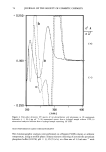
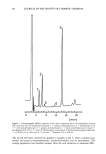
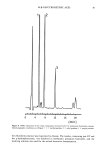
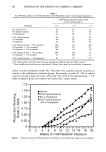
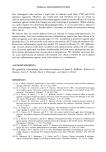
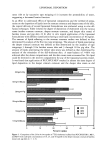
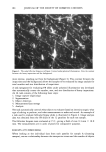
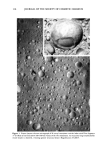
80 JOURNAL OF THE SOCIETY OF COSMETIC CHEMISTS 2 0 4 8 12 16 20 Figure 7. Chromatographic (HPLC) separation of the cream components left in the chloroformic solution after extraction with 1% ammonium hydroxide: 1 = methyl p-hydroxybenzoate 2 = dehydroacetic acid 3 = ethyl p-hydroxybenzoate 4 = propyl p-hydroxybenzoate 5 = butyl p-hydroxybenzoate. Column: 5 •m Hypersil C18,250 x 4.5 mm I.D. Mobile phase: acetonitrile:0.02 M potassium phosphate buffer (pH = 3) 60:40 (v/v) at a flow rate of 1.0 ml min-1. Detection: UV at 248 nm. The second derivative method was applied to samples 4 and 5, which contained just methyl and propyl p-hydroxybenzoate, imidazolidinylurea, and no antioxidants. The sample preparation was therefore simpler: After the acid extraction to eliminate IMU,
Purchased for the exclusive use of nofirst nolast (unknown)
From: SCC Media Library & Resource Center (library.scconline.org)