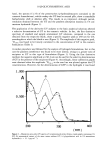
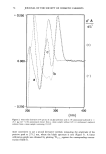
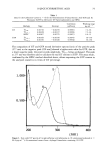
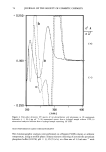
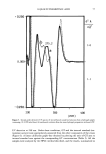
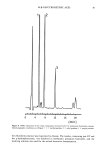
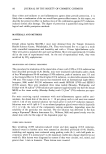
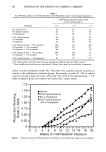
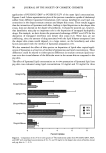
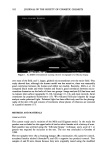
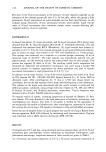
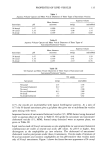
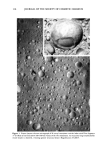
116 JOURNAL OF THE SOCIETY OF COSMETIC CHEMISTS Figure 1. Freeze fracture electron micrograph of N-cocoyl sarcosinate vesicles laden with Dior fragrance 37 D. Most of the fields show 300-500-nm vesicles with two membranes. An occasional large multilamellar vesicle (inset) is observed, revealing greater structural detail. Magnification 45,000X.

PROPERTIES OF LIPID VESICLES 117 sarcosinate vesicles laden with Dior fragrance 37 D (Parfums Christian' Dior). Most of the fields show 300--500-nm vesicles with two membranes. Occasional large, multila- mellar vesicles are also seen (Figure 1, insert). DISCUSSION N-acyl sarcosinates have a long and wide acceptance for skin and hair care. Because they are extremely mild and adsorb readily onto the skin at neutral or slightly acid pH, they are used as cleansers and moisturizers for oily skin. Formulations containing N-acyl sarcosinates in vesicular form provide not only the desirable properties of the sarcosinates themselves, but also the benefits of delivering a variety of water-miscible and water-immiscible active ingredients in a programmable fashion. The high capacity for water-immiscible substances represents perhaps the major advantage in the cosmetic area, since it allows for the controlled delivery and sustained release of fragrant and emollient oils, conditioning silicone fluids, and active molecules such as the oil-soluble vitamins. REFERENCES (1) J. M. Gebicki and M. Hicks, Ufasomes are stable particles surrounded by unsaturated fatty acid membranes, Nature, 243, 232 (1973). (2) W. R. Hargreaves and D. W. Deamer, Liposomes from ionic single-chain amphiphiles, Biochemistry, 17, 3759 (1978). (3) T. Kunitake and Y. Okahata, A totally synthetic bilayer membrane, J. Am. Chem. Soc., 99, 3860 (1977). (4) Y. Okahata and T. Kunitake, Formulation of a stable monolayer membrane and related structures in dilute aqueous solutions from two-headed ammonium amphiphiles, J. Am. Chem. Soc., 101, 5231- 5234 (1979). (5) T. Kunitake, Y. J. Okahata, M. Shimomura, S. Yasunami, and K. Takarabe, Formation of stable bilayer assemblies in water from single-chain amphiphiles. Relationship between the amphiphile structure and the aggregate morphology, J. Am. Chem. Soc., 103, 5401 (1981). (6) T. Kunitake, Organization and functions of synthetic bilayers, Ann. N.Y. Acad. Sci., 471, 70 (1986). (7) J. H. Fendler, Surfactant vesicles as membrane mimetic agents: Characterization and utilization, Accts. Chem. Res., 13, 7 (1980). (8) Y. Okahata, S. Tanamachi, M. Nagai, and T. Kunitake, Synthetic bilayer membranes prepared from dialkyl amphiphiles with nonionic and zwitterionic head groups, J. Colloid Interface Sci., 82, 401 (1981). (9) Y. Murakami, A. Nakano, and H. Ikeda, Preparation of stable single-compartment vesicles with cationic and zwitterionic amphiphiles involving amino acid residues,.]. Org. Chem., 47, 2137 (1982). (10) R. M. Handjani-Vila, A. Ribier, B. Rondot, and G. Vanlerberghe, Dispersions of lameliar phases of non-ionic lipids in cosmetic products, Int. J. Cosmet. Sci., 1, 303 (1979). (11) A. J. Baillie, A. T. Florence, L. R. Hume, G. T. Muirhead, and A. Rogerson, The preparation and properties of niosomes--Non ionic surfactant vesicles,.]. Pharm. Pharmacol., 37, 863 (1985). (12) Y. Ishigami and H. Machida, Vesicles from sucrose fatty acid esters,J. Am. Oil Chem. Cos., 66, 599 (1989). (13) P. Schenk, M. Ausborn, F. Bendas, P. Nuhn, D. Arndt, and H. W. Meyer, The preparation and characterization of lipid vesicles containing esters of sucrose and fatty acids, J. Microencapsul., 6, 95 (1989). (14) E. W. Kaler, K. Murthy, B. E. Rodriguez, and J. A. Zasadzinski, Spontaneous vesicle formation in aqueous mixtures of single-tailed surfactants, Science, 245, 1371 (1989).
Purchased for the exclusive use of nofirst nolast (unknown)
From: SCC Media Library & Resource Center (library.scconline.org)