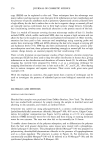
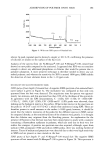
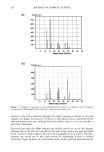
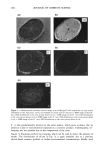
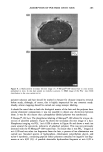
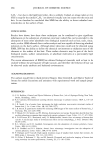
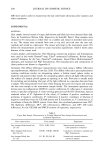
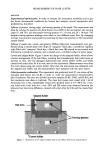
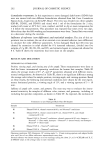
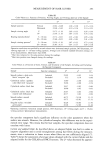
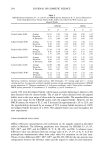
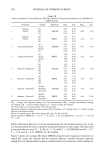
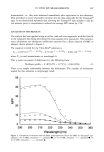
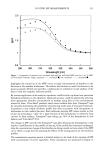
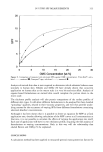
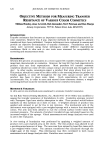
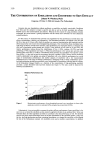
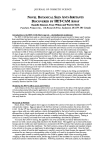
ADSORPTION OF POLYMER ONTO HAIR 281 5000- ß • 4000 • 3000 Cls 2000 Ols 1000 • S2p Si2p 1000 900 800 700 600 500 400 300 200 100 0 Binding Energy/eV Figure 4. Wide-scan XPS spectra of bleached hair. silicon 2p peak, regional spectra showed a singlet at 101.9 eV, confirming the presence of silicones or silanes on the surface of the hair (22). Analysis of the spectra from the N-Merquat©-100 and P-Merquat©-100-treated hair showed no new peaks compared to the untreated. It appeared that XPS was not sensitive enough to detect any additional phosphorus or chlorine that would be present due to polymer adsorption. A more sensitive technique is therefore needed to detect any ad- sorbed polymer, and whereas the sensitivity for XPS is around 1000 ppm, SIMS enables the detection of most elements down to the 1-10 ppm scale. SECONDARY ION MASS SPECTROMETRY (SIMS) SIMS spectra of hair lengths: Untreated hair. A negative SIMS spectrum of an untreated hair's outer surface is given in Figure 5a. The instrument was configured so that only ions sputtered from the hair were detected. The acquisition time for spectra was approxi- mately two minutes, and this sputtered less than 10% of the thickness of the epicuticle. In agreement with the XPS measurements, C- (12D), CH- (13D), O- (16D) OH- (17D), C 2- (24D), C2H- (25D), CN- (26D) and S- (32D) peaks were observed, these making up the biological matrix at the surface. Of particular interest in the spectrum are the peaks at 19 D (F-) and 35/37 D (Cl-), which were undetected using XPS. These are therefore present in small amounts at the surface ( 1000 ppm) however, it should be noted that the relative intensities of the peaks for the different species in SIMS cannot be compared directly, as the sensitivity factors of the elements vary greatly. It is thought that the chlorine may originate from the bleaching process. An explanation for the presence of fluorine is that the hair may have been treated prior to study with a cosmetic containing a fluorocarbon surfactant or polymer, which are used due to their very low surface free energies. A positive ion spectrum was also acquired, although, apart from sodium (23D), potassium (39D) and silicon (28D) peaks, there was nothing further of interest. Traces of sodium and potassium were detected due to their very high sensitivity in SIMS and are present as trace metals in the hair. SIMS spectra of hair lengths: P- and N-Merquat©-lOO-treated hair. The negative SIMS spectrum of hair treated with N-Merquat©-100 is given in Figure 5b. This spectrum is

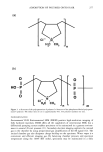
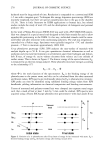
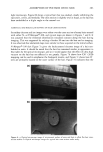
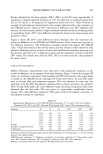
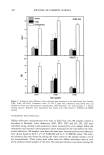
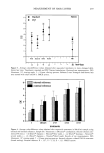
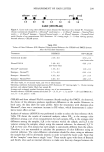
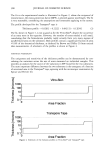
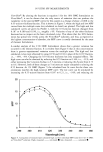
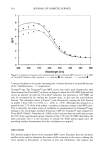
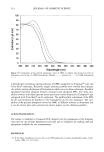
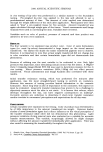
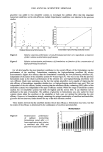
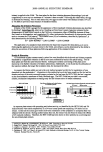
282 JOURNAL OF COSMETIC SCIENCE (a) Counts / a.u. 700 6OO 500 400 3O0 200 100 5 10 5 20 25 30 35 40 45 50 Mass/Charge (Daltons) (b) Counts / a.u. 500 ..... '• ..................................... ', : : 400 300 ............................................':.........j...................... 100 .... 5 10 15 20 25 30 35 40 45 50 Mass/Charge (Daltons) Figure 5. a: Negative ion spectrum of untreated bleached hair. Counts are in arbitrary units. b: Negative ion spectrum of N-Merquat©-100-treated hair. Counts are in arbitrary units. similar to that of the untreated, although the relative amount of chlorine on the hair appears to be higher. The presence of chlorine in the polymer may be responsible for the observed higher count rate, although from this evidence alone it is not yet possible to draw firm conclusions. Elemental and molecular SIMS imaging was initially carried out on the hair lengths, although due to the hair not lying flat on the stub, image quality was poor and much of the contrast in these images is related to the topography of the specimen. Therefore, imaging was carried out on hair cross sections by embedding in resin as detailed previously. Figure 6a shows the microtomed surface of the resin and hairs obtained by
Purchased for the exclusive use of nofirst nolast (unknown)
From: SCC Media Library & Resource Center (library.scconline.org)