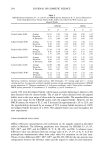
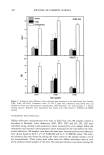
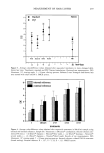
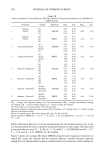
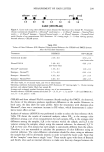
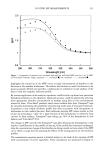
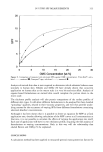
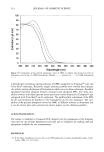
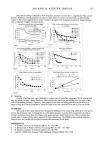
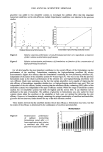
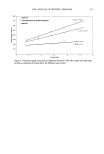
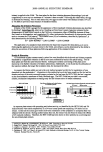
2000 ANNUAL SCIENTIFIC SEMINAR 325 Since batch milling is affected by flow properties, product viscosity shows a significant effect on this process. Reduction of large particles was about 3 times faster in a lower viscosity batch, as indicated by Figure 5. This result suggests that in order to achieve the same level of pigment dispersion, longer milling time is required in higher viscosity batches. Changes of Particle Size and Count dudng Milling as Measured by FBRM $000 l[•"'-•a.--'•- -'•--Z ........ TotalCount I 250 • 5000 } ...... % • ..... Count •149 mcro) • 200 • I Ml_ Mean Chd Lenth/ 4000 [ ---- ---- --• 150 100 50 0 0 200 400 600 u•. sec Figure 1 Effect of Recycle Flowrate on Parhcle S•ze Reducbon In-L•ne Milling at Constant RotorSpeed 12o lOO 8o 40 20 0 Effect of Rotor Speed on Particle Count Reduction In - Tan k Millin g 120 • 100 80 ,• • 60 4o • •o o Rgure 2 o 100 200 300 400 Tlrl•, sec Performance Companson In- Tank vs In- L•ne F•gure 3 200 400 600 800 Time, sec Effect of Batch Viscosity on P•gment Milling 80 4O 20 0 0 100 200 300 400 500 600 Ftgure 4 T•me, sec Effect of Batch S•ze on the Reqmred Milhng T•me • o 50 lOO Time, sec F•gure 5 lOOO 8oo 600 4OO 200 0 F•gure 6 ß In-Line - ß In-Tank - --- i Dnear 0n-Line) Linear (In-Tank) i 25 5O 75 1CO 125 150 Batch Slze,lb E. Scale Up A series of milling tests were conducted at various sizes of pilot plant equipment. While holding mill size and speed constant, a linear function is observed between batch size and milling time for both in-tank and in-line milling processes (Figure 6). This graph indicates that the milling time required to achieve a target milling level can be predicted by using the slope of the line calculated from lab or pilot test results. SUMMARY The results of this study indicate that the pigment milling process is generally affected by rotor speed and by batch turnover rate. Consequently, it is affected by product viscosity, mill arrangement (in-tank or in-line), and recirculation flow rate. Higher mill speed and better batch turnover rate reduce milling time significantly. Longer milling time is required for larger batch sizes. The FBRM in-line particle analyzer is found to be a very useful tool to collect real-time data necessary for the study. REFERENCES 1. T. Goldner, Cosmetics & Toiletries 101 (4): 91 - 94, 1986. 2. R. Johnson and A. Hodel, Chemical Processing 50 (11): 108 - 110, 1987. 3. H. Epstein, Cosmetics & Toiletries 110 (3): 83 - 89, 1995. 4. Lasentec, FBRM User Manual, Understanding & Utilizing FBRM, May 1998.

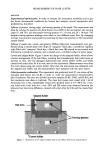
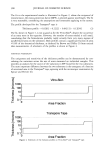
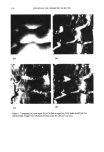
326 JOURNAL OF COSMETIC SCIENCE OBJECTIVE METHODS FOR MEASURING TRANSFER RESISTANCE OF VARIOUS COLOR COSMETICS Melissa Hundey, Jesse Leverett, Bob Alexander, Terri Peterson and Ron Sharpe Amway Corporation, 7575 E. Fulton Street, Ada, M149355) INTRODUCTION: Transfer resistance has become an important consumer-perceived characteristic in color cosmetics. However few, if any, objective methods for measuring the amount transferred have been published. Various techniques were evaluated to assess and provide an objective determination of transfer resistance. Foundations and lip- colors were screened using these techniques under different experimental conditions. Both in vitro and in vivo tests were assessed for acceptability as screening and measurement tools. BACKGROUND: Seventy-five percent of consumers in a recent panel felt transfer resistance to be an important characteristic in cosmetics. However, far less felt they had experienced a product that met their expectations. Most panelists felt transfer resistant cosmetics should not come off with casual contact and should last throughout the day•. In other words, consumers expect a product that stays where they put it. The product should not come off on their collar in the morning (when the product is freshly applied), or come off throughout the day with casual contact (after the product has been in place some time). Such expectations do not seem unreasonable. Yet, in order to meet and exceed these consumer desires, a simple screening method would be extremely useful to the cosmetic formulator. METHODS/h VARIABLES: In vitro and in vivo methods were examined to evaluate transfer resistance. An Ink Rub Tester (Testing Machines, Inc., Model #10-18-01-0001) was modified to assess the transfer resistance of foundations in vitro. Cosmetics sponges covered with Transpore Tape have similar absorption to skin. Thus product would behave similarly on this substate as it does on skin. A weighed amount of product was applied and allowed to set for five to ten minutes. The mechanical arm of the instrument was equipped with a pre-weighed sponge with a texture that simulated cotton. The arm was then allowed to rub the covered surface twelve times with constant pressure. The amount of product transferred was calculated based on the increased weight of the sponge. Visual assessments and Image Analysis were used to aid in the evaluation. In vivo testing of foundation was preformed by applying a weighed amount of product over a pre-marked area on the cheek. The test product was allowed to set a predetermined amount of time. The area was then swiped by hand five times with a pre-weighed white tissue. The amount transferred was calculated through the weight gain of the tissue. This information was then correlated to both visual assessments and Image Analysis data. Variables were reviewed.
Purchased for the exclusive use of nofirst nolast (unknown)
From: SCC Media Library & Resource Center (library.scconline.org)