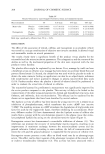
216 JOURNAL OF COSMETIC SCIENCE 40øC) and is designated as Mp-3, and then finally the last solid fraction of the model sebum melts at approximately 55øC and is designated as Mp-4. At -50øC the lipid mixture is a solid, and by 100øC all components have completely melted and the mixture is a liquid. From the DSC profiles and melting endotherms, we can conclude that the model sebum is crystalline in nature. Generally, pure lipids or homogeneous systems yield single sharp peaks whereas heterogeneous systems produce broad multiple peaks (12). Ifsebum was a homogeneous mixture, there would be one melting transition, but the presence of multiple melting transitions indicates that there are multiple phases. From the temperatures of these melting transitions, it appears that at skin temperature (32øC), some of the components of sebum are solids and some are liquids, which are not completely miscible with each other. In order to identify the component associated with each transition, singular components were run through the DSC under the same conditions as the model sebum. The com- ponents used for carbon chain length 16 are given in Figure 2. Adding other substances -50 -30 -10 10 30 50 70 90 Transition Temperature(øC) a. Tripalmitolein m.p. = -21.184øC b ct-Palmitoleic acid m.p. = -18.7øC c. Oleyl Oleate m.p. = -4.234øC d ¾-Palmitoleic acid = 2.1 øC e. Palmityl Palmitate = 55.166øC f. Palmitic acid = 63.866øC g. Tripalmitin = 67.326øC Figure 2. Thermograms showing transition temperatures of individual components

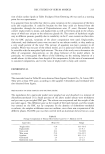
DSC STUDIES OF SEBUM MODELS 217 to pure compounds usually decreases their melting point. In the DSC thermogram, investigating the effect of C-16 (Figure 3), the peak, Mp-4, is possibly a combination peak of the triglyceride tripalmitin (m.p = 67.316øC DSC run shown in Figure 2), and the fatty acid is palmitic acid (m.p = 63.866øC Figure 2). The peak for Mp-3 in C-16 can be assigned to the peak of the wax ester, palmityl palmitate (m.p = 55.166øC). Palmitoleic acid exists in the form of two isomers, •/(m.p = -18.7øC) and c• (m.p = 2.1øC) (13). Mp-2 can be a mixture of the unsaturated wax ester, oleyl oleate (m.p. = -4.234øC) and the c• form of palmitoleic acid. Mp-1 may be a mixture of the triglyc- eride tripalmitolein (m.p = -21.184øC) and the •/form of palmitoleic acid. Squalene has a m.p of -75øC and does not show any transitions. Its only role is probably that of a solvent, and it may be affecting all the peaks in decreasing their melting temperatures. Similarly, for the carbon chain lengths of 14 and 18, the peaks can be assigned to their individual components (DSC runs done separately, not shown here). In general, Mp-! is the peak of the unsaturated triglyceride and unsaturated fatty acid, Mp-2 is the peak of the unsaturated wax ester, Mp-3 is the peak of the saturated wax ester, and Mp-4 is the peak of the saturated triglyceride and fatty acid. It is safe to assign the peaks to this mixture of compounds as the individual compounds show their peaks around these melting transitions. In Figure 3, investigating C-14, an extra peak is seen before Mp-3. This can be attributed to a polymorphic form of one of the components. CARBON CHAIN LENGTH From Figure 4, it is obvious that as the carbon chain length increases, all the melting temperatures increase, which would be expected. The slopes of the unsaturated compo- -0.8 .• Mp-•p-4 C-16 • C-1 -50 -25 0 25 50 75 100 -Temperature (øC) Figure 3. Thermogram showing the effect of carbon chain length in the model sebum (ratio of unsaturation to saturation 1:1).
Purchased for the exclusive use of nofirst nolast (unknown)
From: SCC Media Library & Resource Center (library.scconline.org)