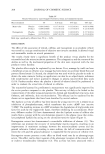
234 JOURNAL OF COSMETIC SCIENCE Table V Statistical Comparison of Data for the Formulations Total o•-TAc permeated (% of applied dose) Extent of metabolism • [o•-T/(o•-T + o•-TAC)] x 100 Metabolite-o•-T concentration in viable tissue (% of dose) IPM b •' gel 1 x •/ x IPM •, gel 2 x ,/ x IPM +* gel 3 x x x IPM •-• Emul 1 x •/ x IPM *-• Emul 2 • x •/ IPM +* Emul 3 x • x Gel 1 •,gel2 x x x Gel 2 •' gel 3 x •/ x Gel t *-• get 3 •/ x x Emul 1 +* Emul 2 • • x Emul 1 ** Emul 3 x x x Emul 2 •' Emul 3 •/ x x 7: Statistically significant difference (o• = 0.05) exists between the terms connected by the arrow symbol determined using Tukey's test. x: No statistically significant difference (o• = 0.05) exists between the terms connected by the arrow determined using Tukey's test. a In viable skin at 24 hours. b An IPM solution of •-TAc. time. No other metabolites of ot-T were detected in viable skin in the 24-hour study period. Metabolism did not occur in the stratum corneum, but was restricted to the viable skin. The F-test revealed no interday variability, thus validating the efficiency of the randomized complete block design we had chosen as the statistical model for the experiment. We have shown that ot-TAc can be delivered through skin by using a simple topical formulation (an IPM-solution). Wester and Maibach (13) demonstrated delivery of radiolabeled ot-TAc across human skin using a simple cream formulation. Gehring et a/. (14) showed that ot-T leads to an increase in stratum corneum hydration irrespective of whether it was incorporated in an o/w or w/o emulsion. Earlier, Norkus eta/. (3) and Trevithick and Mitton (2) had demonstrated metabolism of ot-TAc to ot-T in mouse skin. Norkus eta/, (3) reported about 10% metabolism of the ot-TAc to o•-T in total skin, inclusive of the stratum corneum. We found, on an average, about 25% metabolism in total skin, about 2.5 times their value. However, Alberts et M. (5) have reported negligible metabolism in human skin. We found o•-TAc to be absorbed into pig skin after topical application. Other authors have observed similar absorption of ot-TAc in mouse and human skin (2,3,15). Kamimura and Matsuzawa have used autoradiographic studies to show the cutaneous transport of ot-TAc in skin (15). Although there are reports on ot-TAc metabolism in rat and mouse skin, we did not come across any report on pig skin. Tojo and Lee (16) studied the bioconversion of a provitamin to vitamins C and E in mouse skin dermis. The provitamin was inherently stable and was expected to develop actions of both vitamins E and C in the body through splitting off the phosphoric acid esters by enzyme phosphatase. They calculated the yield of bioconversion to be about 96% in the hairless mouse skin. Nabi et aL (17) have used skin culture models and explants to demonstrate the bioconversion of ot-TAc to o•-T.

DELIVERY AND METABOLISM OF c•-TAc 235 In a previous experiment (unpublished observations), we had been unable to detect any endogenous c•-T in untreated pig skin, using similar HPLC conditions. This shows that any c•-T detected after application of the formulation was due to the metabolism of the active (c•-TAc) in the formulation. Mouse skin, human skin, and pig skin contain esterase activity, which is believed to catalyze the bioconversion of c•-TAc. The overall metabolizing capacity of the skin is believed to be lower than that of the liver by nearly two orders of magnitude (1). Hydrolytic enzymes such as esterases occur in the cytosol and the endoplasmic reticulum, although their presence extracellularly in the stratum corneum has not been ruled out (1). However, the metabolism in the stratum corneum, if any, was below our limits of detection. Vehicles are known to play an important role in the percutaneous absorption of topically applied compounds (18). There is not much systematic data on the effect of the delivery system on the permeation and metabolism of c•-TAc. Our data conclusively show that the permeation and metabolism of c•-TAc was formulation-dependent. The internal phase of o/w systems could serve as a reservoir of lipophilic actives. Mi- croemulsions are infinitely stable compared to emulsions. The incorporation of lipophilic actives into the internal phase of an o/w microemulsion has become an attractive tech- nique for solubilizing these actives and using microemulsions as topical drug-delivery vehicles (19,20). Natsuki et at (21) have studied liposome size on the penetration of dl-tocopheryl acetate and found that smaller vesicle size enhanced penetration. The accumulation ofc•-T in tissue after topical application was studied by Martini et at (22). They observed that the penetration of labeled c•-T was faster from a microemulsion than from a w/o emulsion and vaseline. The microemulsion contains a high surfactant con- centration to make the particle size smaller than in normal emulsions. High permeation in a microemulsion may be due to skin damage by the surfactant. However, we do not think it to be a significant factor because polysorbate 80, a nonionic surfactant, is not known for a tendency to affect stratum corneum properties. IPM solution, gel 3, and emulsion 2 had a higher extent of metabolism compared to other formulations. Alcoholic gels 1 and 2, with high alcoholic content, exhibited significant metabolism, perhaps because most of the alcohol disappeared quickly by evaporation and the amount absorbed into the skin was probably very small. Trevithick and Mitton (2) have used chloroform as the organic vehicle for the active, which was removed under a stream of nitrogen (2). Beijersbergen van Henegouwen et al. (23) used ethanolic solutions of c•-TAc and (x-T, and there was no mention of a drying procedure. Emulsion 2 had the best total per- meation of c•-TAc and also the largest extent of metabolism. Since total permeation and extent of metabolism are the most important parameters in our study, emulsion 2, which is a microemulsion containing IPM, emerged as the most effective formulation. In summary, we have demonstrated the metabolism of o•-TAc to c•-T in pig skin and have shown that permeation of c•-TAc and its metabolism is dependent on the delivery system used. An emulsion system containing IPM emerged as the most desirable for- mulation in terms of skin delivery of o•-TAc. REFERENCES (t) S.W. Collier, J. E. Storm, and R.L. Bronaugh, "Cutaneous Metabolism," in In Vitro Percutaneous
Purchased for the exclusive use of nofirst nolast (unknown)
From: SCC Media Library & Resource Center (library.scconline.org)