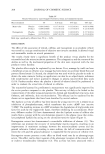
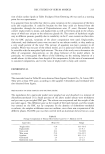
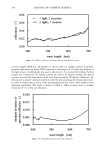
238 JOURNAL OF COSMETIC SCIENCE THEORY Human hair consists of the cuticle, cortex, and medulla. The cortex and medulla contain melanin, which provides the hair a particular color tone (4). Therefore, human hair can be considered as a heterogeneous substance (e.g., cortex, medulla) in which a coloring substance (e.g., melanin) is embedded. The reflective process of light on such a hetero- geneous substance is commonly expressed using a DRM (dichromatic reflection model) (3,5). DRM corresponds to the Phong's model in computer graphics, and is also called SRM (standard reflective model) or NIR (neutral interface reflection model). The method assumes that the reflective light from a heterogeneous substance can be described as a linear combination of two different reflective compositions, as shown in Figure 1. The first composition is called a specular reflection or an interface reflection, and is recognized as the color of the illumination light--the color of the composition reflected from the surface of the object, regardless of its color. The second composition, which corresponds to optical dispersion by coloring particles of matter, is called a diffuse reflection or an internal reflection, and is recognized as the object's color. In DRM, when a composition of specular reflection is Is and a composition of diffuse reflection is Id, the measuring value of a reflectance Ir is given as: Ir(0,)•) -- Is(0) + Id(0,)•) (1) A composition of specular reflection is expressed as: Is(0): (2) Generally, gloss of an object (luster) is expressed by the strength of compositions of specular reflection (6), and luster L is the same as the composition of specular reflection Is in equation 2, as follows: L(0) = Ir(0,}t) - Id(0,}t) (3) EXPERIMENTAL VERIFICATION OF THE DICHROMATIC REFLECTION MODEL IN HUMAN HAIR DRM is not effectuated in all objects. For example, a copper plate will have unique reflective characteristics, and will not apply to DRM. Therefore, it was necessary to confirm whether DRM would be effectuated in human hair. An important assumption of DRM is that spectrum compositions of a reflection are constant, even if there is any change in the measurement angle, since separation of wavelength and a geometric parameter is possible. By performing the examination on this point, it is possible to verify whether human hair can be described by DRM. The schematic representation of an optical system is shown in Figure 2. In our experiment, the reflectance of human hair was measured at the incident angle 0 of 45 degrees, with the receiving angle 0 changing from -20 degrees to 70 degrees. INFLUENCE OF ARRANGEMENT ANGLE OF HUMAN HAIR ON REFLECTANCE The influences on reflectance by an arrangement angle, which is made by the plane containing both light sources and a receiver, and the direction in which human hair

DEVICE TO MEASURE HAIR LUSTER 239 specular reflection incident light diffuse reflection vehicle colorant / Figure 1. Reflection process of heterogeneous material. flows, were examined. The schematic representation of an optical system is shown in Figure 3. The reflectance of human hair was measured under the condition of the incident angle 0 at 45 degrees, with the receiving angle qb changing from -20 degrees to 70 degrees and arrangement angles p of 0 degrees, 45 degrees, 90 degrees, and 180 degrees. EXAMINATION OF THE OPTICAL SYSTEMS In the actual measurement using DRM, it is necessary to measure both the surface brightness It, including diffuse and specular compositions, and the diffuse composition Ia'. If the measurement angle of Ir is set to 45 degrees, there is the possibility of light source receiver hair Figure 2. Structure of the experimental device.
Purchased for the exclusive use of nofirst nolast (unknown)
From: SCC Media Library & Resource Center (library.scconline.org)