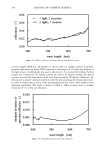
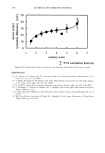
250 JOURNAL OF COSMETIC SCIENCE •, 50 40 • • 30 ß • • 20 = 10 o •'• 0 I I I I I 1 2 3 4 5 6 7 sensory score I' 95% confidence intervals Figure 20. Relationship between the sensory score of human hair luster and the device output. REFERENCES (1) A. Guiolet, J. C. Garson, and J. L. Levecque, Study of the optical properties of human hair, Int. J. Co.•met. Sci., 9, 111-124 (1987). (2) T. Maeda, M. Okada, H. Watanabe, and T. Hara, Measurements of hair luster by color image analysis, J. Sot'. Cosmet. Chem. Japan, 25,215-222 (1992). (3) S. A. Shafer, Using color to separate reflection components, Color Res. Appl., 10, 210-218 (1985). (4) Y. Watanabe, T. Tamura, H. Harada, and Y. Yagihara, Hair Science (Japan Hair Research Institute, Tokyo, 1986), pp. 3-15. (5) S. Tominaga and S. Ohhashi, A color reflection model for object surfaces, Trans. IPSJapan, 33, 37•45 (1992). (6) The Color Science Association of Japan, Ed., Handbook of Color Science, (University of Tokyo Press, Tokyo, 1980), pp. 625-644.

j. Cosmet. sci., 52, 251-253 (July/August 2001) Abstracts Journal of the Society of Cosmetic Chemists Japan Vol. 34, No. 3, 2000* Properties of Sugar and Its Derivatives and Their Application for Cosmetics Takeshi Ikemoto Cosmetics Laboratory, KANEBO Ltd. Many kinds of sugar derivatives have been used to various cosmetics, as for humectants and hydrophilic moieties of surfactants. It has been also interested in newly ones, such as trehalose, raftnose and xylitol. On the other hands, the important role of glycosides in the plant kingdom have been clarified by many of recent studies. It is also recognized that glycosides are desirable materials as for cosmetics, due to their hydrophilic and low-toxic properties. Several glycosides, alkyl glycoside, glucosides of hydroqinone and vitamin C had been already appeared in the market. In this article, it would be discussed about the possibilities of glycosides in the cosmetics field though the development of ethyl glucosides, eugenyl and raspberry ketone glucosides. Studies of Bisphenol A on In Vitro Percutaneous Permeation Hiroshi Tokunaga, Younson Chung, Tadasi Uchino, Masanori Ando National Institute of Health Sciences Permeation of bisphenol A (BA) through the skin imagined as one kind of the endcrine disruptores was investigated. After mounting the guinea-pig abdominal skin onto the Franz -type diffusion cell, add 10mM sodium dodecyl sulfate, 10 mM benzalkonium chloride (BK) or 0.5% polyoxyethylene (10)oleyl ether (POE.OE) solution in the donor side and stand for 2h at 32 øC. After eliminating the surfactant's solution from the donor side, add 0.05% BA solution. During 14 to 24h at 32øC, BA concentrations permeated into the receptor side were determined by HPLC. HPLC conditions were to use the column of Unisil Q C18 (4.6mm i.d.x 150mm), the mixture of water and acetonitrile (3:2) as mobile phase and the fluorometer (excitation wavelength:280nm, fluorescence wavelength:305nm). When the skins after treating with BK and POE.OE for 2h were compared with water, the flux of BA increased 1.6and 1.2times, respectively. In the case of the treatment of skin with the mixture of 0.05% BA and either BK or POE.OE, the flux of BA obtained from BK and POE.OE reduced 0.1 and 0.22 times, respectively. Facial Attractiveness and Its Recognition:Social Psychological Perspectives Ikuo Daibo Department of Social Psychology, Graduate School of Human Sciences, Osaka University Facial attractiveness is evaluated in terms of the physical features, and is affected by social context and essential culture in nature too. A lot of studies in the area of facial beauty have shown us that perceived beauty was influenced by the ethnical identity and the physiognomic features derived evolutionary adaptation. Japanese have remained to repress the expression of facial beauty and physical appearance since old times. They have attached importance to the general equality among people, but they have not denied the facial beauty. Japanese view of the facial beauty is different from European and other Asian. Japanese show the conformity and the collectivism. It is necessary to clarify the relationships between the physiognomic features and the communicative efficacy. * These abstracts appear exactly as they were originally published. They have not been edited by the Journal of Cosmetic Sdence. 251
Purchased for the exclusive use of nofirst nolast (unknown)
From: SCC Media Library & Resource Center (library.scconline.org)