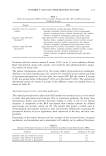
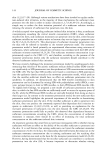
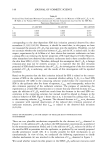
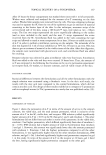
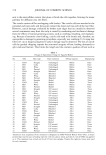
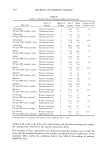
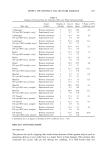
176 JOURNAL OF COSMETIC SCIENCE unit is the intercellular cement that glues or binds the cells together, forming the major pathway for diffusion into the fibers. The cuticle consists of flat overlapping cells (scales). The cuticle cells are attached at the proximal end (root end), and they point toward the distal end (tip end) of the hair fiber. However, cuticle damage evidenced by broken scale edges that can usually be observed several centimeters away from the scalp is caused by weathering and mechanical damage from the effects of normal grooming actions, such as combing, brushing, and shampoo- ing. Because of extensive cross-linking, cuticle cells tend to be brittle and, therefore, are susceptible to damage by grooming procedures, especially wet combing (1). In long hair fibers (25 cm or longer), progressive surface damage may be observed. The loss of cuticle cells by gradual chipping impairs the structural integrity of hair, leading ultimately to split ends and fracture. This limits the length and the cosmetic qualities of hair such as Table I Design of Experiment Using the Taguchi Model No. Oils Hair type Hair treatment Oiling sequence Shampooing 1 CNO Straight Undamaged Before Once 2 SFO Curly Undamaged Before Once 3 MO Wavy Undamaged Before Twice 4 MO Permed Undamaged Before Twice 5 CNO Straight Bleached Before Once 6 SFO Curly Bleached Before Once 7 MO Wavy Bleached Before Twice 8 MO Permed Bleached Before Twice 9 SFO Straight Boiled Before Twice 10 CNO Curly Boiled Before Twice 11 MO Wavy Boiled Before Once 12 MO Permed Boiled Before Once 13 SFO Straight UV-treated Before Twice 14 CNO Curly UV-treated Before Twice 15 MO Wavy UV-treated Before Once 16 MO Permed UV-treated Before Once 17 MO Straight Undamaged After Once 18 MO Curly Undamaged After Once 19 CNO Wavy Undamaged After Twice 20 SFO Permed Undamaged Afier Twice 21 MO Straight Bleached After Once 22 MO Curly Bleached After Once 23 CNO Wavy Bleached After Twice 24 SFO Permed Bleached After Twice 25 MO Straight Boiled After Twice 26 MO Curly Boiled After Twice 27 SFO Wavy Boiled Afier Once 28 CNO Permed Boiled After Once 29 MO Straight UV-treated After Twice 30 MO Curly UV-treated After Twice 31 SFO Wavy UV-treated After Once 32 CNO Permed UV-treated After Once Treatments were sequential. If the treatment is designated as CNO-Permed-Boiled-After-Once, it means permed hair was first put in boiling water for 120 min and air dried, and then 0.2 ml of CNO was applied to it. This treatment was carried out for all 25 hair tress samples. Twenty-five replicate tresses were used for each treatment.

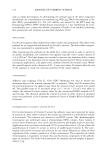
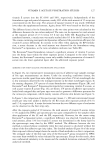
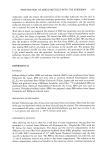
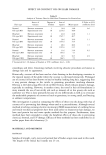
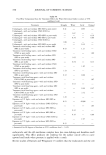
EFFECT OF COCONUT OIL ON HAIR DAMAGE 177 Table II Analysis of Variance Data for Half-Head Treatments for Protein Loss Hair type Source of Degrees of Sum of F-Value at 95% variance freedom squares Mean square confidence level Normal Oil type MO Bleached Oil type MO Normal Oil type SFO Bleached Oil type SFO Normal Oil type CNO Bleached Oil type CNO Between treatments Experimental error Between treatments Experimental error Between treatments Experimental error Between treatments Experimental error Between treatments Experimental error Between treatments Experimental error 1 34.8 34.8 o.6 38 2234.6 58.8 1 42.8 42.8 1.1 38 1545.7 40.7 1 39.6 39.6 1.1 38 1345.6 35.4 1 48.6 48.6 1.5 38 1195.6 31.5 1 31.6 31.6 6.2 38 195.6 5.1 1 36.5 36.5 4.9 38 286.5 7.5 F theoretical for 1.38 degrees of freedom at 95% confidence level = 4.08. smoothness and shine. Grooming methods involving abrasive procedures are known to damage hair and its appearance. Historically, coconut oil has been used as a hair dressing in the developing countries in the tropical regions of the globe where the coconut is cultivated extensively. Prolonged use of coconut oil has been known to lead to healthy looking long hair, suggesting that it may prevent damage to the cuticle in grooming procedures involving abrasion. Obvious is the lubricating effect of oil on fiber friction, which reduces abrasive damage, especially in combing. However, in modern times, the trend in hair oil formulations is more towards the use of non-sticky oils such as mineral oil or less greasy oils such as sunflower oil. This is done primarily because of cost differentials as well as to overcome the undesirable properties of coconut oil such as greasiness, its strong smell, and freezing at ambient temperatures. This investigation is aimed at comparing the effects of these two oils along with that of coconut oil in preventing hair damage when used as a preconditioner. Although several methods involving scanning electron microscopy (SEM) measurement of combing forces and tensile mechanical properties have been used earlier to characterize hair damage, we have used protein loss and water uptake methods for this purpose. Furthermore, these methods have been extended to study the beneficial effects of these oils in preventing chemical, thermal, and UV damage. Efficacy of these methods has been established in an earlier paper from this laboratory (3). MATERIALS AND METHODS MATERIALS Samples of straight, curly, wavy and permed hair of Indian origin were used in this work. The length of the Indian hair strands was 25 cm.
Purchased for the exclusive use of nofirst nolast (unknown)
From: SCC Media Library & Resource Center (library.scconline.org)