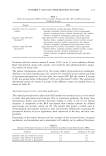
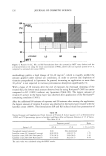
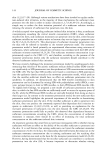
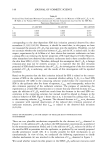
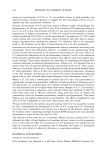
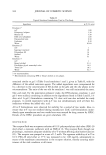
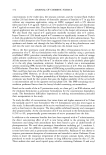
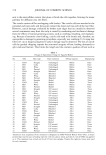
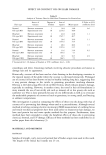
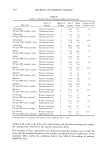
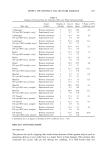
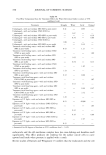
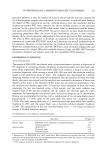
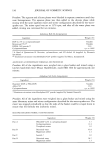
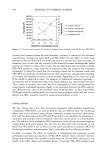
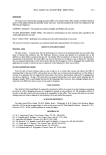
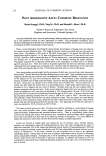
190 JOURNAL OF COSMETIC SCIENCE Table VI Pair-Wise Comparison Data for Treatment Effects for Water Retention Index (t-values at 95% confidence level) Treatment Straight Wavy Curly Permed 0.41 -- O.O9 Undamaged--with and without MO (MO as post-wash) Undamaged--with and without CNO (CNO as post-wash) Undamaged--with and without SFO (SFO as post-wash) Undamaged--with and without MO (MO as pre-wash) Undamaged--with and without CNO (CNO as pre-wash) Undamaged--with and without SFO (SFO as pre-wash) Treatment with boiling water--with and without MO (MO as post-wash) Treatment with boiling water--with and without CNO (CNO as post-wash) Treatment with boiling water--with and without SFO (SFO as post-wash) Treatment with boiling water--with and without MO (MO as pre-wash) Treatment with boiling water--with and without CNO (CNO as pre-wash) Treatment with boiling water--with and without SFO (SFO as pre-wash) Treatment with bleaching agent--with and without MO (MO as post-wash) Treatment with bleaching agent--with and without CNO (CNO as post-wash) Treatment with bleaching agent--with and without SFO (SFO as post-wash) Treatment with bleaching agent--with and without MO (MO as pre-wash) Treatment w•th bleaching agent--with and without CNO (CNO as pre-wash) Treatment with bleaching agent--with and without SFO (SFO as pre-wash) Exposure to UV light--with and without MO (MO as post-wash) Exposure to UV light--with and without CNO (CNO as post-wash) Exposure to UV light--with and without SFO (SFO as post-wash) Exposure to UV light--with and without MO (MO as pre-wash) Exposure to UV light--with and without CNO (CNO as pre-wash) Exposure to UV light--with and without SFO (SFO as pre-wash) 1.98 __ 0.43 1.43 0.12 1.45 0.21 O.43 1.87 -- -- -- -- O.36 O.34 -- O.O9 1.02 0.24 0.12 0.32 0.19 O.34 1.21 1.85 0.06 0.46 2.12 0.098 1.97 1.89 0.13 1.87 O.47 1.85 0.09 t theoretical for 48 degrees of f}eedom at 95% confidence level = 1.645. endocuticle and the cell membrane complex have less cross-linking and therefore swell significantly. This effect produces the tendency for the surface cuticle cells to curve upward and break when pressure is applied with a comb. Recent studies of Ruetsch and Weigmann (7) confirm that the endocuticle and the cell

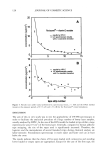
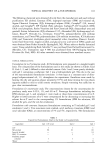
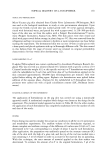
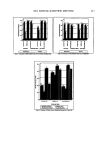
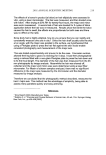
EFFECT OF COCONUT OIL ON HAIR DAMAGE 191 membrane complex (CMC) are the foci of weakness and that the cuticle cell often lifts and fractures when the fiber is extended. Chemical methods impair the adhesion by weakening the cell membrane complex between the cuticle cells. The degree of swelling of the cuticle layers is increased by disulfide cleavage and oxidation. This enhances the combing damage and protein loss, especially in wet combing, as observed in this study. Coconut oil is mostly a triglyceride of lauric acid and is hydrophobic. Application of coconut oil as a pre-wash conditioner coats the hair and inhibits the penetration of water into the hair. A small part of it is also absorbed into the hair during the wash when the fiber is swollen. Introduction of this hydrophobic component reduces the swelling propensity of the cuticle, which limits the upward curving of the surface cuticle. This reduces the chipping away of the cuticle cells, which reduces protein loss, as observed in this work. Because of the low molecular weight of coconut oil, it penetrates the cortex, whereas mineral oil, being a hydrocarbon, does not penetrate the hair at all. This has been shown in the earlier study (4). It is possible that sunflower oil does not penetrate the fiber because it has a bulkier structure as a result of double bonds in the fatty acid chain. Coconut oil triglyceride has a linear structure, which is why it solidifies at room temperature, whereas sunflower triglyceride has an irregular ball-like structure because the fatty acid chains fold on themselves due to one or two double bonds. This is why sunflower oil is a liquid at room temperature. It is likely that it does not penetrate the fiber as well as the coconut oil. This may be the reason why the WRI is low for coconut oil as compared to mineral and sunflower oils. CONCLUSIONS This study has firmly established the superiority of the protective effect of coconut oil on hair damage in grooming processes when it is used as a pre-wash conditioner as compared to mineral oil and other vegetable oils such as sunflower oil. It not only has a protective effect on undamaged hair but also on chemically treated hair, UV-treated hair, and hair treated with boiling water (i.e., hair in water at 100øC for 2 hr). The ability of coconut oil to penetrate into hair cuticle and cortex seems to be responsible for this effect. Coated on the fiber surface, it can prevent or reduce the amount of water penetrating into the fiber and reduce the swelling. This, in turn, reduces the lifting of the surface cuticle and prevents it from being chipped away during wet combing. A reduction in the WRI is additional evidence of its efficacy in decreasing water absorp- tion. The data presented in this work clearly show the superiority of coconut oil as a hair damage protectant, in the grooming of untreated or damaged hair. ACKNOWLEDGMENTS The authors thank the management of Marico Industries Ltd. for providing an oppor- tunity to work on this project, and Dr Yash Kamath, Director of Research, T.R.I., Princeton, New Jersey, for his valuable guidance in writing this paper. REFERENCES (1) M.L. Garcia and J. Diaz, Combability measurements on human hair, J. Soc. Cosmet. Chem., 27, 379-398 (1976).
Purchased for the exclusive use of nofirst nolast (unknown)
From: SCC Media Library & Resource Center (library.scconline.org)