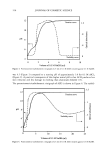
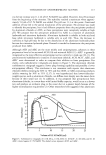
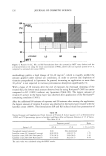
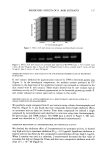
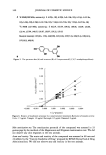
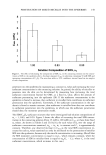
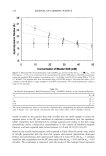
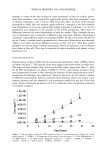
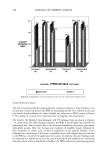
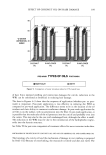
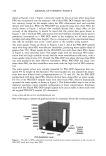
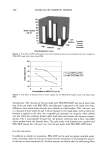
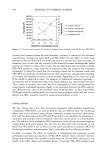
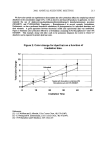
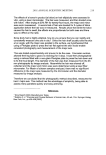
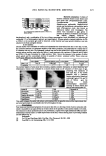
2002 ANNUAL SCIENTIFIC MEETING 213 We have also carried out experiments to demonstrate the color protection effects by employing selected absorbers in the concentration range 0.5% - 6.0% in leave-in and rinse-off products. In particular, we have explored the use of dodecyl-[3-(p-dimethylaminobenzamido)propyl] dimethylammonium p-tosylate (DDABDT), and PVP/DMAPMA Copolymer - Benzophenone-4 in several cosmetic formulations. Furthermore, we have performed theoretical calculations of photoprotection for individual absorbers and their mixtures. A good agreement between theoretical model and experimental data was established. Figure 2 illustrates color protection offered by a formulation containing 0.5% Benzophenone-3 and 0.5% DDABDT. This example, along with other work to be presented, illustrates the extent to which UV absorbers can be expected to protect dyed hair color. Figure 2: Color change for dyed hair as a function of irradiation time. 12 Untreated • Treated with formulation containing 0.5% • • Benzophenone-3 and 0.5% DDABDT. 10 0 10 20 30 40 Irradiation Time $0 References: [ 1 ] - L.J.Wolfram and L.Albrecht, J. Soc. Cosmet. Chem., 82, 179 (1987). [2] - E. Hoting and M. Zimmcnna• J. Soc. Cosrnet. Chern., 48, 79 (1997). [3] - F.W.Marschner and F. Schebece, USP 5, 045,307.

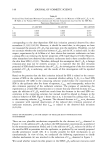
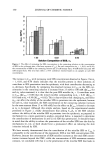
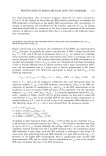
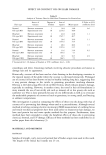
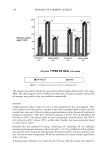
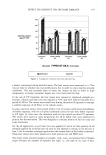
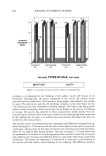
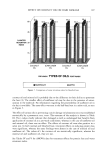
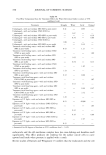
214 JOURNAL OF COSMETIC SCIENCE EFFECT OF MINERAL, SUNFLOWER AND COCONUT OIL ON PREVENTION OF HAIR DAMAGE Aarti S. Rele Marico Industries Ltd, Mumbai, India SYNOPSIS Previously published results showed that coconut oil application to hair prevents hair damage. Using the same methodology, the properties of mineral and sunflower oil on hair were studied. Taguchi Design of Experimentation was used to include all the variables and factors such as hair types, treatments, oils and to reduce experimentation, cost and effort without impacting the results. Among three oils, coconut oil was the only oil found to reduce the protein loss remarkably. (both as a pre/post-wash). This difference in results could be because of composition of each of these oils. Coconut oil, being a tri- glyceride of lauric acid has a high affinity for hair proteins, additionally low molecular weight and straight linear chain, enhances its penetration into the hair shaft. Mineral oil, being a hydro-carbon and sunflower oil, being a tri- glyceride of linoleic acid with a bulky structure (presence of double bonds), do not penetrate the hair. INTRODUCTION Morphologically, a fully formed hair fiber contains three and sometimes four different units or structures, i.e. cuticle, cortex, medulla and intercellular cement. Because of extensive cross-linking, cuticle cells tend to be brittle and therefore, are susceptible to damage by grooming procedures, especially wet combing (1). The loss of cuticle cells by gradual chipping impairs the cosmetic qualities of hair such as smoothness and shine. Grooming methods involving abrasive procedures are known to damage hair and its appearance. Historically, coconut oil has been used as a hair dressing in the developing countries in the tropical regions of the globe where coconut is cultivated extensively. Prolonged use of coconut oil has been known to lead to healthy looking long hair, suggesting that it may prevent damage to the cuticle in grooming procedures involving abrasion. However, in modem times, the trend is more towards usage of non-sticky oils such as mineral oil or less greasy oils such as sunflower oil in hair oil formulations. This investigation is aimed at comparing the effects of these two oils along with that of coconut oil in preventing hair damage. Although, several methods involving scanning electron microscopy (SEM), measurement of combing forces and tensile mechanical properties have been used earlier to characterize hair damage, we have used protein loss and water uptake methods for this purpose. Furthermore, these methods have been extended to study the beneficial effects of these oils on in preventing chemical, thermal and UV damage. Efficacy of these methods has been established in an earlier paper from this laboratory (3). MATERIALS AND METHODS MATERIALS Samples of straight, curly, wavy and perm hair of Indian origin, 25cm in length were used in this work. For each of the treatment per hair type, 25 hair tresses were used. The reagents for protein estimation were obtained from Sigma Chemicals Co. of St. Louis, MO. The other reagents such as buffers, salts, etc were of analytical grade. Whereas the oil samples were the way they are available commercially. SAMPLE PREPARATION Hair tresses of 34-0.5 g were prepared for this investigation. They were standardized. Both Undamaged and damaged hair tresses were used. The damaging treatments were Bleaching, UV and boiling water treatment. These hair tresses were treated both before (pre) and after (post) these treatments with coconut/mineral/sunflower oil. The entire study involved a large no. of variables such as oils, hair types, oiling sequence, etc. resulting in quite complex study. In order to simplify the complexity of the experiment without compromising on the quality of results, a statistical tool termed as Taguchi Design Of Experimentation was used.
Purchased for the exclusive use of nofirst nolast (unknown)
From: SCC Media Library & Resource Center (library.scconline.org)