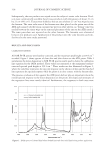
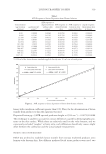
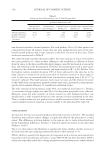
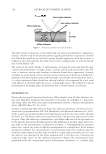
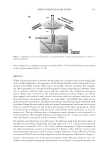
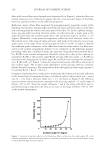
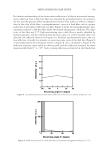
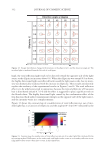
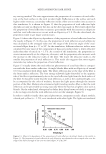
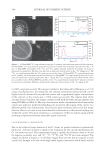
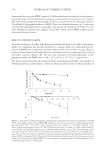
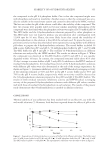
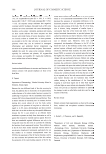
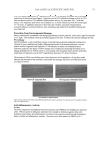
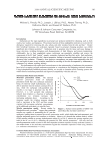
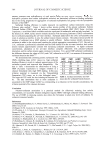
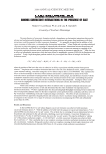
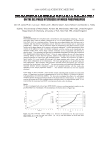
JOURNAL OF COSMETIC SCIENCE 332 hand, the total refl ection light tends to be directed toward the opposite side of the light source as the ellipticity increases above 0.6. When the ellipticity was around 0.9 or above, the highly directional light was refl ected back toward the light source side, but its inten- sity was dramatically weakened with the increase in ellipticity. These results satisfactorily explain the tendency of the experimental results in Figures 5 and 6. The total refl ection effect is to be widely perceived in appearance because the typical ellipticity of Caucasian hair is distributed around 0.7 (14) and the effect is suggested to play a signifi cant role on the blonde shine. The highly directional light caused by the condensation effect of the lens function (back surface transmission) emerges on the opposite side of the light source, and the intensity varies in a complex manner. Figure 13 shows the contour map of a number ratio of total refl ection rays out of inci- dent light fl ux as a function of ellipticity and the angle φ (0° ≤ φ ≤ 90°) obtained by the Figure 12. Energy distribution change with variations in the ellipticity, E, and the direction angle, φ. The incident light is irradiated from the left side of each fi gure. Figure 13. Contour map of a number ratio of total refl ection rays out of incident light fl ux calculated by the ray-tracing method. Refl ectance at the surface and such higher order events as a secondary refl ection occur- ring inside a fi ber are not taken into account in this simulation.

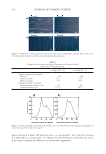
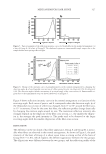
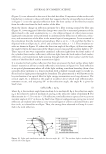
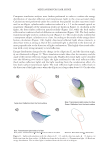
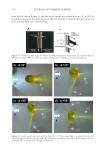
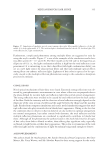
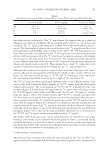
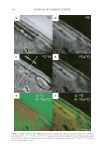
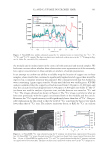
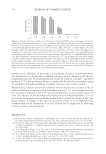
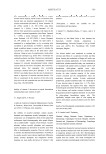
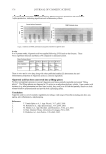
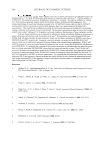
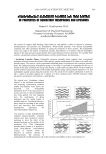
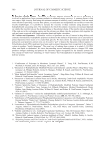
MECHANISM FOR HAIR SHINE 333 ray-tracing method. The ratio approximates the proportion of occurrence of total refl ec- tion at the back surface in the total incident light. Refl ectance at the surface and such higher order events as a secondary refl ection inside a fi ber are not taken into account in this simulation. It is shown in Figure 13 that the proportion of total refl ection light depends not only on ellipticity but also on the direction angle, φ. The results show that the proportion of total refl ection occurrence gets smaller with the increase in ellipticity and that total refl ection never occurs with an ellipticity of 1.0. On the other hand, the proportion tends to get larger as φ increases. Figure 14 shows the ellipticity dependence of the proportions of total refl ection based on the results in Figure 13. In this case, the proportion of total refl ection at each ellipticity was calculated as the averaged value over the range of the direction angle of the cross- sectional ellipse from φ = 0° to 90°. In the simulation, different refractive indices were calculated because most of the components of hair-care products have a lower refractive index than that of cuticle (n = 1.54). As a result of the simulation, the proportion in- creases monotonically as the ellipticity decreases, and the proportion also increases with the increase in the refractive index of the fi ber. The lower the refractive index is, the smaller the proportion of total refl ection is. This result also suggests that most organic materials may reduce the proportion of total refl ection. Figure 15 visually shows the total refl ection phenomenon of a real hair fi ber in compari- son with the front surface refl ection. A single blonde fi ber with an ellipticity of around 0.63 was irradiated with white light. The white refl ection line at the edge of the fi ber is the front surface refl ection. The very strong yellowish light observable at the opposite side of the fi ber is predominantly due to the total refl ection light from the back surface of the fi ber. It should be noted that the total refl ection, as well as the condensed light, is to be accompanied by the color of melanin, because the light passes through the interior portion of the fi ber. Melanin also attenuates light traveling inside a fi ber so that the total refl ection can be perceivable as strong rays only when the hair has a lighter color such as blonde. On the other hand, absorption by darker hairs (from brown to black) is supposed to be too large even for the total refl ection to let out (for example, Figure 9). In order to exhibit visually these optical phenomena, transparent acrylic elliptic models, colored pale yellow (n = 1.50), were irradiated with white light. The light was irradiated Figure 14. Ellipticity dependence of the proportions of total refl ection calculated, based on the results in Figure 13. The proportion of total refl ection at each ellipticity was obtained as the averaged value over the range of the direction angle of the cross-sectional ellipse, 0° ≤ φ ≤ 90°.
Purchased for the exclusive use of nofirst nolast (unknown)
From: SCC Media Library & Resource Center (library.scconline.org)