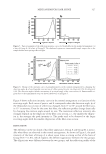
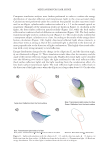
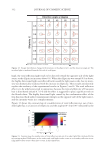
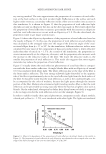
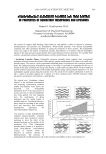
MECHANISM FOR HAIR SHINE 335 Figure 17. Simulation of multiple optical events among the acrylic fi ber models (ellipticity of the left model: 0.9 of the right model: 0.7). The incident light is irradiated from the left side. IL: incident light. TR: total refl ection. LC: light condensation. Furthermore, complicated phenomena among multiple fi bers are suggested to exist by using the acrylic models. Figure 17 is one of the examples of the simulation results for a two-fi ber system (E = 0.7 and 0.9). The fi ber model on the left side in the fi gure has an ellipticity of 0.9, i.e., the light condensation ability is high but the total refl ection is not pronounced. It is interesting to see that a hair fi ber with light condensation ability can act as a new light source for adjacent hair fi bers and that such multiple optical effects among fi bers can enhance refl ection light. Lightness of hair color is expected to be espe- cially crucial to the multiple-refl ection phenomenon owing to the cumulative absorption processes by melanin. CONCLUSIONS Novel optical mechanisms of hair shine were found. Extremely strong refl ections were ob- served by goniophotometric measurements in cases where a fi ber was set perpendicular to the plane defi ned by incident light and refl ection light (the normal optical arrangement). The strong refl ections were revealed to be caused by total refl ection from the back surface of the fi ber. Both the intensity and the direction of total refl ection strongly depend on the ellipticity of the cross section of a fi ber and the angle between the ellipse and the incident light. Results from computer simulations and acrylic model simulations suggest that mul- tiple refl ections also play essential roles in blonde hair’s appearance. Owing to the fact that the conditions that we observe in hair in daily life are due neither to coplanar arrangement nor normal arrangement, but rather contain both elements, the total refl ection and the multiple refl ection phenomena are considered to signifi cantly contribute to blonde hair shine. Although all the phenomena the authors found in this work hold true for all types of hair color, from dark to blonde or white, these effects plays signifi cant roles, especially on blonde to light brown or white hair’s appearance. This is due to attenuation of the total refl ection light and the condensation of light by melanin being small enough to observe. ACKNOWLEDGMENTS The authors thank Dr. Naohisa Kure, Mr. Satoshi Onitsuka of Kao Corporation, Mr. Dave Muenz, Ms. Cony Weaver, and Ms. Heather Bryer for their strong support for the study.

JOURNAL OF COSMETIC SCIENCE 336 The authors owe thanks to Dr. Steven Breakspear of Kao Corporation for his valuable comments and advise on this paper. The authors are also obliged to Ms. Masae Sakaguchi for taking the beautiful fi ber picture of total refl ection. REFERENCES (1) P. Henry, Br. J. Appl. Phys., 4, 531 (1953). (2) T. L. Ward and R. R. Benerito, Correlation of visual luster with measured refl ectance of cotton fabrics, Textile Res. J., 35, 271 (1965). (3) L. Fourt, Improvement of luster of wool fabrics, Textile Res. J., 36, 915 (1966). (4) W. Thompson and C. Mills, Proc. Sci, Sect. T.G.A., No. 15 (1951). (5) R. F. Stamm, M. L. Garcia, and J. J. Fuchs, The optical properties of human hair. I. Fundamental con- siderations and goniophotometer curves, J. Soc. Cosmet. Chem., 28, 571 (1977). (6) R. F. Stamm, M. L. Garcia, and J. J. Fuchs, The optical properties of human hair. II. The luster of hair fi ber, J. Soc. Cosmet. Chem., 28, 601 (1977). (7) W. J. Conover, Practical Nonparametric Statistics (John Wiley & Sons, New York, 1980), p. 299. (8) J. H. S. Rennie, S. E. Bedford, and J. D. Hague, A model for the shine of hair arrays, Int. J. Cosmet. Sci., 19, 131 (1997). (9) C. Reich and C. R. Robbins, Light scattering and shine measurements of human hair: A sensitive probe of the hair surface, J. Soc. Cosmet. Chem., 44, 221 (1993). (10) R. Meredith and J. W. S. Hearle, Physical Methods of Investigating Textiles (Interscience, New York, 1959), Ch. 12. (11) H. K. Bustard and R. W. Smith, Investigation into the scattering of light by human hair, Appl. Optics, 30, 3485 (1991). (12) W. Czepluch, G. Hohm, and K. Tolkiehn, Gloss of hair surfaces: Problems of visual evaluation and pos- sibilities for goniophotometric measurements of treated strands, J. Soc. Cosmet. Chem., 44, 299 (1993). (13) N. Shinobu, S. Shibuichi, A. Kenichi, K. Emiko, and S. Naoki, Infl uence of internal structure of hair fi ber on hair appearance. I. Light scattering from the porous structure of the medulla of human hair, J. Cosmet. Sci., 53, 89 (2002). (14) N. Shinobu, S. Naoki, and N. Koichi, Infl uence of internal structure of hair fi ber on hair appearance. II. Consideration of the visual perception mechanism of hair appearance, J. Cosmet. Sci., 53, 387 (2002). (15) O. Masayuki, Y. Ryoko, M. Akira, I. Shigeto, N. Shinobu, S. Shibuichi, K. Emiko, and S. Naoki, Infl u- ence of internal structure of hair fi ber on hair appearance. III. Generation of light-scattering factors in hair cuticles and the infl uence on hair shine, J. Cosmet. Sci., 54, 353 (2003). (16) S. Satoshi, S. Hirayuki, W. Shunsuke, K. Tetsuya, and S. Naoki, Mechanism of blonde hair appearance, 14th International Hair-Science Symposium, ‘HairS’ 05, 2005. (17) A. Franbourg, P. Hallegot, F. Baltenneck, C. Toutain, and F. Leroy, Current research on ethnic hair, J. Am. Acad. Dermatol., 48, S115 (2003).
Purchased for the exclusive use of nofirst nolast (unknown)
From: SCC Media Library & Resource Center (library.scconline.org)