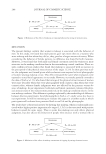
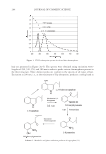
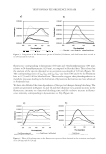
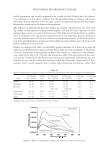
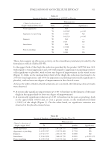
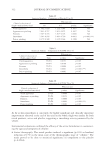
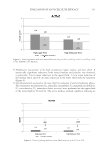
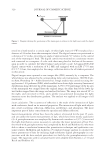
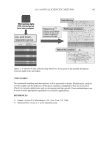
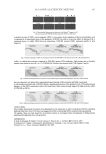
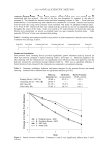
TRYPTOPHAN FLUORESCENCE IN HAIR 295 335–350 nm, which corresponds to the fl uorescence of Trp (2). The maximum of this peak shifts towards shorter wavelength with a decrease of melanin pigmentation. The emissions at 420 nm, 465 nm, and 495 nm are due to N-formylkynurenine, kynurenine, and 3-hydroxykynurenine, respectively (7–14). The peaks from 3-hydroxykynurenine and L-kynurenine were previously identifi ed by comparing the spectrum of hair with the spectra of pure solid L-kynurenine (emission maximum at 465 nm) and 3-hydroxykynure- nine (emission maximum at 495) (14,15). The emission peak at 395 nm, evident in spectra obtained by a double-grating instrument, was not identifi ed. It should be pointed out that all types of the investigated hair, including Chinese hair not shown in Figure 2, share similar emission characteristics with the most prominent emission peaks corre- sponding to Trp and kynurenines. Figure 2. Fluorescence spectra of (a) white hair, (b) Piedmont hair, (c) blonde hair, (d) brown hair, (e) African hair, and (f ) bleached hair.

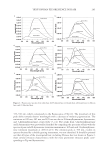
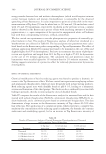
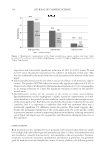
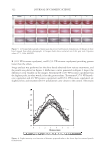
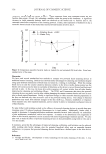
JOURNAL OF COSMETIC SCIENCE 296 The emission spectra of the solid samples of three different melanins, including sepia, synthetic melanin, and lipomelanin, are very similar and show a relatively weak fl uores- cence with small maxima at 417, 468, and 609 nm for an excitation wavelength of 380 nm. The strongest band has a maximum at 417 nm and is characterized by intensity in the range of 1-2⋅105 cps depending on the melanin sample. The analysis of the spectra obtained at excitation wavelengths of 290, 320, and 350 nm did not show any additional features of the fl uorescence characteristics of melanin (15–17). Considering the relatively low intensity of the fl uorescence of intact melanin, it can be probably assumed that its direct contribution to the emission characteristics of hair is minor. On the other hand, it may be expected that the high incident light absorption by melanin pigment and its high concentration in dark-colored hair can signifi cantly reduce the emission intensity of pro- tein chromophores such as Trp and the kynurenines. The above hypothesis evolved from experimental data showing that the intensity of the fl uorescence emission from unpigmented hair is much higher than that from pigmented hair (14). For Trp emission due to excitation at 290 nm, the maximum fl uorescence in- tensity is 1.2⋅106, 6.1⋅105, and 6.6⋅105 cps for unpigmented, dark brown, and black- colored hair, respectively. For spectra obtained at higher excitation wavelengths, the difference in emission intensity between unpigmented and pigmented samples is even larger. For an excitation wavelength of 350 nm, the emission intensities at 420 nm (as- cribed to N-formylkynurenine) were 1.4⋅107, 9.0⋅105, and 1.1⋅106 cps for Piedmont, dark brown, and black-colored Chinese hair, respectively. The spectral features of bleached hair excited at 290 nm include a band at 345 nm, with a maximum intensity of 1.1⋅106 cps corresponding to the emission of Trp, and broad peak with a maximum at 435 nm and an intensity of 1.7⋅106 cps (Figure 2f). The shape of this peak suggests that it consists of several bands including those corresponding to the kynurenines (420 nm and 465 nm) and possibly due to melanin decomposition products as well. It was reported that the melanin intermediates formed as a result of its bleaching (and solubilization) by the reaction with hydrogen peroxide were found to be highly fl uo- rescent (15–17). Since the melanin decomposition products are present in bleached hair, as evident by the thermally induced re-melanization reaction, they can probably contrib- ute to the observed emission band at 435 nm. Similar to the spectrum of Piedmont hair, the intensity of this peak increases to 6.27⋅106, 1.6⋅107, and 2.1⋅107 cps for excitation wavelengths of 320, 350, and 380 nm, respectively. Further analysis of bleached hair was carried out by using a double-grating fl uorescence instrument, which provides higher resolution spectra than a traditional, single-grating spectrophotometer. A comparison of the fl uorescence spectra of bleached, Piedmont, and dark brown hair, obtained by excitation at 290 and 320 nm, is shown in Figures 3a and 3b. It should be noted that these results were obtained for so-called blended hair, i.e., hair collected from many individuals. The spectra show Trp and kynurenine bands with a high ratio of kynurenine/Trp (I440/I356=1.78) for yellow-colored Piedmont hair. This value is as high as the highest ratio previously recorded for unpigmented hair collected from a single panelist. As shown previously for a population of eleven panelists, this ratio can vary from 0.36 to 1.78 and is probably related to environmental and metabolic fac- tors. For the blended dark brown hair employed in the present work, the ratio, I440/I356, was 0.6—approximately in the middle of the range of values previously recorded for pig- mented hair derived from a single panelist (14). In the case of bleached hair, the ratio I440/ I356 was 0.78. It should also be pointed out that Piedmont hair emits higher intensity
Purchased for the exclusive use of nofirst nolast (unknown)
From: SCC Media Library & Resource Center (library.scconline.org)