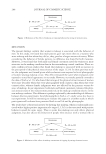
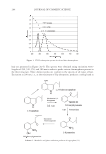
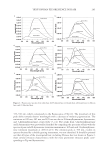
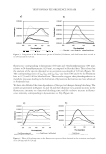
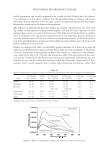
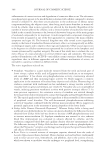
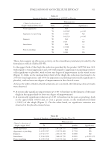
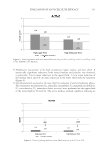
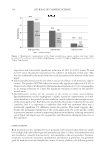
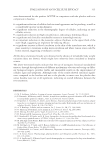
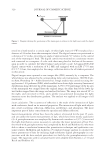
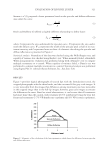
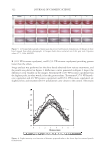
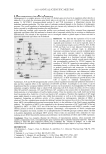
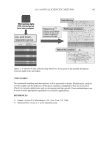
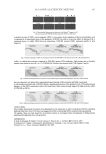
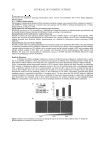
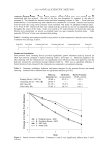
TRYPTOPHAN FLUORESCENCE IN HAIR 297 fl uorescence corresponding to kynurenine (460 nm) and 3-hydroxykynurenine (495 nm), relative to N-formylkynurenine (420 nm), as compared to bleached hair. This is based on the analysis of the spectra obtained at an excitation wavelength of 320 nm (Figure 3b). The corresponding ratios of I460/I420 and I495/I420 vary from 0.86 and 0.52 for Piedmont hair to 0.79 and 0.46 for bleached hair. These results suggest that photodegradative or metabolic processes leading to the formation of kynurenine derivatives are more advanced in Piedmont hair. We have also followed the time dependence of the spectral changes during bleaching. The results are presented in Figures 4a and 4b and they illustrate (a) a general increase in the fl uorescence intensity as a function bleaching time and (b) a relative increase in fl uores- cence intensity corresponding to kynurenines vs. Trp (Figure 4a). Figure 3. Comparison of the fl uorescence spectra of bleached, Piedmont, and dark brown hair excited at (a) 290 nm and (b) 320 nm. Figure 4. Effect of bleaching time on the fl uorescence spectra of hair obtained at the excitation wavelength of (a) 290 nm and (b) 320 nm.

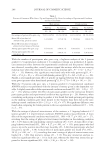
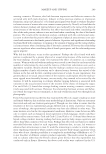
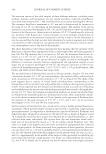
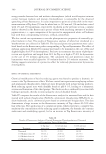
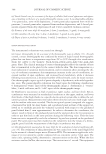
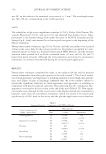
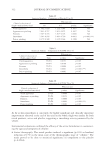
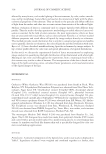
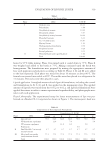
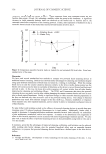
JOURNAL OF COSMETIC SCIENCE 298 FLUORESCENCE ANALYSIS OF PHOTO AND THERMAL DEGRADATION OF HAIR Figure 5 presents emission spectra of intact and photo-exposed Piedmont hair, which were obtained at an excitation wavelength of 290 nm. A decrease in the intensity of the peaks at 350 nm (43%), 420 nm (27%), and 465 nm (23%) as a result of 24-hour irra- diation in a weatherometer is evident, suggesting photodecomposition of Trp and the kynurenines. It should be noted that a decrease in the Trp emission is signifi cantly larger than the corresponding reductions in the intensity of the peaks at 420 and 465 nm, which may be related to the phenomenon that kynurenines are fi rst formed as a result of Trp photo-oxidation reactions before undergoing subsequent photodecomposition. Further examination of fl uorescence spectra obtained at an excitation wavelength of 350 nm con- fi rms the decomposition of kynurenines by showing reductions of peak intensities at 420 nm (12%) and 465 nm (17%). Similar trends were observed in the spectra of Piedmont hair subjected to thermal treatment with hot irons at 160°C (15,19). A decrease in the intensity of peaks corresponding to both Trp and kynurenine emissions was observed. In the case of thermally treated hair (160°C for 30 minutes), an increase in the ratio of I465/ I420 (from 1.12 for intact hair to 1.37 for thermally treated hair, as calculated from the spectra obtained at an excitation wavelength of 290 nm) was noted, which may refl ect predominant formation of kynurenine, which could in turn be responsible for the yellow coloration of thermally treated Piedmont hair. The results of the fl uorescence analysis of photodegradation of various types of hair as a result of irradiation for 72 hours are collected in Table II. White and Piedmont hair showed the largest loss of Trp fl uorescence (in the range of 56.7% to 64.8%), while the corresponding decreases for highly pigmented dark brown and Asian hair were signifi - cantly smaller (47.7% to 42.9%). For kynurenines, the fl uorescence decreases were smaller especially for highly pigmented Chinese and dark brown hair. It should also be men- tioned that for dark brown and black Chinese hair the analysis of the spectra resulting from excitation at 350 nm actually shows an increase in the intensity of the peaks as- cribed to kynurenines (for dark brown hair, an increase of 11% and 14% at 420 and 465 nm, respectively). This result may suggest that the melanin, present in dark-colored hair, offers selective photoprotection to kynurenines by decreasing the extent of their photode- composition. It should also be added that the dark brown hair employed in this work was Figure 5. Comparison of the fl uorescence spectra of Piedmont hair, untreated and irradiated for 24 hours.
Purchased for the exclusive use of nofirst nolast (unknown)
From: SCC Media Library & Resource Center (library.scconline.org)