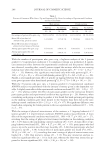
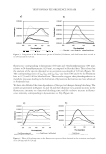
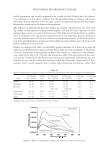
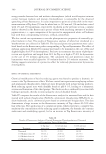
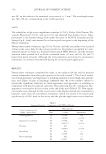
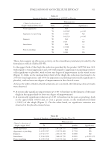
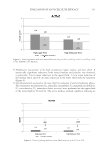
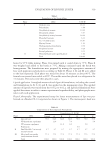
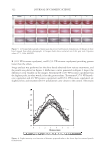
EVALUATION OF LIPSTICK LUSTER 323 Table III Luster Parameters of Evaluated Lipstick Formulations Control A B C D E F Mean ± SD Mean ± SD Mean ± SD Mean ± SD Mean ± SD Mean ± SD Mean ± SD Specular 1038.70 60.34 1081.78 14.86 1153.39* 48.32 1074.52 14.65 1028.80 31.03 1131.93* 23.95 1102.88 8.15 Diffuse 856.44 101.88 835.55 19.23 844.75 37.17 852.62 14.50 846.58 20.07 851.09 46.38 841.94 4.09 Peak 197.54 9.83 214.07 3.67 242.25* 2.19 217.01 1.41 197.89 7.02 230.63* 8.11 213.96 5.44 Max width 3.37 0.45 3.52 0.16 3.05 0.24 2.92 0.25 3.23 0.31 3.29 0.41 3.69 0.11 L Stamm 0.18 0.05 0.23 0.02 0.27* 0.01 0.21 0.01 0.18 0.02 0.25 0.03 0.24 0.01 LR-R 0.36 0.03 0.37 0.02 0.45* 0.03 0.43 0.03 0.38 0.04 0.39 0.01 0.36 0.01 *Treatments statistically signifi cant from the control at p 0.05. seem to be in agreement with the visual differences depicted among treatments, but a more rigorous analysis was needed. Luster parameters for the various formulations evaluated were calculated using equations 1 and 2, and the results are displayed in Table III. The results shown represent average and standard deviation values obtained from four separate measurements for each treat- ment. The results for the peak height were 197.54, 242.25, 214.07, 217.01, 197.89, 230.63, and 213.96 for the control and formulations A, B, C, D, E, and F, respectively. The two treatments that had the highest peaks and were statistically different from the control were treatments B (11% VP/eicosene copolymer) and E (5% VP/eicosene copoly- mer). The rest of the treatments, although visually different, were not statistically differ- ent from the control. Both luster parameters were calculated: LStamm and LR-R. The values for LStamm were 0.18, 0.27, 0.23, 0.21, 0.18, 0.25, and 0.24 for the control and formula- tions A, B, C, D, E, and F, respectively. The values for LR-R were 0.36, 0.45, 0.37, 0.43, 0.38, 0.39, and 0.36 for the control and formulations A, B, C, D, E, and F, respectively. The only treatment that was statistically different from the control in both luster param- eters was treatment B (11% VP/eicosene copolymer). DISCUSSION It appears from the results obtained thus far that the addition of VP/eicosene copolymer to lipstick formulations increases their shine. The incremental increase in shine is concen- tration-dependent, as the lipstick containing 11% has more shine than the one contain- ing 5% only. The addition of polybutene to lipstick has a very small contribution to shine compared to the control. On the other hand, the addition of VP/hexadecene copolymer contributed to the overall shine but was not as effective as the addition of VP/eicosene copolymer. The abilities of the two polymers, VP/hexadecene and VP/eicosene, to impart shine in lipstick formulations in two different capacities led us to pay more attention to their chemical structures. They are both derived from VP and long-chain alpha olefi ns how- ever, they do not have the same alkyl chain length, degree of alkylation, or molecular

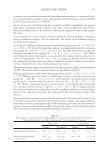
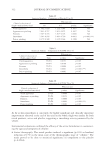
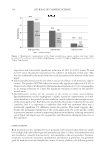
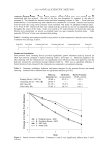
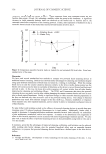
JOURNAL OF COSMETIC SCIENCE 324 weight. These polymers are often used as pigment dispersants and fi lm formers. If the addition of a polymer helps create a better pigment dispersion, the formulation will have better shine since shine is more visible in darker shades than in lighter ones. Our insight to identify their mode of action led us to calculate RGB values for all formulations used, to evaluate if pigment dispersion was a factor. These data are displayed in Table IV and plotted in Figure 5. RGB values of lips treated with different lipstick formulations were obtained by image histogram analysis. Averages and standard deviations of the RGB values displayed were obtained from four separate treatments for each formulation. Total RGB values for the control and formulations A, B, C, D and E were 275.0, 221.6, 209.1, 196.1, 213.2, and 222.4, respectively. Only two formulations were statistically different from the control: formulations B (11% VP/eicosene) and C (7% VP/hexadecene copoly- mer and 4% VP/eicosene copolymer). CONCLUSIONS Based on the results obtained in this study, we can conclude that both of the tested VP-containing polymers are good pigment dispersants and will contribute to visually detected shine from lipsticks. The method presented in this paper could help researchers screen formulations for their optical properties. Table IV RGB Values of Evaluated Lipstick Formulations Control A B C D E F Mean ± SD Mean ± SD Mean ± SD Mean ± SD Mean ± SD Mean ± SD Mean ± SD Red 136.4 3.0 117.9 6.20 112.2* 2.3 106.89* 0.7 114.7 3.6 120.9 1.9 119.0 2.2 Green 61.2 3.5 45.7 5.54 42.2 3.2 39.09* 0.4 41.1* 3.4 47.8 2.2 44.6 1.0 Blue 77.3 1.9 58.1* 5.49 54.8* 2.4 50.15* 1.2 57.1* 3.4 62.3 0.7 58.80* 1.4 Total 275.0 8.3 221.6 17.07 209.1* 7.8 196.13* 2.1 213.2 10.3 231.0 4.6 222.4 4.6 *Treatments statistically signifi cant from the control at p 0.05. Figure 5. A comparison of different treatments based on the total RGB values of lipsticks. *Treatments statistically signifi cant from the control at p 0.05.
Purchased for the exclusive use of nofirst nolast (unknown)
From: SCC Media Library & Resource Center (library.scconline.org)