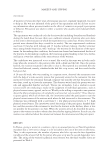
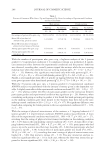
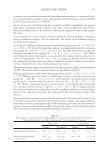
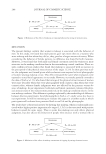
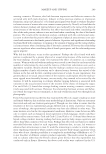
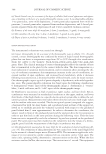
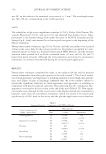
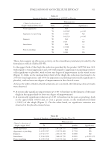
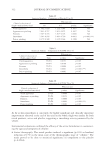
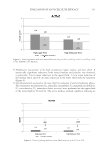
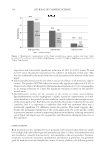
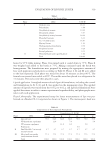
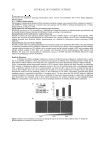
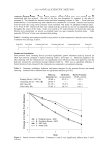
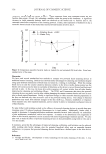
MAKEUP AND TIPPING 287 In order to test the relation between the three independent variables, correlational analy- ses were performed according to participant gender and experimental condition. Results of the analyses are presented in Table II. As we can see, the relation between the dependent variables is signifi cant and positive only when considering men’s behavior and their rating of physical attractiveness, whereas for women, most of the relations, although non-signifi cant, went in the opposite direction. To test whether the rating of attractiveness mediates the effect of makeup on tipping, a statistical mediation analysis (10) was performed. The results of the mediation analysis are illustrated in Figure 1. As can be seen, makeup signifi cantly correlated with tipping behavior (B = .15, ES = .07, t = −1.99, p = .05). It was also found that makeup was signifi cantly related to attractive- ness ratings (B = 1.05, ES = .13, t = 8.43, p .001) and that attractiveness ratings sig- nifi cantly correlated with tipping (B = .18, ES = .04, t = 4.10, p .001). When controlling the attractiveness rating, it was observed that makeup did not appear to cor- relate with tipping (B = .04, ES = .08, t = .47, ns), suggesting that the relation between the independent variable (make up condition) and the dependent variable (tipping behav- ior) was mediated by the attractiveness rating of the waitress. The same mediation analysis was performed with the amount of tipping as the dependent variable. The results of the mediation analysis are illustrated in Figure 2. Makeup signifi cantly correlated with the amount of the tip (B = .42, ES = .16, t = −2.59, p = .02). Makeup was also found to significantly correlate with the attractiveness rating (B = 1.08, ES = .19, t = 5.57, p .001) and that the attractiveness rating significantly correlated with the amount of the tip (B = .29, ES = .09, t = 3.14, p .01). When controlling the attractiveness rating, it was shown that makeup did not correlate with the amount of tip (B = .12, ES = .18, t = .66, ns) suggesting that the relation between the independent variable (makeup condition) and the depen- dent variable (amount of tipping) was mediated by the attractiveness rating of the waitress. Separate mediation analyses were performed with male and female patron data. It was found that attractiveness mediated the relation between makeup and tipping behavior only when considering male patron data both with tipping behavior and the amount of tipping. However, such a mediating effect was not found when considering female patron data, with both the two latter dependent variables considered. Table II Bravais-Pearson Correlation Between Tipping Behavior, Amount of Tip, and Rating of the Waitress’s Physical Attractiveness According to Experimental Condition and Sex of Customer Male patrons Female patrons Makeup No makeup Makeup No makeup Tipping/physical attractiveness r(56) = .27 r(52) = .40 r(28) =.34 r(30) =−.12 p = .04 p. .005 ns ns Amount of tipping/physical attractiveness r(30) = .49 r(17) =.82 r(8) = −.49 r(7) = −.38 p .005 p .001 ns ns

JOURNAL OF COSMETIC SCIENCE 288 DISCUSSION The present fi ndings confi rm that women’s makeup is associated with the behavior of men. In this study, we found that male patrons gave tips more often to a waitress who wore makeup and that when they did so, they gave her a larger amount of money. When considering the behavior of female patrons, no difference was found for both measures. However, it was found that both male and female customers rated the waitress as more attractive in the makeup condition than in the non-makeup control condition. These re- sults confi rm previous studies that found that makeup is associated with an increase in the perception of the physical attractiveness of the target (1,3,4). In these previous stud- ies, the judgment was formed/given while evaluators were exposed to facial photographs of women wearing makeup or not. This effect remained the same when evaluators were exposed to actual facial appearance in our study. However, our results partially contradict the data of Cash et al. (5), who found that ratings of the physical attractiveness of women were more favorable when they were photographed with cosmetics than when they were cosmetics-free, whereas female judgments were not affected by the presence versus ab- sence of makeup. In our experiment, both male and female customers evaluated the phys- ical attractiveness of the waitress more positively in the makeup condition relative to the non-makeup condition. This difference is perhaps explained by the methodological difference between the two experiments: facial photographs in Cash et al.’s study versus live faces in our experiment. It will be interesting to evaluate this aspect in a further study in which participants will evaluate faces presented both in real life and by photographs. The results have a theoretical interest by showing that makeup, which is traditionally asso- ciated with a higher positive impression of a target (1,3,5,6). is also associated with positive behavior toward the same target. Thus it seems that makeup not only affects physical judgment, but also affects the behavior of people who interact with a woman who is Figure 1. Mediation of the effect of makeup on tipping behavior by rating of attractiveness. Figure 2. Mediation of the effect of makeup on amount of tipping by rating of attractiveness.
Purchased for the exclusive use of nofirst nolast (unknown)
From: SCC Media Library & Resource Center (library.scconline.org)