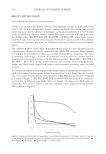
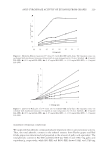
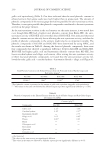
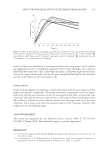
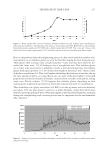
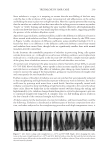
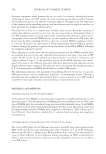
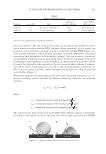
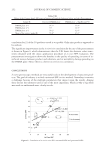
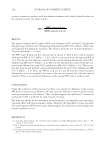
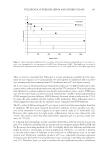
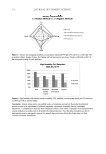
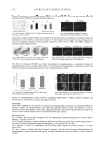
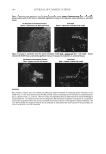
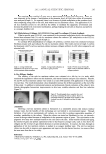
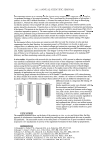
TREHALOSE IN HAIR CARE 237 Here it is hypothesized that the straightening process of a hair switch soaked in trehalose solu- tion produces in situ trehalose glasses on or in the hair fi ber during the heat drying process. These glasses then scavenge water at high humidity—water that may have otherwise dis- turbed the “water wave” (15,16) leading to loss of straight hair style. That trehalose glasses act as water sinks and convert to dihydrate crystals is well documented here the trehalose glasses would pick up about 11–12% of their own weight in water and “lock” them in their di-hydrate crystal form (14). This could explain the fi nding that both sets of switches take up the same amount of water—it is just that in one case some of the water (albeit a very small proportion) is locked in trehalose di-hydrate crystal and not available to disturb the styling water wave. Recent evidence (17,18) suggests that trehalose glasses, depending on their starting point, might pick up nearly four waters per molecule just prior to crystallization. Thus if trehalose is in a glassy state below 50% RH, it can take up water, and as the humidity goes above 50% any glass present converts to a stable dihydrate crystal after which there would be no further pickup of water. What this implies is that the relative humidity conditions during the straightening style creation process may be important for the anti-humidity effect observed. Figure 4. Water uptake DVS curves of trehalose dihydrate (dashed line) and trehalose part-crystalline/part- glassy material (solid line). The dihydrate form shows no water uptake until 80% RH. However, the part-glassy form shows moisture uptake until 50% RH and no further uptake after 60% RH. The “corrected” values on the right hand y-axis assume approximately 40% crystalline material in the part-crystalline/part-glassy sample. Figure 5. Powder x-ray patterns of trehalose dehydrate crystal (dashed line) and part-crystalline/part-glassy material (solid line).

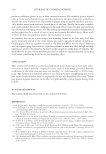
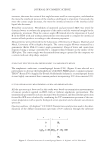
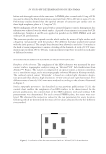
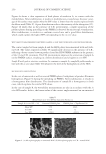
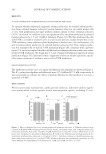
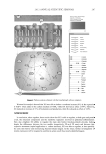
JOURNAL OF COSMETIC SCIENCE 238 CLIMATIC ROOM EXPERIMENTS The fi nding above suggests an important testable concept, i.e., for anti-humidity action to take effect trehalose must be in an anhydrous or glassy form below 50% RH. To test this, experiments were performed under controlled conditions of 30% RH and ~20°C and 60% RH and ~20°C. Control hair switches (those “treated” only with water) and hair switches treated with trehalose were styled using straightening irons at the two conditions given above in a climatic room. Subsequently the humidity and temperature in the testing area were increased to a fi nal state of 80% RH and ~30°C. The switches continued to remain in the climatic room while the conditions were being changed. The results are given in Figures 6 and 7. In both experiments, control (i.e., water-treated only) switches are the fi rst and the last switches and fl ank the six trehalose-treated switches in between. It can be seen that trehalose-treated switches styled at lower %RH show anti-humidity benefi ts (Figure 6, right) while those styled at higher %RH do not (Figure 7, right). It is proposed that in the latter case, as the conditions were being changed to high-humidity conditions, any glassy material formed during the styling phase would have converted to the crystal form even before the high-humidity conditions of 80% set in and thus would not have shown anti-humidity benefi ts. Clearly Figures 6 and 7 offer compelling evidence that the anti-humidity benefi t obtained from trehalose and heat is intimately related to the starting styling conditions. Trehalose- treated and hot-iron straight-styled switches at lower relative humidity conditions show noticeable anti-humidity benefi ts. Thus if one assumes that the use of hot irons (~200°C) in the straightening process converts the trehalose to a glassy form in situ, this suggests that the ability of the trehalose glassy form to pick up water below 50% RH and convert to a stable dihydrate crystal above 50% RH is linked to the anti-humidity activity observed. DISCUSSION ON MECHANISM OF ACTION OF TREHALOSE Here we have presented evidence for trehalose- and heat-treated switches showing anti- humidity benefi ts compared to the control. Evidence has also been presented that glassy forms of trehalose can pick up water compared to the crystal form and that hair treated with trehalose and heat has similar overall water-uptake properties compared to the control. Finally, it has been shown that if the starting condition during style creation is at low relative humid- ity, only then is the anti-humidity benefi t seen. Here we summarize the mechanism of action of trehalose to give anti-humidity benefi ts. Figure 6. Left: after styling with straighteners at ~20°C and 30% RH. Right: After changing the condi- tions in the room to high humidity at ~30°C and 80% RH. In both pictures the fi rst and the last switches are control (treated with water) and fl uff up at high humidity, i.e., do not show the anti-humidity benefi t. All switches in the middle are treated with 2% trehalose solution and show the anti-humidity benefi t.
Purchased for the exclusive use of nofirst nolast (unknown)
From: SCC Media Library & Resource Center (library.scconline.org)