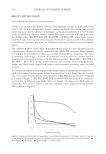
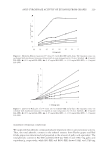
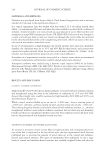
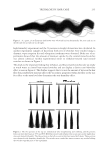
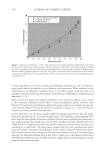
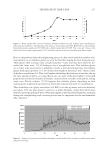
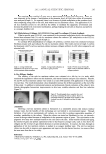
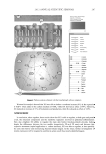
IN VITRO SPF DETERMINATION ON HD6 PMMA 253 A previous study showed the importance of the physical characteristics of the surface substrate used. The reproducibility of the in vitro SPF results can readily be improved by controlling roughness by using the HD6 molded plates. Although the method proposed on the HD6 plates showed good correlation with the in vivo results for the majority of products, we still observed deviations for certain types of products. In order to go further into the reliability of the method, we investigated the behavior of the formulae on the HD6 during spreading. Upon consideration of the hydrophilicity level of the molded plate, the present study was inspired by the interfacial tension phe- nomena that are present between product and substrate. With the aim of modifying this interfacial tension, an amphoteric pretreatment with C.B. was investigated. The results obtained showed the benefi ts in the spreading quality and, as a consequence, in the in vitro/in vivo correlation. In the case of high interfacial tension between product and HD6 PMMA plates, it will decrease to enable better adherence so as to obtain suitable spreading. In the case of low interfacial tension, it isn’t affected, but it slightly improves the repartition of the vehicle, resulting in better homogeneity of the results on the whole surface without any infl uence on the SPF result. With this pretreatment, the chemical characteristics of the spread- ing were improved in terms of wettability and in adherence of the product onto the HD6 PMMA. Of the 30 products tested, the C.B. pretreatment improved the results for the nine non-correlated SPF values obtained without pretreatment. Interestingly, the C.B. application had no effect on the SPF values of the 21 well-correlated products. The C.B. pretreatment is, however, suitable for both correlated and non-correlated products. The control of the chemical aspect of spreading enabled us to access a more universal method, adapted for each type of vehicle (O/W, W/O, gel, oil). The future goal is to evaluate the pretreatment technique at different laboratories in order to extend the results and validate inter-laboratory variability. ACKNOWLEDGMENT The authors thank Dr Alice Mija (Laboratory of Chemistry of Organic Materials and Metal, University of Nice-Sophia Antipolis) for her excellent support in the wettability measurements. REFERENCES (1) The Colipa In Vitro Photoprotection Methods Task Force, Method for in vitro determination of UVA protec- tion. Colipa web site is available at www.colipa.eu/publications-colipa-the-european-cosmetic-cosmetics- association/guidelines.html?view=item&id=33 (2011) (accessed May 2011). (2) M. Pissavini and L. Ferrero, In vitro determination of sun protection factor, Business Briefi ng, Global Cosmetics Manufacturing (2004). (3) M. Pissavini, L. Ferrero, V. Alard, U. Heinrich, H. Tronnier, D. Kockott, D. Lutz, V. Tournier, M. Zambonin, and M. Meloni. Determination of the in vitro SPF, Cosmet. Toiletr., 118, 63–72 (2003). (4) M. Rohr and E. Klette, In vitro sun protection factor: Still a challenge with no fi nal answer, Skin Pharmacol. Physiol., 23, 201–212 (2010). (5) M. Pissavini, S. Marguerie, A. Dehais, L. Ferrero, and L. Zastrow, Characterizing roughness: A new substrate to measure SPF, Cosmet. Toiletr., 124(9), 56–64 (2009). (6) L. Ferrero, M. Pissavini, S. Marguerie, and L. Zastrow. Importance of substrate roughness for in vitro UV protection assessment, IFSCC, 9(2), 2–13 (2006).

JOURNAL OF COSMETIC SCIENCE 254 (7) G. Andreatta, Insertion et organisation de nanoparticules à l’intérieur de bicouches de tensioactifs déposées sur substrats solides. Available at http://tel.archives-ouvertes.fr/docs/00/36/33/31/PDF/Manuscrit-light- GAndreatta.pdf (2008) (accessed September 2010). (8) J. P. Kientz, Les tensioactifs. Available at http://www.acstrasbourg.fr/sections/enseignements/secondaire/pedagoge/ les_disciplines/maths-sciences_en_lp/pedagogie/cours_a_l_usage_du_p/chimie/chimie/downloadFile/ attachedFile_1/Les_tensioactifs.doc?nocache=1212670711.21 (2010) (accessed September 2010). (9) K. D. Danov, S. D. Kralchevska, P. A. Kralchevsky, K. P. Ananthapadmanabhan, and A. Lips, Mixed solutions of anionic and zwitterionic surfactant (betaine): Surface tension isotherms. Adsorption and relaxation kinetics. Available at http://www.lcpe.uni-sofi a.bg/publications/2004/pdf/pdf/2004-05-KD-SK- PK.pdf (2004) (assessed September 2010). (10) S. Casellas and G. Clere, Surfaces très hydrophobes ou très hydrophiles: Préparation et application. Avail- able at http://mqm-nice.ibelgique.com/cours/Biblio07/PDF/SURFACES_TRES_HYDROPHOBES_Casellas_ Clere.pdf (2007) (accessed September 2010). (11) Adhésion le minimum à savoir. Available at http://www.art-pjm.com/collage-technique/technique-collage- adhesion.html (2010) (accessed September 2010). (12) Verre et innovation. Available at http://www.idverre.net/veille/dostec/pate-de-verre-analyse-defauts/pate-de-verre- analyse-defauts.pdf (2005) (accessed September 2010). (13) K. Nawroth, TEGO® BETAIN F50. Concentrated Cocamidopropyl Betain. EVONIK Industries (2008). (l4) Patent FR07-08972. (15) J. Lademann, A. Rudolph, U. Jacobi, H. J. Weigmann, H. Schaefer, and W. Sterry, Infl uence of nonho- mogenous distribution of topically applied UV fi lters on sun protection factors, J. Biomed. Optics, 9(6), 1358–1362 (2004).
Purchased for the exclusive use of nofirst nolast (unknown)
From: SCC Media Library & Resource Center (library.scconline.org)