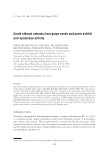
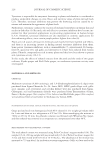
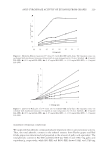
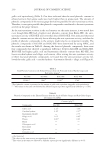
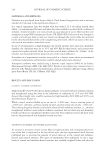
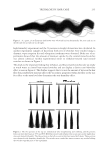
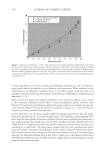
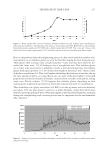
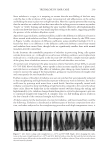
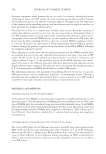
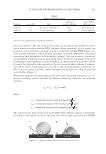
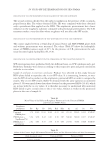
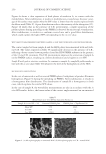
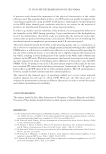
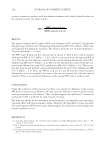
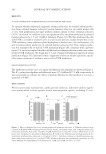
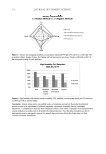
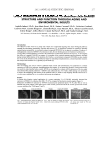
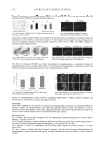
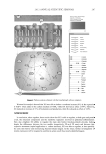
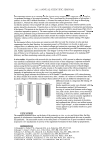
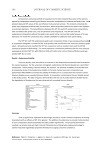
IN VITRO SPF DETERMINATION ON HD6 PMMA 251 PMMA plate is signifi cantly different from the value obtained with sample A. Therefore, the lowest interfacial tension of the interface solid/liquid explains the good wettability of sample B when it’s applied on an untreated PMMA plate (Table VIII). The examination of this value between the sunscreen product and the PMMA surface after C.B. pretreat- ment explains the increase in the homogeneity of the sunscreen and the lower covariance obtained (large decrease in the contact angle). In addition, the fi nding of an SPF value almost equivalent with or without pretreatment for sample B demonstrates that the C.B. fi lm does not affect the microtopography of the substrate and, as a consequence, conforms with the criteria of the control chart. WETABILITY MEASUREMENTS BETWEEN SAMPLE A AND THE UNTREATED AND PRETREATED HD6: EXTENSION OF THE COHORT OF FORMULATIONS The study was extended to 30 sunscreen formulations coming from internal develop- ment, as well as to competitive products, in order to have a wide range of galenic proper- ties. The in vivo SPF value or claimed SPF is known for each formulation. When one considers the protocol without C.B. pretreatment, even if the R2 is low (0.17), the overall Table VI Values of the Contact Angle (θ) between Sunscreen Product A and the Substrate before and after Pretreatment Sample A Untreated HD6 HD6 + C.B. PMMA plate n° 1 63° 45° PMMA plate n° 2 64.4° 47° PMMA plate n° 3 62.8° 51° Mean of the contact angle (θ) 63.4° 47.6° Table VII Mean Values of In Vitro SPF for Sunscreen Product B Sample B (in vivo SPF = 30) Untreated PMMA plate PMMA plate + TegoBetain F50 Mean SPF 35.22 36.91 Std. SPF 3.69 1.17 Cov. SPF 10.49% 3.16% Figure 5. (a) Microphotography on untreated HD6. (b) Microphotography on pre-treated HD6.

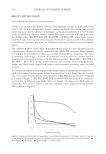
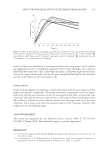
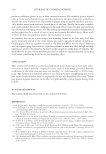
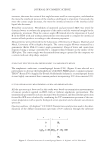
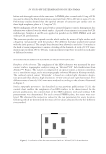
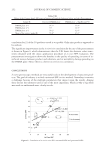
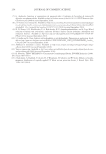
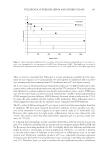
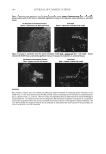
JOURNAL OF COSMETIC SCIENCE 252 correlation for 21 of the 30 products tested is acceptable. Only nine products appeared to be outliers. The signifi cant improvement in the in vitro/vivo correlation by the use of the pretreatment is shown in Figure 6, which demonstrates that the C.B. limits the aberrant values some- times obtained with the classic application procedure of in vitro SPF evaluation. The pretreatment investigation shows the benefi ts in the quality of spreading in terms of in- terfacial tension between product and substrate, and in wettability during spreading on the PMMA plate. Hence there is a better in vitro/in vivo correlation. CONCLUSIONS In vitro spectroscopic methods are very useful tools in the development of sunscreen prod- ucts. The goal of industry is to fi nd a universal SPF in vitro method. Nowadays it remains a challenge because of the multiple parameters that impact upon the results. Among these factors the substrate used is one of the most important, which is why a big effort was made to understand more clearly its role. Figure 6. Correlation of in vivo/in vitro SPF: untreated HD6 and pretreated HD6. Table VIII Values of the Contact Angle (θ) between Sunscreen B and the Substrate before and after Pretreatment Sample B Untreated PMMA plate PMMA plate + TegoBetain F50 PMMA plate n° 1 56.7° 44.8° PMMA plate n° 2 53° 40.5° PMMA plate n° 3 58.2° 42.6° Mean of the contact angle (θ) 55.9° 42.6°
Purchased for the exclusive use of nofirst nolast (unknown)
From: SCC Media Library & Resource Center (library.scconline.org)