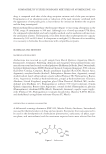
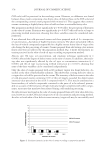
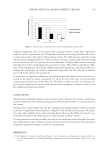
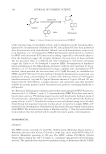
JOURNAL OF COSMETIC SCIENCE 342 stearyl glycyrrhetinate (SG), are used for external use in cosmetic fi eld as lenitive and antireddening agents (2) and in the fi eld of dermatology, because they seem to improve the symptoms of acute and chronic dermatitis (3,4). DG and SG show high chemical stability and emulsifying properties but show different physicochemical features and solubility in fact, while DG has a good water solubility, SG is characterized by a pronounced lipophilic character. These physicochemical properties appear to be unsuitable because actives characterized by extremes of hydrophilic or lipo- philic natures are not well absorbed (5). Different physical and chemical approaches have been developed to overcome the skin barrier and to have better control of active transport across the skin (6–8). Among them, penetration enhancers are one of the most convenient materials and show relatively high effects, interacting with skin constituents to increase the fl ux of active substances (6,9). Another new and very promising strategy is represented by the use of innovative carriers such as solid lipid nanoparticles (SLNs) (10). In recent years, an unmeasured number of research papers have been published describing the use of lipid based carriers for cosmetic application. SLNs with a solid particle matrix are developed from o/w emulsions by sim- ply replacing the liquid lipid (oil) by a solid lipid, i.e., being solid at body temperature (11). Scientifi c literature reports, with different examples, the benefi ts associated to the application of lipid nanoparticle strategy to the formulation of products aimed to dermal administration (12–14). The main advantages recognized for these nanocarriers are the capability to enhance the drug penetration into the skin increasing treatment effi ciency, to target the epidermis, and to reduce the systemic absorption and consequently the side effects of many drugs and cosmetic actives that should limit their activity to the skin lay- ers. However, considering the chemical features of SLNs, these nanoparticles seem to be idoneous to vehiculate lipophilic compounds rather than hydrophilic ones. The objective of this study was to assess the ability of some vehicles (emulsion and emul- gel), containing hydrogenated lecithin as penetration enhancer, in increasing DG and SG percutaneous absorption. Furthermore, SG-loaded SLNs were prepared and the effect of this vehicle on SG permeation profi le was evaluated as well. Percutaneous absorption has been studied in vitro, using excised human skin membranes (i.e., SCE), and in vivo, deter- mining their anti-infl ammatory activity. MATERIALS AND METHODS MATERIALS DG and SG were purchased from Maruzen Pharmaceuticals Co., LTD. (Hiroshima, Japan). Brij® 721P (steareth-21), Brij® 72 (steareth-2), Arlamol® E (PPG-15 Stearyl Ether, butylated hydroxy toluene) were purchased from Croda Italiana S.P.A. (Mortara, Italy). Cetearyl alcohol, Myritol® 318 (caprylic/capric triglyceride), Cetiol® SB45 (Butyrospermum parkii), Pluronic® F68 (poloxamer 188), were purchased from BASF Corporation (Florham Park, NJ). Colonial monolaurin (glyceryl laurate) was purchased by Colonial Chemical, Inc. (South Pittsburg, TN). Dermosoft® OMP (methylpropandiol, caprylyl glycol, phenylpropanol) was purchased from Dr. Straetmans GmbH (Hamburg, Germany). Arginine was obtained by ACEF S.p.A. (Fiorenzuola d’Arda, , Italy). Lecinol® S-10 (hydrogenated lecithin) was obtained by Nikko

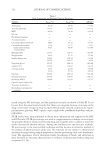
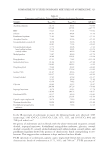
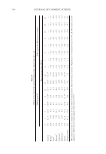
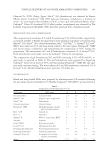
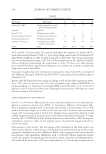
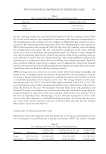
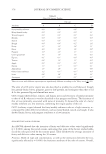
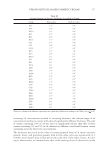
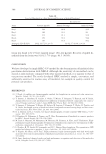
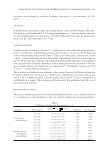
TOPICAL DELIVERY OF ANTI-INFLAMMATORY COMPOUNDS 343 Chemical Co., LTD. (Tokyo, Japan). Silicol® 200 (dimethicone) was obtained by Esperis (Milan, Italy). Compritol® 888 ATO (glyceryl behenate, tribehenin), a mixture of mono-, di- and triglycerides of behenic acid (C22), was a gift of Gattefossè (Milan, Italy). Carbopol® Ultrez 20 (acrylates/C10-30 alkyl acrylate crosspolymer) was obtained by The Lubrizol Corporation (Wickliffe, OH). All other materials were of analytical grade. PREPARATION OF DG AND SG FORMULATIONS The composition of emulsions A,C and B,D containing 0.5% of DG and SG, respectively, is reported in Table I. Briefl y, the ingredients of the emulsion oily phase (cetearyl alcohol, Myritol® 318, Silicol® 200, colonial monolaurin, Brij® 721P, Brij® 72, Arlamol® E, Cetiol® SB45) were mixed at 60°C and then slowly added to the water phase (Dermosoft® OMP and water) using a turbomixer and maintaining the temperature of 60°C during the preparation. The water phases of C and D formulations contained 1% of Lecinol® S-10. Final formulations were made viscous by Carbopol® Ultrez 20 and arginine. The composition of gel formulations E,G and F,H containing 0.5% of DG and SG, re- spectively, is reported in Table II. The gel formulations were prepared by dispersing Carbopol® Ultrez 20 in water at 60°C and then adding Dermosoft® OMP, DG and argi- nine with constant stirring. The water phases of G and H formulations contained 1% of Lecinol® S-10. All the formulations were stored at 4°C before use. SLN PREPARATION Blank and drug-loaded SLNs were prepared by ultrasonication (US) method following the procedure reported elsewhere (15). Briefl y, Compritol® 888 ATO (5 g) was melted at Table I Composition of A–D emulsions (% w/w) Trade name INCI name A B C D Cetearyl alcohol Cetearyl alcohol 2.5 2.5 2.5 2.5 Myritol® 318 Caprylic/capric triglyceride 4 4 4 4 Silicol® 200 Dimethicone 1.5 1.5 1.5 1.5 Colonial monolaurin Glyceryl laurate 1.5 1.5 1.5 1.5 Dermosoft® OMP Methylpropandiol, caprylyl glycol, phenylpropanol 2.5 2.5 2.5 2.5 Brij® 721P Steareth-21 2 2 2 2 Brij® 72 Steareth-2 3 3 3 3 Arlamol® E PPG-15 stearyl ether, BHT 4 4 4 4 Arginine Arginine 1 1 1 1 Cetiol® SB45 Butyrospermum parkii 5 5 5 5 Lecinol® S-10 Hydrogenated lecithin — — 1 1 Potassium glycyrrhizinate Potassium glycyrrhizinate 0.5 — 0.5 — Stearyl glycyrrhetinate Stearyl glycyrrhetinate — 0.5 — 0.5 Carbopol® Ultrez 20 Acrylates/C10-30, alkyl acrylate crosspolymer 0.3 0.3 0.3 0.3 Water Aqua 72.2 72.2 71.2 71.2
Purchased for the exclusive use of nofirst nolast (unknown)
From: SCC Media Library & Resource Center (library.scconline.org)