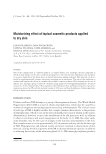
J. Cosmet. Sci., 64, 355–370 (September/October 2013) 355 Determination of physicochemical properties of delipidized hair ROGER L. McMULLEN, DONNA LAURA, SUSAN CHEN, DONALD KOELMEL, GUOJIN ZHANG, and TIMOTHY GILLECE, Materials Science Department, Corporate R&D, Ashland Specialty Ingredients, Wayne, NJ 07470. Accepted for publication April 22, 2013. Synopsis Using various physicochemical methods of analysis, we examined human hair in its virgin and delipidized state. Free lipids were removed by a solvent extraction technique (covalently bound lipids were not removed) using a series of solvents with varying polarity. We analyzed the surface properties of hair by conducting me- chanical combing and dynamic contact angle analysis. In addition, we used inverse gas chromatography surface energy analysis to explore the chemical composition of the hair surface based on interactions of various nonpolar and polar probes with biological molecules residing on the hair surface. Further, we investigated the importance that free lipids play in the internal structural properties of hair using dynamic scanning calorim- etry and tensile strength measurements. The microstructure of the hair surface was probed by atomic force mi- croscopy, whereas the lipid content of hair’s morphological components was determined by infrared spectroscopic imaging. We also monitored the water management properties of virgin and delipidized hair by dynamic vapor sorption, which yielded unique water sorption isotherms for each hair type. Using all these techniques, dif- ferences were found in the chemical composition and physical behavior of virgin and delipidized hair. To better understand the infl uence of hair lipid composition on hair styling treatments, we conducted mechani- cal analyses of hair shaped into omega loops to determine the stiffness, elasticity, and fl exibility of hair–polymer assemblies. Although there were no discernible differences between untreated virgin and delipidized hair, in terms of stiffness and elasticity, we found that treatment with hair styling agents produced different effects depending on the hair type used. Likewise, streaming potential measurements were carried out to monitor the binding capacity of rinse-off treatments on virgin and delipidized hair. Using this technique, we moni- tored the surface potential of hair and found signifi cant differences in the binding behavior of cationic poly- mers and surfactants (polyquaternium-55 and quaternium-26) on both hair types. INTRODUCTION Lipids play an important role in the functional and structural properties of hair. They are often designated as surface or internal lipids, and can be of sebaceous origin, or they may carry out a structural role. The structural lipids can be covalently bound [e.g., 18-methyleicosanoic acid (18-MEA) on the surface] or free (e.g., free fatty acids, cholesterol, ceramides, etc.). Address all correspondence to Roger McMullen at rmcmullen@ashland.com.
Purchased for the exclusive use of nofirst nolast (unknown)
From: SCC Media Library & Resource Center (library.scconline.org)