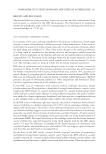
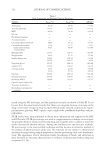
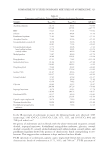
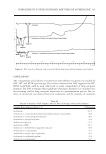
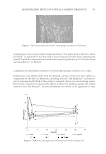
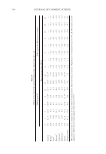
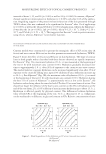
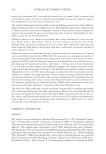
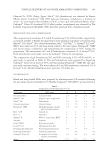
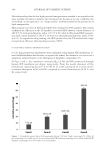
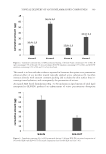
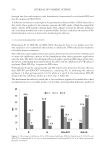
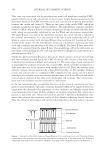
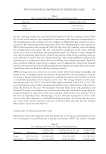
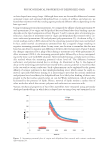
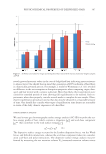
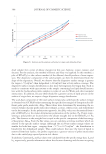
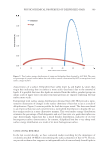
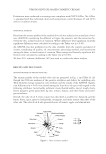
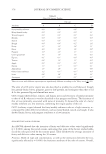
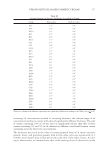
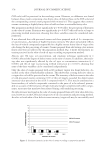
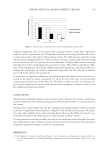
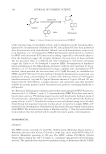
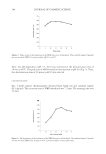
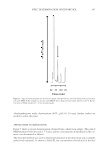
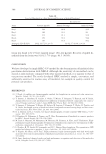
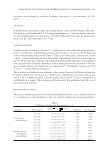
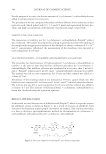
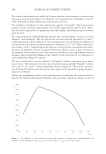
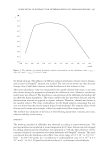
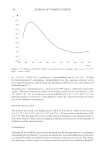
JOURNAL OF COSMETIC SCIENCE 398 A = 0.1355c − 0.0017 for 3-cyclohexene-1-carboxaldehyde and A = 0.1525c − 0.0489 for hydroxyisohexyl 3-cyclohexene carboxaldehyde were the equations achieved at the least squared regression, with A being the absorbance (AUS) and c the concentration of aldehyde (μmol·l-1). Standard curves consistently gave r2 values above 0.999 within a calibration range of the analyte. The molar absorptivity under our measuring conditions was calculated as 1.36 × 10³ l·mol-1·cm-1 for 3-cyclohexene-1-carboxaldehyde and 1.52 × 10³ l·mol-1·cm-1 for hydroxyisohexyl 3-cyclohexene carboxaldehyde, which was determined from the linear part of the aldehyde concentration. PRECISION AND ACCURACY The method was found to be highly precise (Table I). Intra-batch coeffi cient of variation at 2.5 × 10⁻⁵, 1.0 × 10⁻⁴, and 3.0 × 10⁻⁴ mol·l−1 (n = 6) was noted to vary between 2.8% and 3.4%. The precision and accuracy results based on absorbance ratios with good recov- eries were obtained. There were no signifi cant differences between the added amounts of aldehydes and the amounts found. INTERFERENCES Although all the aldehydes are potential interference in the determination of 3-cyclohexene carboxaldehydes by Purpald®, literature has shown that structural differences in the prod- ucts formed by different aldehydes lead to variations in their spectra (23,24). The impor- tant advantage of this reagent is its sensitiveness and specifi city for aldehydes. Purpald® Figure 6. The infl uence of Purpald® solution concentration on the absorbance value caldehyde=4.0 × 10⁻⁴ mol·l−1, cNaOH=1.0 mol·l−1.

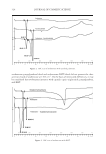
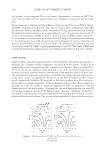
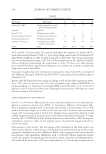
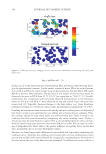
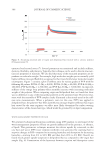
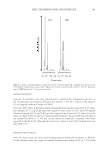
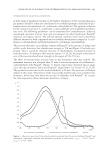
APPLICATION OF PURPALD® FOR DETERMINATION OF CARBOXALDEHYDES 399 does not react with esters, amides, formic acid, hydroxylamines, quinones, hydrazines, and aminophenols to yield purple products (25). Furthermore, the presented study shows that the developed method can also be applied to the determination of aldehydes in cos- metics because the other ingredients do not react with Purpald®. The lotion used, which is a mixture of many compounds, also absorbs visible radiation and the maximum absorbance is at a wavelength of 630 nm (Figure 3). The value of ab- sorbance at 538 nm is small, but for low concentrations of the hydroxyisohexyl 3-cyclohexene carboxaldehyde contained in cosmetic it can have a signifi cant effect on the determination. Therefore, to determine the concentration of this aldehyde in cosmetics, we prepared blank solution that contains the lotion, and sodium hydroxide solution without Purpald® solution. This procedure eliminates the infl uence of other cosmetic ingredients on the determination of hydroxyisohexyl 3-cyclohexene carboxaldehyde. ASSAY OF HYDROXYISOHEXYL 3-CYCLOHEXENE CARBOXALDEHYDE FROM COSMETICS PRODUCT The developed spectrophotometric method for the determination of hydroxyisohexyl 3-cyclohexene carboxaldehyde with Purpald® reaction was successfully applied to cos- metic product lotion. The procedure was based on calibration curve method. The amount of hydroxyisohexyl 3-cyclohexene carboxaldehyde in the tested cosmetic has been deter- mined under optimal conditions and it is (1.05 ± 0.06) × 10−4 mol·l−1 with relative stan- dard deviation at 2.75% (n = 6). CONCLUSION In conclusion, the reaction between Purpald® and aldehydes can be carried out quantita- tively, which allows the analyses of compounds with carbonyl group. The developed method for determination of aldehydes is simple, cheap, and reproducible. Moreover, to the best of our knowledge, the proposed method is the fi rst analytical procedure for determination of 3-cyclehexene-1-carboxaldehyde and is the fi rst spectrophotometric procedure for the deter- mination of hydroxyisohexyl 3-cyclohexene carboxaldehyde. GC–MS and HPLC can be used for the analysis of volatile chemicals such as perfumes or fragrance mixtures. The linear range in the proposed method was as follows 0.1-2 × 10⁻² mol·l−1 (5), 5.7 × 10⁻⁶–2.8 × 10⁻⁵ mol·l−1 (7). However, with the proposed, simple spectrophotometric procedure using selec- tive derivatization reagent, it seems possible to effi ciently determine aldehydes also in com- plex matrices such as cosmetics. The described method of preparation of samples is simple, does not require many reagents, and it is relatively short. Thus, this method could overcome some problems related to sample preparation. The obtained result from the analysis of the commercial products lotion indicates that the developed method can be considered as a tool useful in routine analyses of complex matrices such as cosmetics. REFERENCES (1) R. Carvalho, P. Maio, C. Amaro, R. Santos, and J. Cardoso, Hydroxyisohexyl 3-cyclohexene carboxaldehyde (Lyral®) as allergen: Experience from a contact dermatitis unit, Cutan. Ocul. Toxicol., 30(3), 249–250 (2011). (2) K. F. Baxter, S. M. Wilkinson, and S. J. Kirk, Hydroxymethyl pentylcyclohexene-carboxaldehyde (Lyral®) as a fragrance allergen in the UK, Contact Dermatitis, 48, 117–118 (2003).
Purchased for the exclusive use of nofirst nolast (unknown)
From: SCC Media Library & Resource Center (library.scconline.org)