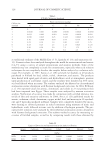
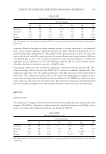
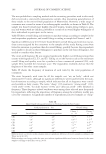
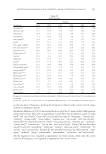
JOURNAL OF COSMETIC SCIENCE 166 The non-probabilistic sampling method and the recruiting procedure used in this study did not provide a statistically representative sample, thus preventing generalization of these results to the entire female population of Montevideo. However, a wide range of consumers was covered in terms of sociodemographic variables, as shown in Table II. The sample was biased toward more highly educated women, women living without a part- ner, and women with no children, probably as a result of an overall higher willingness of these individuals to participate in the survey. Table III shows overall liking and intention to purchase ratings according to sample for the total respondent population, and overall liking according to sample for Clusters 1 and 2. Signifi cant differences (p ≤ 0.05) were found between overall liking and intention to pur- chase scores assigned by the consumers to the samples of this study. Rating scores were lower for intention to purchase than for overall liking, possibly because the respondents were unable to decide on their willingness to purchase on the sole basis of fragrance, but needed to consider other factors. The cream with fragrance E4 was assigned signifi cantly higher overall liking ratings than creams with fragrances E2, E3, and E5. Taking six on the 9-point scale as the minimum overall liking and quality score for a product to have commercial potential (24), only sample CE4 exceeded the minimum score. The respondents evidently did not like the fragrances of the other cream samples. Table IV shows the frequency of mention of each term by the total population of consumers. The most frequently used term for all the samples was “use on body,” which was mentioned 167 times, although no signifi cant differences were found between the num- ber of mentions according to sample, which indicates that all six fragrances were consid- ered suitable as body creams. The terms “cheap” (116 mentions), “strong smell” (112), “mild smell” (109), “for older women” (109), and “delicious smell” (103) followed in frequency. Three fragrance-related attributes were among those selected most frequently by respondents, refl ecting the importance of fragrance among the attributes readily per- ceived by consumers. A signifi cant number of respondents perceived samples as “cheap” Table III Mean Overall Liking and Intention to Purchase Scores (9-Point Scales) Sample Total population (n = 63) Overall liking Overall liking Intention to purchase Cluster 1 n = 22 Cluster 2 n = 41 CE1 5.2a,b 4.6b 5.1b A 5.3a,b A CE2 4.9b 4.4b 6.5a,b A 4.1b,c B CE3 5.0b 4.5b 6.2a,b A 4.4a,b,c B CE4 6.2a 5.7a 7.3a A 5.6a B CE5 4.8b 4.4b 6.2a,b A 4.0c B CE6 5.6a,b 4.8a,b 5.8b A 5.4a A Different lower case letters within columns indicate signifi cant differences between samples according to the Tukey test (p ≤ 0.05). Different upper case letters within the same row indicate signifi cant differences between clusters for the same sample according to the Tukey test (p ≤ 0.05).

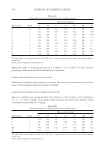
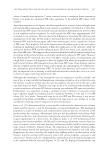
SELECTION OF FRAGRANCE FOR COSMETIC CREAM CONTAINING OLIVE OIL 167 on the sole basis of fragrance, showing how fragrance infl uences the instant mental image evoked in consumers’ minds. Signifi cant differences (p ≤ 0.05) were found between 18 of the 24 terms of the CATA question mentioned by more than 10% of respondents. Cream CE1 was described in terms of “mild smell” and “use on body.” Cream CE2 was described in terms of “energizing,” “daytime use,” “artifi cial,” “strong smell,” “mass market,” “summer use,” “use on feet,” and “use on body.” Cream CE3 was mainly described as “fresh,” “for young women,” “daytime use,” “artifi cial,” “strong smell,” “summer use,” “use on feet,” and “use on body.” Cream CE4 was described mainly in terms of “nourishing,” “softening,” “natural,” “delicious smell,” “mild smell,” “fa- cial use,” and “use on body.” Cream CE5 was described as being “for older women,” “anti- aging,” “artifi cial,” “cheap,” “strong smell,” “mass market,” “use on feet,” and “use on body.” All the fragrances were regarded as appropriate for body creams, while only the cream with the E4 fragrance was regarded as appropriate for a facial cream. Table IV CATA Results Attributes Samples CE1 CE2 CE3 CE4 CE5 CE6 Nourishing* 14.3 14.3 19.1 31.8 22.2 15.9 Moisturizingns 22.2 23.8 23.8 39.7 20.6 25.4 Softening* 15.9 19.1 22.2 34.9 12.7 28.6 Energizing* 7.9 19.1 15.9 4.8 3.2 11.1 Anti-aging** 6.4 1.6 3.2 9.5 17.5 12.7 Fresh* 12.7 22.2 33.3 28.6 11.1 25.4 For young women* 15.9 14.3 30.2 20.6 7.9 12.7 For older women** 20.6 28.6 17.5 23.8 42.9 28.6 Daytime use** 20.6 38.1 34.9 28.6 17.5 17.5 Night time usens 19.1 7.9 19.1 17.5 15.9 19.1 Natural* 15.9 6.3 19.1 28.6 15.9 20.6 Artifi cial* 22.2 33.3 31.7 11.1 28.6 25.4 Cheap* 25.4 31.8 36.5 22.2 42.9 23.8 Delicious smell** 19.1 20.6 28.6 46.0 20.6 28.6 Disagreeable smellns 15.9 19.1 17.5 9.5 22.2 11.1 Strong smell*** 17.5 42.9 49.2 11.1 36.5 20.6 Mild smell*** 44.4 14.3 11.1 42.9 17.5 42.9 Mass market*** 11.1 30.2 19.1 7.9 27.0 14.3 Summer use*** 11.1 28.6 36.5 19.1 14.3 14.3 Winter usens 12.7 3.2 6.4 14.3 12.7 9.5 Use on feet** 3.2 12.7 14.3 1.6 15.9 15.9 Use on handsns 27.0 30.2 25.4 23.8 28.6 22.2 Facial use** 7.9 4.7 9.5 25.4 14.3 17.5 Use on bodyns 44.4 30.2 50.8 55.6 44.4 39.7 Frequency of mention according to attribute and sample. Only terms used by more than 10% of respondents are shown. *p ≤ 0.05, **p ≤ 0.01, ***p ≤ 0.001, ns: no signifi cant differences (p 0.05) according to Cochran’s Q test.
Purchased for the exclusive use of nofirst nolast (unknown)
From: SCC Media Library & Resource Center (library.scconline.org)