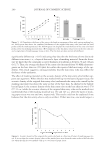
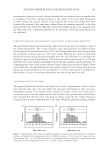
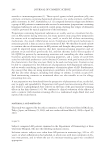
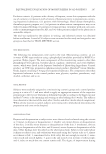
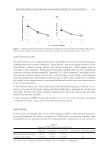
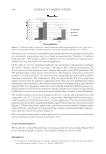
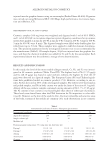
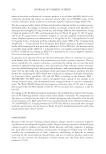
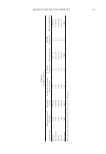
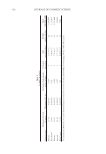
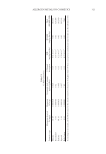
EQUIVALENCE EVALUATION OF MOISTURIZERS IN AD PATIENTS 301 SUBJECT QUESTIONNAIRE For questionnaire items regarding feel of use, some differences were seen between groups, although there was no major difference. “Spreadability” was more highly evaluated in the moisturizing cosmetic group, whereas the control group got a little higher score in “stickiness” and “tightness.” With regard to the skin condition after use for 1 month, the proportion of subjects who responded “improved” or “a little improved” was higher in the moisturizing cosmetic group than in the control product group. From a questionnaire regarding further use of the respective preparations, subjects who would like to continue use tended to feel improvements in moisture and dryness and to report good pleasantness of use of the preparation. In free answers before use, many subjects provided favorable responses to the use of cos- metics as one part of treatment, stating that this would help to maintain the condition of their skin. On the other hand, negative opinions were also seen, such as the idea that medications are more reliable. In the evaluation of QOL, an upward tendency was seen in several categories, including “evaluation of sleep,” especially in moisturizing cosmetic group. DISCUSSION In this study, we thought that use of a moisturizing cosmetic with superior moisture- retaining properties for dryness symptoms of AD patients in remission together with pleasantness of use and good tactile feel would promote continuation of use and give a Figure 1. Trends in dryness/desquamation and pruritus during the trial. (A) dryness/desquamation, (B) pruritus. Closed and open squares indicate moisturizing cosmetic group and control product group, respectively. Table V Change in TEWL Values before and after Use Improved Unchanged Exacerbated Total number of analysis subjects Moisturizing cosmetic group 3 (13%) 7 (29%) 14 (58%) 24 Control product group 3 (14%) 7 (32%) 12 (54%) 22 The subject with a change of less than 1 of TEWL value was defi ned as “unchanged.”

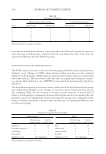
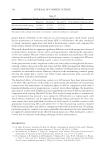
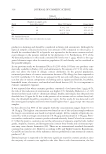
JOURNAL OF COSMETIC SCIENCE 302 Table VI Comparison of Number of Subjects with Moisture Content Improvement after Use Improved Unchanged Exacerbated Total number of analysis subjects Moisturizing cosmetic group 14 (58%) 6 (25%) 4 (17%) 24 Control product group 13 (59%) 3 (14%) 6 (27%) 22 The subject with a change of less than 1 of moisture content was defi ned as “unchanged.” greater degree of freedom in the selection of a moisturizing agent. Such results would lead to maintenance of remission and better QOL in AD patients. We thus conducted a 4-week continuous application trial with a moisturizing cosmetic and compared the results with a widely used moisturizing medication as a control. This study showed that no apparent signifi cant differences in both groups were observed in improvement, moisture content, safety, and questionnaire, indicating the equivalence of two test samples. Because control product was a pharmaceutical product, this study indicates the possibility of usefulness of moisturizing cosmetics in support for AD treat- ment. This is an important fi nding to give a clue to a novel role of cosmetics. In the questionnaire at the completion of the trial, many subjects thought that the mois- turizing cosmetic was good in the feel of use and that QOL was improved. Moisturizing cosmetics may thus help to maintain the skin condition of AD patients in remission and contribute to emotional recovery. However, subjects in the moisturizing cosmetic group felt that the sample had a “sticky” feel. These results indicated that there was room for improvement in product development. The benefi cial effects of moisturizing cosmetics in AD patients have been demonstrated so far (8,9). The signifi cance of this study is to demonstrate the usefulness of moisturizing cosmetics for the maintenance of remission phase of AD by comparison study with a heparinoid pharmaceutical preparation as a control. Given these fi ndings, the moisturiz- ing cosmetic in this study displayed no special problems in terms of effi cacy and safety in comparison with existing Hirudoid® lotion. This study focusing on how to continue the use of moisturizer may provide a new option for AD patients as a topical agent with which better compliance can be expected. Regarding allergy prevention by skin care, some reports have been published, but there are little reports of suitable cosmetics with appropriate moisturizing effect and safety (10,11). Our moisturizing cosmetics showed both moisturizing effect and safety in comparison with medical moisturizers. For allergy prevention purpose, cosmetics are more preferable than medicines because moisturizers are applied to normal skin but not affected skin in many cases. This study gives a clue to a novel role of cosmetics with taking advantage of their characteristics. REFERENCES (1) H. Saeki, M. Furue, F. Furukawa, M. Hide, M. Ohtsuki, I. Katayama, R. Sasaki, H. Sudo, and K. Takehara, Guideline for management of atopic dermatitis, J. Dermatol., 36, 563–577 (2009). (2) M. Kawashima, N. Hayashi, T. Nogita, K. Yanagisawa, and A. Mizuno, The useful of moisturizers for maintenance of remission in atopic dermatitis, Jpn. J. Dermatol., 117, 1139–1145 (2007). (3) E. L. Simpson, J. R. Chalmers, J. M. Hanifi n, K. S. Thomas, M. J. Cork, W. H. I. McLean, S. J. Brown, Z. Chen, Y. Chen, and H. C. Williams, Emollient enhancement of the skin barrier from birth offers effective atopic dermatitis prevention, J. Allergy Clin. Immunol., 134, 818–823 (2014).
Purchased for the exclusive use of nofirst nolast (unknown)
From: SCC Media Library & Resource Center (library.scconline.org)