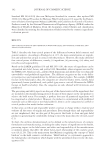
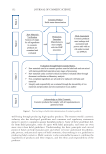
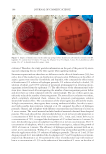
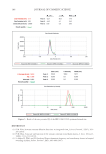
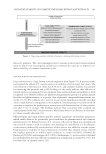
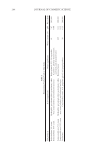
JOURNAL OF COSMETIC SCIENCE 186 REFERENCES (1) P. M. E lias, Strat u m corneum defensive functions: an integrated view, J. Invest. Dermatol., 125(2), 183– 200 (2005). (2) P. M. Elias, Struc t ure and function of the stratum corneum extracellular matrix, J. Invest. Dermatol., 132(9), 2131–2133 (2012). (3) S. Adalat, D. Wall , and H. Goodyear, Diaper dermatitis-frequency and contributory factors in hospital attending children, Pediatr. Dermatol., 24(5), 483–488 (2007). Figure 3. Result of the zeta potential (ζ) of the BBC-8 (K13/092) optimum formulation.

NEXT-GENERATION NATURAL BABY BARRIER CREAM FORMULATIONS 187 (4) R. Phillip, A. Hug h es, and J. Golding, Getting to the bottom of nappy rash, Br. J. Gen. Pract., 47, 493–497 (1997). (5) U. Blume-Peytavi, M . Hauser, L. Linnemann, G. N. Stamatis, J. Kottner, and N. Garcia Bartels, Pre- vention of diaper dermatitis in infants—a literature review, Pediatr. Dermatol., 31(4) 413–429 (2014). (6) A. N. Carr, T. DeWitt, M. J. Cork, L. F. Eichenfi eld, R. Folster-Holst, D. Hohl, A. T. Lane, A. Paller, L. Pickering, A. Taieb, T. Y. Cui, Z. G. Xu, X. Wang, S. Brink, Y. Niu, J. Ogle, M. Odio, R. D. Gibb, Diaper dermatitis prevalence and severity: Global perspective on the impact of caregiver behavior. Pedi- atr Dermatol. 2019 00:1–7. (7) SCCS, The SCCS Note s of Guidance for the Testing of Cosmetic Ingredients and their Safety Evaluation, 9th Revision, Vol. SCCS/1564/15 (Scientifi c Committee on Consumer Safety, Brussels, Belgium, 2016). (8) R. Arbuckle, M. Clark, J. Harness, N. Bonner, J. Scott, Z. Draelos, K. Copley-Merriman, Item reduc- tion and psychometric validation of the oily skin self assessment scale (OSSAS) and the oily skin impact scale (OSIS). Value in Health, 12(5), 828–837 (2009). (9) C. M. Mowad, K. J. McGinley, A. Foglia, J. J. Leyden, The role of extracellular polysaccharide substance produced by Staphylococcus epidermidis in miliaria, J. Am. Acad. Dermatol., 33(5), 729–733 (1995). (10) K. Amr, O. Messao u d, M. E. Darouti, and S. El-Abdelhak, Mutational spectrum of Xeroderma pigmen- tosum group A in Egyptian patients, Gene, 533, 52–56 (2014). (11) G. J. Nohynek, E. Antignac, T. Re, and H. Toutain, Safety assessment of personal care products/cosmet- ics and their ingredients, Toxicol. Appl. Pharmacol., 243(2), 239–259, 2010. (12) N. S. Al-Waili, C l inical and mycological benefi ts of topical application of honey, olive oil and beeswax in diaper dermatitis, Clin. Microbiol. Infect., 11(2), 141–163 (2005). (13) A. A Attama, C. C . Muller-Goymann, Effect of beeswax modifi cation on the lipid matrix and solid lipid nanoparticle crystallinity, Colloids Surf A., 315(1), 189–195 (2008). (14) Y. Rosiaux, V. Ja n nin, and S. Hughes, D. Merchaud, Solid lipid excipients—matrix agents for sustained drug delivery, J Control. Release, 188, 18–30 (2014). (15) N. Kamairudin, S. S. A. Gani, H. R. F. Masoumi, M. Basri, P. Hashim, N. M. Mokhtar, and M. E. Lane, Modeling of a natural lipstick formulation using an artifi cial neural network, RSC Adv., 5(84), 68632– 68638 (2015). (16) J. Pardeike, A. H o mmoss, and R. H. Muller, Lipid nanoparticles (SLN, NLC) in cosmetic and pharma- ceutical dermal products, Int. J.Pharm., 366, 170–184 (2009). (17) D. G. Kim, W. R. P ark, J. H. Kim, E. C. Cho, E. J. An, and J. W. Kim, Fabrication of pseudo-ceramide- based lipid microparticles for recovery of skin barrier function, Colloids Surf. B Biointerfaces, 94, 236– 241 (2012). (18) Y. Liu, N. Feng, N anocarriers for the delivery of active ingredients and fractions extracted from natural products used in traditional Chinese medicine (TCM), Adv. Colloid Interface Sci., 221, 60–70 (2015). (19) V. Ruiz, M. A. Ar i as, and J. L. Gallardo, “Skin creams made with olive,” in Olives and Olive Oil in Health and Disease Prevention (2010), pp. 1520. (20) I. Gorini, S. Ior i o, R. Ciliberti, M. Licata, G. Armocida, Olive oil in pharmacological and cosmetic traditions, J. Cosmt. Dermatol., 18(5), 1575–1579 (2019). (21) ICI, No The HLB Sy stem (ICI Americas Inc, Wilmington, DE, 1976). (22) G. W. C., Classifi cation of surface-active agents by HLB, J. Soc. Cosmet. Chem., 1, 311–326 (1949). (23) A. D. Gadhave, Na n oemulsions: formation, stability and applications, Int. J. Res. Sci. Adv. Technol., 2(3), 38–43 (2014). (24) A. Gadhave, Deter m ination of hydrophilic-lipophilic balance value, Int. J. Sci. Res., 3(4), 573–575 (2014). (25) ICI. Ed., The HLB System- a Time-Saving Guide to Emulsifi er Selection (ICI Am. Inc., Wilmington, DE, 1980). (26) S. M. Choi, T. H. Roh, D. S. Lim, S. Kacew, H. S. Kim, and B. Lee, Risk assessment of benzalkonium chloride in cosmetic products, J. Toxicol. Environ. Heal. Part B, 21(1), 8–23 (2018). (27) K. B. Kim, Y. W. Kim, S. K. Lim, T. H. Roh, D. Y. Bang, S. M. Choi, B. M. Lee, Risk assessment of zinc oxide, a cosmetic ingredient used as a UV fi lter of sunscreens. Journal of Toxicology and Environmental Health, Part B, 20(3), 155–182 (2017). (28) K. Kosemund, H. S c hlatter, J. L. Ochsenhirt, E. L. Krause, D. S. Marsman, and G. N. Erasala, Safety evaluation of superabsorbent baby diapers, Regul. Toxicol. Pharmacol., 53(2), 81–89 (2009). (29) Offi cial Journal of the European Union, “Cosmetic products should be safe under normal or reason- ably foreseeable conditions of use,” in Particular, a Risk-Benefi t Reasoning Should Not Justify a Risk to Hu- man Health, 1223, Brussels, Belgium (2009).
Purchased for the exclusive use of nofirst nolast (unknown)
From: SCC Media Library & Resource Center (library.scconline.org)