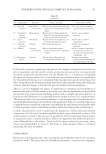
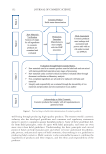
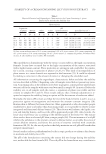
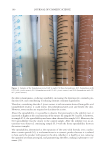
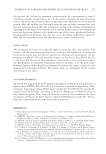
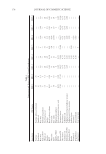
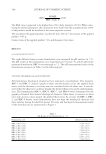
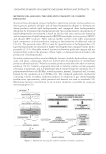
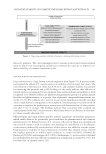
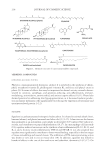
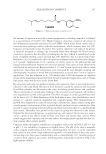
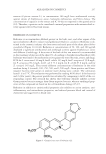
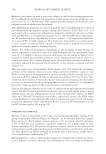
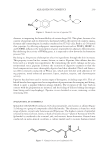
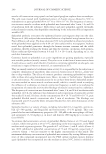
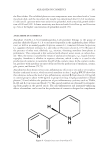
JOURNAL OF COSMETIC SCIENCE 216 more research, signifi cantly less scientifi c work has been performed on unsaponifi able compounds. The focus of this article is on unsaponifi able compounds of vegetable butters and oils, and their action on the skin after dermal application. UN SAPONIFIABLE COMPOUNDS By defi nition, unsaponifi able compounds are components of vegetable butters and oils that are not saponifi ed when treated with alkali such as NaOH and KOH, but are soluble in lipids (3,4). They are typically extracted using organic solvents such as acetone, ether, heptane, hexane, and petroleum ether, and are not volatile at 103°C (4,5). The content of unsaponifi able compounds in vegetable butters and oils usually varies between 0.3 and 2% (6). Composition is complex and includes terpenic and aliphatic compounds, waxes, tocopherols and tocotrienols, phospholipids, and phenolic compounds (1,3), which are reviewed in the sections of this article that follow. Specifi c chemical families such as al- kylfurans, alkylphenols, alkenylphenols, ferulic acid derivatives, lignans, limonoids, and polyprenols are exceptional (3). The content and composition of unsaponifi able compounds is usually specifi c to a vegeta- ble butter or oil, but varies depending on the geographical origin, climatic and agro- nomic conditions, the quality of plant material for extraction, the extraction method, and exposure to refi ning. Changes in composition may also occur during the storage of a but- ter or oil, and are mainly due to hydrolysis and oxidation, that is, exposure to air (oxygen and humidity), temperature, and microbial contamination. The identifi cation of unsa- ponifi able compounds is thus particularly essential for the evaluation of a butter’s or oil’s quality, including possible falsifi cation. Analytical methods typically used are TLC, HPLC, GC-MS/FID, LC-GC, and SFC (7,8). DER MAL EFFECTS Sou nd scientifi c evidence about the benefi cial effects or effectiveness of dermally applied unsaponifi able compounds in cosmetic and pharmaceutical products is completely lack- ing because, to the best of our knowledge, there have been no in-depth, systematic stud- ies performed in this area to date. A d etailed search of scientifi c databases and books was performed for the purpose of this review article. Butters and oils presented in the section on “Unsaponifi able compounds in vegetable butters and oils” were included in Table 1 together with the composition of unsaponifi able compounds. It should be noted that the content of total and individual unsaponifi able compounds is based on the results of different scientifi c sources listed in the reference section and may vary in different studies. This mainly depends on the geo- graphic origin of a butter or oil, and the extraction procedure. DER MAL EFFECTS OF ISOLATED UNSAPONIFIABLE COMPOUNDS The following section provides a detailed review of the skin or skin-related effects of iso- lated unsaponifi able compounds grouped according to their general chemical structures (Figure 1).

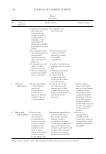
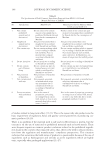
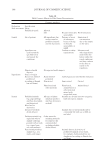
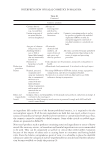
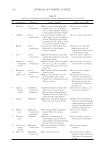
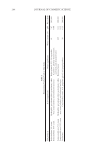
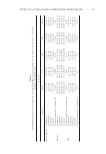
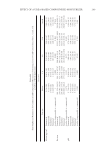
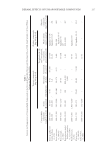
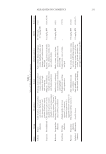
Table 1 Content and Composition of Unsaponifi able Co mpounds in the Reviewed Vegetable Butters and Oils [mg/100 g of Oil]. Slash Symbol (/) Is Used When Information Was not Available Unsaponifi able compounds [mg/100 g of oil](-sitosterol) Terpenic compounds [mg/100 g of oil] Aliphatic compounds [mg/100 g of oil] Phenolic compounds [mg/100 g of oil] Sterols 4-Methylsterols Triterpene alcohols Carotenoids β-carotene Tocopherols (-, β-, and Ƴ-tocopherol), tocotrienols, plastochromanol-8) Hydrocarbons (mainly squalene) Elaeis sp. pulp (1,3) 200–1,000 30–265 9–36 8–32 38–200 10–150 Squalene 42–98 / Corylus avellana , (1,3,79) 200–300 106–200 / 5–6 / 22–61 Squalene 19–25 291 Persea americana , (1,3,80,81) 400–12,200 250–2,000 90–440 50–170 4–23 0–80 290–390 Squalene 34–37 882 Brassica napus , (1,3,82) 500–5,000 450–1,130 7–27 18–54 / 36–268 Squalene 44 / 207 Butyrospermum parkii/ Vitellaria paradoxa , (1,3,21,65,83) 3,000–10,000 150–360 100 800–6,200 / 3–81 920–4,000 407 3,000 Perilla frutescens , (3,69) 1,000–1,800 1,800–4,000 / / / 45–67 Squalene 150 / Glycine max , (1,3,84,85) 500–1,700 180–474 25–66 40–84 7–0.03 60–337 90 Squalene 10–14 42.6 Coffea arabica , (1,3,86) 7,600–15,000 132–5,000 / / / 12–61 / / DERMAL EFFECTS OF UNSAPONIFIABLE COMPOUNDS 217
Purchased for the exclusive use of nofirst nolast (unknown)
From: SCC Media Library & Resource Center (library.scconline.org)