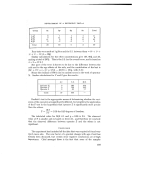
DEVELOPMENT OF A DETERGENT TEST--I This dishwashing test, it may be well to point out, is not the only impor- tant factor in evaluating a detergent, for the product must satisfy other ., conditions, such as, it must not be harmful to the skin, cause corrosion or tarnishing of metals, or staining of plastics. Also, we are here not so much interested in the efficiency of a detergent as in its capacity for a certain amount of work. To investigate the former one would probably use glass surface and instrumental methods of measuring the trace of foodstuff, scum, or film that remains on the washed article. The argument concerning the respective merits of natural and artificial soils seems to occur in practically all tests of detergency. Generally, both types of soil have to be used, artificial methods of soiling being needed when insufficient naturally soiled test material is available and also tests must :• include the use of natural soils to ensure that most of the conditions encountered in practice are represented. An artificial soil (designated as type Q) was used in the experiments detailed below. It was prepared by melting 1,500 grams of a proprietary ß cooking fat--"Trex"--at 50 ø C., adding 60 grams oleic acid, 3 grams oil- soluble blue dye, and mixing in 1,440 grams flour. Stirring was continued during cooling. Shortly before a group of tests, the soil is applied to the plates (white dinner plates of 25 cm. diam.) by the operator who is to wash them. Eight grams of the soil is weighed out on a small square of p.v.c. film, and transferred to each plate, and is then spread into a uniform layer. The soiled plates are stacked in racks, to prevent the soil from one plate contaminating any other, until ready for use--that is, for at least half an hour and no longer than three hours. As it is the use of detergents for domestic dishwashing that we are studying, we use a conventional washbowl (30 centimetres diameter at the water level and 10 centimetres deep from the rim), the plates being washed with a small bristle brush of about 5 cm. diameter. This limits the amount of work that can be exerted in removing the soil and is, therefore, expected to give more reproducible results by different operators than would a dish cloth or dish mop. Nevertheless, differences between different operators are still appreciable and hence detergents are tested in blocks of 2 to 12 samples, all tests in one block being made by the same operator and using plates selected at random from stacks prepared at the same time. The standard conditions are provisionally selected as using 4 litres of water (soft or hard as required by the scheme of testing) with an initial temperature of 47 q- 1 ø C. The plates are at room temperature, and thus the detergent solution will cool as washing proceeds--the troublesome maintenance of a constant temperature is preferably avoided. After adding the detergent (all materials being in solution) the operator uses a wire beater held in the hand to beat up a foam for 60 seconds. Washing of the plates one at a time in a smooth rhythmical manner is then carried out until the 97

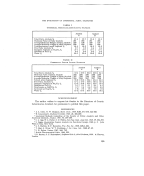
JOURNAL OF THE SOCIETY OF COSMETIC CHEMISTS foam almost disappears and is no longer a continuous layer over the liquid surface. The number of plates washed is recorded. Various methods of determining the end-point can be used, of which the most common is to consider foaming the main criterion of performance and record the number of plates washed until the foam is reduced to a thin surface layer. Different operators will differ in their interpretations of the end-point: for example, one may usually wash one plate more than another in a typical result of, say, 15 to 25 plates. Alternatively, the en&point can be taken when grease is deposited on the side of the basin or when it becomes impossible to clean further plates--one of such methods necessarily being used for those detergents (e.g., certain non-ionics) which do not foam. Nevertheless, a high correlation between results on different end-points is shown and in general the choice of procedure has no effect on the compara- tive results for different detergents. PRECISION OF THE TEST The first stage in evaluating any test procedure is to determine the precision of the test, i.e., the repeatability of the results when as many variables as possible are maintained constant. The repeatability is then re-determined with these variables controlled at different levels--e.g., one variable being the operator, another operator will be studied--and thus the levels at which to control the variables so as to obtain results of high precision is determined. It is necessary to determine the repeatability for different levels of the variable being measured as it frequently is not constant. The first experi- ment was carried out using four different quantities of a detergent, expected to give results of from 4 to 30 plates, which was thought to be the useful range of the test. The simplest method of determining the repeatability would be for one operator to perform about six successive tests with each detergent using the same batch of soil. However, we can here introduce statistical methods into the design of our experiment ß instead of performing the six successive tests with the same batch of soil and operator, we can use different operators and different soils, and thus study the additional factors. To obtain the same reliability of the estimate of precision, we should, with three operators, need 12 tests per sample. This is twice the work, but yields three-fold as much information because the effects of varying the operator and batches soil are assessed as well as the simple repeatability. In fact, the increase information is more than three-fold as we now have the separate estirna tes21•!•' of the abilities of three different operators in place of a repeatability for one operator only. The experiment now has as its objective the investigation of the factors as studied by PughL The methods of performing the test a
Purchased for the exclusive use of nofirst nolast (unknown)
From: SCC Media Library & Resource Center (library.scconline.org)