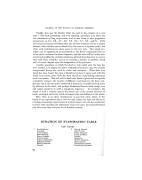
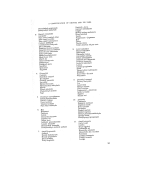
A CLASSIFICATION OF ODOURS AND ITS USES hax'e been published that can be studied by the potential composer or painter, and from which much guidance may be obtained in the course of their work. It is also true that research has provided a solid background to the work of the perfumer, in so far as the chemical and physical constants of each of his raw m•terials have been established, as well as the almost complete analysis o[ most of the essential oils, flower concretes and absolutes, all of which are available in many text-books. Yet, despite this fund of information, it is unfortunate that none of it is of any real value in his creative work. I, myself, may have been guilty of offering, in my three works, suggestions and perhaps even novel ideas that the imaginative experimenter may employ and elaborate in the practice of his profession, but I freely admit that they are more useful to the novice than as a guide and friend to the expert. When I •vrote my first book on perfumery I was conscious of this defect, and although more information is available to-day on what I will call the "Missing Link," and it is still being investigated by different chemists both here and in Europe, nothing of a practical nature had then been published about it. This link is a Classification of Odours and its application, and it was as long ago as 192½ that I began serious work upon it in an attempt to evolve a grouping of aromatic substances on a really sound basis. It took me no less than four years to complete, and you may well speculate upon the reasons why I did not publish the results in the next edition of my books. But at the time I felt it was too valuable for widespread diffusion, and it gives me pleasure to tell you about it here and now since the eve of my departure from the industry is approaching. Before the introduction of synthetics the problem of classification was not quite such a difficult one, because the perfumer had at his command only the commoner essential oils and flower extracts. Chemistry has since evolved not only numerous shades of each odour type, but it has also created entirely new perfume bases. Moreover, many more essential oils are now available, and the whole gamut consists of perhaps a thousand ra•v materials against a former fifth of that number. Rimmel was the first to endeavour to classify the then known substances, and he did so by adopting a type for each class of odours and grouping with them other materials of similar fragrance. He was able to reduce his classification to eighteen distinct types. Piesse later took quite a different view of this problem, and compared odours with sounds. He suggested octaves of odours like octaves in music, where certain odours coincided like the keys of a piano. For instance, one octave might consist of the citrus oils another of almond, heliotrope and vanilla and still another of patchouli, santal and vetivert. These sub- stances certainly blend most admirably: •vith the first as the top note, the second as the middle note, and the third as the base. He eventually arranged the primary odours in positions corresponding with their perception 81

JOURNAL OF THE SOCIETY OF COSMETIC CHEMISTS by the olfactory nerves from the lowest note of patchouli, to the highest of civet or verbena. To obtain a perfectly fragrant blend he suggested it was only necessary to combine the harmonious chords. It was not until 1927 that Crocker and Henderson published their work on this subiect in America. They analysed and classified the odours on a numerical basis, and tried to find the elements of smell that make up all odours. They concluded there were four kinds only' fragrant or sweet acid or sour burnt or empyreumatic and caprylic or cenanthic. These assiduous chemists arranged several hundred pure chemicals and some essen- tial oils according to the relative amounts of each component, to each of which they assigned a figure or coefficient that noted the intensity of that domportent. Thus Jasmin was 6.3.3.3. and Orange 6.5.1.2. If these three classifications were seriously considered by the modern perfumer, he would be bound to give the palm to Piesse but I think it would be fair to say that he would find none of them of much use in the olfactory analysis of perfumes, or of their creation. In more recent years further attention has been paid to this problem by different research workers, whose investigations have proceeded much on the same lines as my own of nearly thirty years ago ß namely, by grouping the synthetics in particular, together with some essential oils, according to their comparative volatility. But no attempt appears to have been made to give practical application to this valuable data, and later in this paper I shall attempt to elaborate my theories in such a way that they will offer some real assistance to the creative perfumer. My first thoughts were directed to the molecular weights of the synthetics and natural isolates, but after tabulating them progressively I soon realised they could not reveal the secret of my quest. I next turned my attention '• to their boiling points at 760 mm., but even these, when tabulated, did not .. appear to solve my problem whereas when taken at a pressure of 3 ram.,. which approximates more nearly the vapour pressure at room temperature, the answer seemed within my grasp. • • However, the essential oils and flower extracts did not respond satis, .. factorily to this method, owing to their complex composition, and since they ,. are the indispensable tools in the hands of every perfumery researcher I compelled to adopt the only alternative, which consisted of the laborious i? estimation of their Duration of Evaporation by oilaction, at a laboratory:i? temperature of 16 ø C. This was going to take much time and patience, I felt it was the only method, which of course depended upon the reliability ii:i of my nose. Moreover, if I should succeed it might incidentally throw brighter light on the dark problem of fixation. And here I must draW.•?• attention to a most important point namely, the great improvement that.:• has since taken place in the production, processing and purification of aRii aromatics, so that the results of my work may require adjustment audi
Purchased for the exclusive use of nofirst nolast (unknown)
From: SCC Media Library & Resource Center (library.scconline.org)