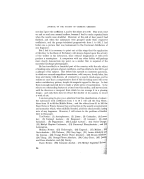
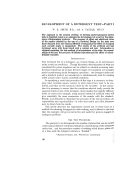
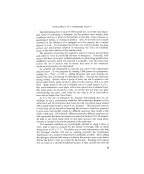
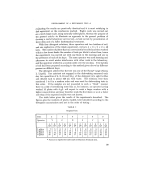
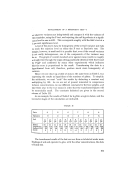
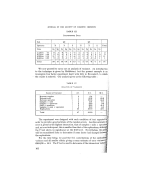
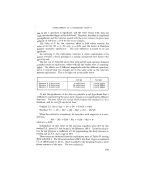
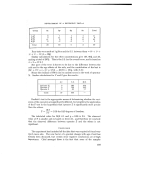
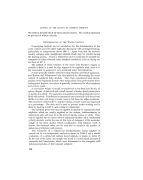
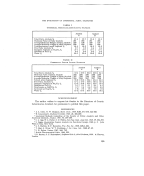
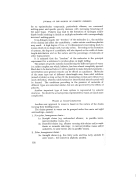
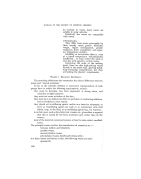
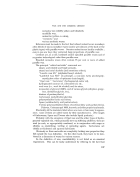
DEVELOPMENT OF A DETERGENT TEST--I ,, ! Group 6a 9p 6p 9a Total 1 g/1 8 1 1 1 11 2 g/1 0 11 -5 0 6 4 g/l 11 5 5 0 21 6 g/1 5 -2 -2 1 2 -- Total 24 15 -1 2 40 Four tests were made at 1 g/litre and the S.S. between them ---- 8' d- 1 • d- l'd-I s--I1•/4=36 i. Similar calculations for the other concentrations give I37, 60 i, and 33, making a total o/267«. This is the S.S./or the overall error, and is based on 4 x 3---- 12d.f. But part o/the error is known to be due to the difference between the soils and to the age effects of the soils, and the contribution of the last is (24 • d- 15 • d- (--1) • d- 22)/4 --40'/16---- 101«, with 3 d.f. Hence the residual of I66 is due to random errors in the work of operator X. Similar calculations for Y and Z give the results: , , d.i. S.S. M.S. Operator X 9 166 18-4 Operator Y 9 128 14-2 Operator Z 9 69 7-7 Total 27 353 -- Bartlett's test is the appropriate means of determining whether the vari- ances of the operators are significantly different, but simpler is the application of the F test to the hypothesis that operator Z is significantly more precise than the others. 16.3 F -- 7-• -- 2-10 for 18/9 degrees of freedom. The tabulated value for 24/9 d.f. and p = 0-05 is 2-9. The observed value of F is smaller and is based on fewer d.f., and therefore we conclude that the observed difference between operator Z and the others is not significant. CONCLUSION The experiment has furnished all the data that was required of it and very much more also. The new factor of a gradual change with age of soil has already been discussed, but certain other negative conclusions are of high importance. Chief amongst these is the fact that none of the samples 105

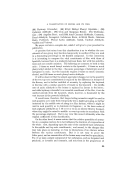
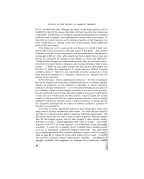
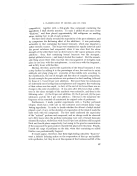
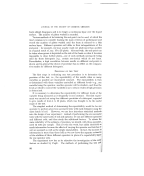
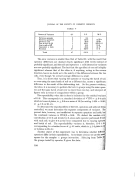
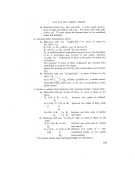
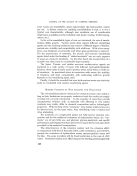
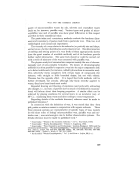
JOURNAL OF THE SOCIETY OF COSMETIC CHEMISTS interactions, in particular neither that of samples x operators nor of samples x soils, is significant. This means that, though different operators and soils produce different results, the effects are the same with all samples when expressed in logarithmic units. The last phrase is the essence of the matter. Different operators or tests with different soils may show variations in the differences between two detergents, but in logarithmic units the differences are constant, implying that it is the ratio of the numbers of plates that should be used as a com- parison of different detergents. Thus it is seen how a single experiment designed in accordance with certain basic statistical principles, but requiring no prior knowledge of the sort of results to be expected, can evaluate a test procedure and provide information concerning: (1) The interpretation of the data: e.g., the ratio of numbers of plates for different detergents is constant whereas the actual differences between numbers of plates may vary with operator and sample. (2) The repeatability of the test: this is proportional to the result, but is, therefore, constant in logarithmic units. It is q- 0.8 plates in 10 and q- 1.6 in 20, etc., or in other terms, the coefficient of variation is 8 per cent. (3) The precision of different operators: none of the three differs appreciably from the others. (4) The effect of uncontrollable variables: different batches 'of soil produce different results and even the same batch gives different results on different days. FURTHER STUDY OF SOIL AND OPERATORS A large number of different types of soil, both synthetic and natural soil from a works canteen, were examined. Although some workers have claimed that certain detergents are more efficient than others for particular types of soil the data collected in these tests did not support the claim. The ' ratio of number of plates for two detergents was substantially the same whatever soil was used. Even with the simplest soil (spreading the fat "Trex" at 2 grams per plate, without any warming, mixing or other treatment), a day-to-day variation larger than that within days was found. Work to find a reproduc- ible soil is still proceeding, but present evidence is that all detergent com- parisons must be made in groups using the same supply of soiled plates, and that the nature of the soil on the plates is unimportant. Consequently, artificial soils are used for routine tests only when insufficient naturatly• soiled plates are available. ':i ß
Purchased for the exclusive use of nofirst nolast (unknown)
From: SCC Media Library & Resource Center (library.scconline.org)