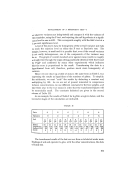
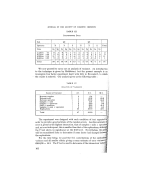
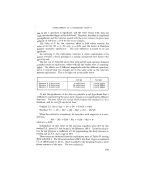
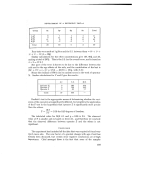
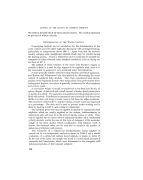
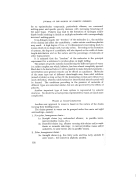
DEVELOPMENT OF A. DETERGENT TEST--I due to soil x operators is significant, and the value found, 2-54, does not reach the tabulated figure at the 0.05 level. Therefore, the effect is considered not significant and the variance pooled with the error variance to give a new estimate of 719-2/41 = 17.6 for the error variance. The value of F for the operators effect is 3-69 which exceeds the value of 3.2 for N1 •-2, N2 =41, p = 0.05, and the factor is therefore deemed "probably significant." The soils difference is found to be not significant. On returning to the replications variance, a closer examination of its sources revealed a trend pointing to a totally unexpected new factor--the age of the soil. The last row of Table III shows that with soil Q2 each operator obtained a smaller result on replication, whilst with Q3 the results were, if anything, higher. The effects are of different magnitude with the different operators, but it is noticed that the changes are in the same order as the intervals between replications. This is brought out in the table below. Soil Q2 Soil Q3 Operator X (3 days later) 9 units lower 3 units higher Operator Y (6 days later) 34 units lower 9 units higher Operator Z (4 days later) 19 units lower 6 units higher To test the significance of the data we postulate a null hypothesis that a coefficient b representing the mean daily change is not significantly different from zero. The best value of b is that which reduces the residual S.S. to a minimum, and for soil Q2 calculated thus: Original S.S. due to age -- (9 • q- 34 •- q- 192)/8 •- 199.7 Residual S.S. ---- ((9 -- 3b)' q- (34 -- 6b)' q- (19 -- 4b)')/8 When the residual is a minimum, its derivative with respect to b is zero, and thus: 3(9 -- 3b) q- 6(34 -- 6b) q- 4 (19-- 4b) = 0 whence b ----- 5.03. Substitution of this value in the previous equation gives 6.6 for the residual S.S., hence S.S. due to age is, by difference, 193.1. A similar calcula- tion for soil Q3 gives a coefficient of 1.42 (representing the daily increase in results) and an S.S. due to age of 15.5. These terms are deducted from the replications term of Table IV leaving 322.4 with 22 d.f. The three interactions of M.S. less than 14 give a combined S.S. of 105.6 based on 15 d.f., which is added to the foregoing to give a more precise estimate of the error. The new analysis is: 103

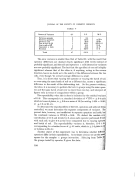
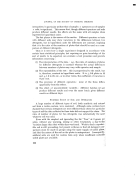
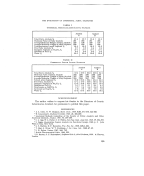
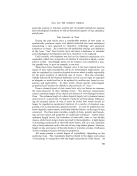
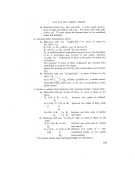
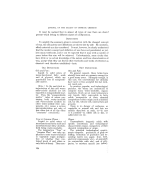
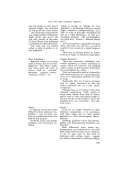
JOURNAL OF THE SOCIETY OF COSMETIC CHEMISTS TABLE V Source of Variance d.f. S.S. M.S. .__ Between samples 3 6.4 -- Between operators 2 129.5 64-8'* Between soils 1 60-8 60.8* Due to age of Q2 1 193.1 193.1'** Due to age of Q3 1 15-5 15.5 Operators x soils 2 82.6 41-3' Residual 37 428.0 11.6 __ Total 47 9! 5.9 -- The error variance is smaller than that of Table III, with the result that operator differences are deemed clearly significant (0-01 level) instead of probably significant, and the soils and operators x soils interaction variances are now probably significant. The fact that the age effect of one soil is highly significant whereas that of the other is, if anything, acting in the reverse direction, leaves no doubt as to the reality of the difference between the two soils, even though 'he overall average difference is small. Thus, it is shown that varying the operator or v'arying the batch of soil, or even using the same batch of soil on a different day, causes a significant,:: difference in the result of the dishwashing test. On the present evidence,i': therefore, it is necessary to perform the tests in groups using the same opera-. tor and the same batch of soil over no more than one day, and interpret all figures only in terms of comparisons within a group. The repeatability when this is done is indicated by the residual variance' •} ' of 11.6. This corresponds to a standard deviation of V'I ].6 = 4- 3.4 unitS::!! which in terms of plates, is 4- 0.8 on a mean of 10 (for antilog. 1.034 ----- or q- 1.6 on 20, etc. To determine the reproducibility of the test, operators and soils not being? controlled, we must determine the separate components of variance. The:! present data, however, are insufficient to separate oper•ators and soils, the combined variance is 272-9/5 = 54.6. We deduct the random contribution of 11.6 and divide by 8, since each operator performed 8 with each soil, to give 5-4 as the error component due to varying open and batch 'of soil. The reproducibility variance is, therefore, 11-6 +.5 I' corresponding to a standard error of 4- 4.1 units, which is 4- 1.0 plate in or 2 plates in 20, etc. Another object of the experiment 'was' to determine whether operators differ in their repeatability. As estimate of error we use the square for the samples x groups interaction. Selecting from Tabl e•III• the groups"tested by operator X gives. the data
Purchased for the exclusive use of nofirst nolast (unknown)
From: SCC Media Library & Resource Center (library.scconline.org)