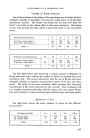
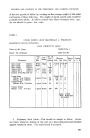
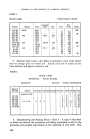
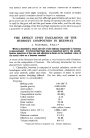
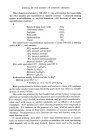
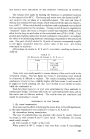
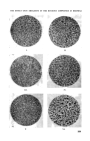
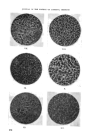
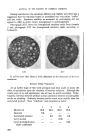
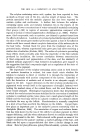
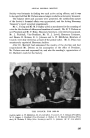
JOURNAL OF THE SOCIETY OF COSMETIC CHEMISTS During manufacture the emulsions differed only slightly and there was a suggestion that the emulsion based on acetylated wax was rather "stiffer" and less white. Emulsion stability as measured by centrifuging did not appear to differ in either cream, homogenised or unhomogenised. Photograph XIII shows the homogenised emulsion made from formula J and photograph XIV the homogenised emulsion made according to formula K. .:•:•".'• •!i:• "•.'•' 2•: ' • :....(.:.•:• .. !!•oE•-,'• :•'.::½-'•'• :• •:•', • :.•.,...• .•?:,,•. •:•,:---•:-... .• :.-•- ..., ß •'• --• ..5 .. -.:-. ... , .: - ::• .... . .,:....':: •. -• ½..: :: •-• . ....:..-:. :• .' . :........• ,- .-. .. . : 9. . .. ß .:. •5.**':' :' '""' ' XIII. XIV. It will be seen that there is little difference in the structure of the t•vo emulsions. EFFECT UPON VISCOSITY At an earlier stage of this work attempts had been made to study the effect of acetylation upon the viscosity of beeswax solutions. Although the results were of no real significance, one set may be worth recording. Unfor- tunately, beeswax does not produce a dear solution in mineral oil and rapidly settles on standing. Ordinary beeswax settles much more rapidly than the acetylated product. Four "solutions" were prepared as below: 1 2 3 4 Mineral oil 95.0 95-0 95-0 95-0 Beeswax 5-0 • • -- Acetylated beeswax • 5-0 5-0 5.0 Cetyl alcohol -- • 0-35 -- Cetyl alcohol/ethylene -- -- -- 0'35 oxide condensate 272

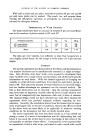
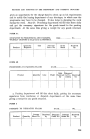
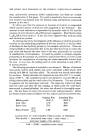
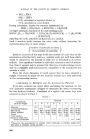
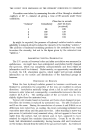
THE EFFECT UPON EMULSIONS OF THE HYDROXY COMPOUNDS IN BEESWAX Viscosities were taken by measuring the rate of flow through a standard capillary at 25 ø C., mineral oil giving a time of 89 seconds under these conditions. Flow time in seconds. "Solution" Immediately After 24 hours (re-stirred) 1 95 105 2 120 135 3 116 122 4 109 119 As might be expected, the presence of hydroxyl radicles tends to reduce solubility in mineral oil and to reduce the viscosity of the resulting "solution." The addition of hydroxyl-containing products to the acetylated wax tends to reduce the viscosity, but not to the figure given by the untreated wax "solution." ABSORPTION SPECTRA EXAMINATION The U.V. spectra of beeswax before and after acetylation was measured in cyclohexane. As might have been anticipated, acetylation hardly changed the spectrum, which was completely uncharacteristic and from which no information could be obtained. Unfmtunately, no opportunity was afforded to study the I.R. absorption spectra, which might well provide detailed information on the nature and distribution of the functional groups in beeswax. DISCUSSION OF RESULTS When the free hydroxyl radicles present in beeswax constituents are blocked by acetylation the properties of the wax are modified in certain directions. Acetylation naturally brings about a fall in acid value and an increase in ester value and, consequently, a considerable increase in the ratio number (E.V./A.V.). The melting point of the acetylated wax is very slightly higher than the untreated wax. Typical cold creams based on beeswax and borax show changed proper- ties when the beeswax is replaced by acetylated wax. The pH of creams A and B are the same. During the manufacture of creams A and B little or no differences were noted but, on cooling, the cream containing untreated wax wa• rather more shiny and the grain more fine. After standing in screw-top jars cream A (untreated wax) remained shiny, did not appear to have lost water from the surface, had not shrunk and, in fact, appeared to have retained its original fine emulsion characteristics. Cream B, on the other hand, had deteriorated considerably, having become dull and translucent on the surface, shrunk from the sides of the jar and lost water. As evidenced 273
Purchased for the exclusive use of nofirst nolast (unknown)
From: SCC Media Library & Resource Center (library.scconline.org)